Close Encounters of the Third Kind: Wonder Over Fear
Spielberg took the alien-invasion picture and pointed it at the sky in awe
Contents
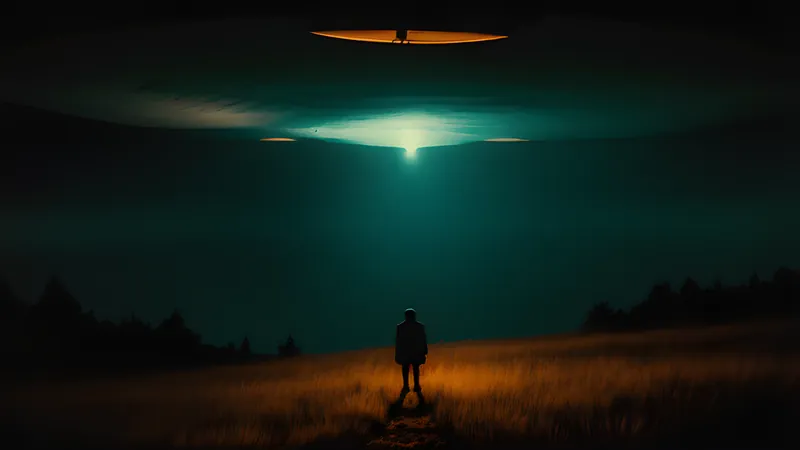
For twenty-five years the flying saucer meant one thing on a cinema screen: run. The disc came down, the ray came out, the city burned. Then in November 1977 a lineman from Indiana stood on a dirt road, tilted his head back, and let the light wash over his sunburned, dumbstruck face — and the whole genre turned on its axis. Close Encounters of the Third Kind is Steven Spielberg’s answer to a decade of visitors who came to kill. His come to invite.
The title is borrowed from J. Allen Hynek, the astronomer who catalogued UFO reports for the US Air Force and graded them: first kind, a sighting; second kind, physical evidence; third kind, contact with the beings themselves. Hynek consulted on the film and turns up in the crowd at the climax, pipe in hand, watching the thing he spent his career defending actually happen. That detail tells you Spielberg’s game. He wanted the picture to feel less like a fantasy than a documentary of the miracle we keep insisting is real.
The ordinary man and the calling
Roy Neary is one of Spielberg’s great unglamorous heroes: a power-company troubleshooter played by Richard Dreyfuss with a sweaty, needling energy that curdles beautifully as the film goes on. Roy has a wife, three kids, a mortgage of small frustrations, and one night on a rural road his truck’s dashboard goes haywire and a light show passes overhead that scrambles something in him permanently. From then on he is a man possessed by a shape he cannot name — the shape that ends up being Devils Tower in Wyoming, which he first sculpts out of shaving foam, then mashed potato, then finally builds as a small mountain of mud and chicken wire in his living room while his family flees in terror.
That domestic collapse is the film’s nerviest choice. Roy is not rewarded for being a good father; he abandons his family entirely to chase the vision, and Spielberg refuses to punish him for it. Teri Garr, as his wife Ronnie, plays the reasonable person watching her husband lose his mind, and the film gives her every rational argument — she is right about everything and the movie still leaves her behind. Spielberg has said in later years that he could not write that ending now, as a father himself. The younger man who made it understood something the older one flinched from: obsession looks like madness right up until the moment it turns out to be true.
The counterweight is Jillian Guiler, played by Melinda Dillon, whose four-year-old son Barry is drawn out of the house by the visitors in the film’s most frightening sequence — toys clattering to life, a screwdriver turning itself, orange light pressing through every seam of the kitchen. Cary Guffey, the child actor, plays Barry’s abduction as pure delight, gurgling at the doorway while his mother screams, and that gap between her terror and his joy is the film’s whole thesis compressed into one scene.
The theremin’s grandchildren
The craft on display is a masterclass in how to shoot the ineffable. Vilmos Zsigmond’s cinematography treats light as the co-star: shafts and coronas and lens flares that Douglas Trumbull’s effects unit built so that the ships read as brightness first and hardware second. You rarely get a clean look at a saucer. You get glare, and silhouettes moving through glare, and the human faces underneath lit gold from below like congregants at an altar. It is the opposite of the pulp instinct to show the monster; Spielberg withholds, and the withholding is what generates awe.
Then there is John Williams. The five-note motif — the tones the scientists use to talk to the ship — is one of the most famous phrases in film music, and its cleverness is that it is diegetic and thematic at once. Inside the story it is a greeting, a mathematical handshake played on a Moog and answered by the mothership. Outside the story it is the score’s DNA, seeded through the whole picture so that by the climax you have been trained, like Pavlov’s dog, to feel the approach of grace in five notes. The film pairs the tones with hand signs adapted from the Kodály method used to teach music to children, so that first contact is staged as a class of adults learning to sing back to something enormous.
The lineage here runs straight back to The Day the Earth Stood Still, whose theremin gave the movies their first genuinely otherworldly sound, and whose visitor also arrived with a message rather than a weapon. Spielberg is working the benevolent side of the ledger that Robert Wise opened in 1951, and both films understand that the sound of the alien is at least as important as the sight of it. Where the 1951 picture warned, Spielberg reassures, and the theremin’s wail becomes an orchestra’s swell.
What it owes and what it fathered
Watch Close Encounters against the paranoid science fiction on either side of it and the daring becomes obvious. The 1950s taught audiences that the sky was hostile, and even the thoughtful entries in that cycle assumed the worst of what waited out there. Spielberg had grown up on those films and chose to argue with them. His ancestor is less the invasion picture than the road-to-Damascus story: a Saul struck blind by light and remade by it. Devils Tower is his Mount Sinai, and the government cordon around it is the priesthood trying to keep the miracle private.
The film that clearly sits over its shoulder is 2001: A Space Odyssey, Kubrick’s cathedral of light and silence, which taught a generation of filmmakers that awe could carry a picture where plot could not. Spielberg populates Kubrick’s cold sublime with weeping, sunburnt, ordinary people, and the warmth is the whole difference between the two men. Kubrick’s monolith is indifferent; Spielberg’s mothership wants to be loved. You can trace both instincts forward — the reverent, communication-obsessed strain arrives decades later in something like Arrival, which shares this film’s conviction that the real drama of first contact is grammatical, a problem of learning to speak. And you can feel the road not taken in the glacial dread of Under the Skin, where the visitor is unknowable and cold — the wonder inverted back into fear.
Spielberg himself kept re-editing the thing. There is a 1977 theatrical cut, a 1980 Special Edition (Columbia dangled money at a struggling Spielberg in exchange for showing more of the mothership interior he had wanted to keep hidden), and a 1998 Director’s Cut that put the mystery back by removing that interior again. The 1998 version is the one to seek out; his second thoughts were his best ones. It is available on the various physical and streaming editions of the film, and worth hunting down over whichever cut turns up first.
The verdict
Close Encounters of the Third Kind is the film in which Spielberg discovered his deepest subject — the ordinary American face turned upward, transfigured — and it remains the purest expression of it he ever managed. It has a cruelty in its centre that his later, softer work sanded away, and that cruelty is what keeps it honest. Wonder that costs nothing is greeting-card sentiment; Roy pays for his with everything he has, and the film has the nerve to say the price was worth it.
For where the movies pointed the saucer downward instead of up, run the fear films alongside it: The Day the Earth Stood Still, which shares its faith in the visitor, and Invasion of the Body Snatchers, which is everything Spielberg refused to make. And for the cold sublime he was answering, 2001: A Space Odyssey remains the summit.
Spoilers below
The ending is the argument, so here it is. Roy reaches Devils Tower, penetrates the government quarantine with Jillian, and finds the scientists — led by the French researcher Claude Lacombe, played by François Truffaut in a lovely bit of stunt casting, the New Wave master gazing up at Spielberg’s lights — waiting on a vast concrete stage to receive the mothership. The ship arrives as a floating city of light, dwarfing the tower, and the humans and the visitors trade the five-note phrase back and forth until it becomes a duet, then a symphony.
Then the ship gives back what it took. Down the ramp come the missing — pilots from the Bermuda Triangle, sailors, a boy: Barry, returned to his mother, none of them aged a day. And the visitors themselves emerge, slender and childlike and benign, and select Roy from the assembled candidates to go with them. He walks aboard willingly. The last image is the mothership rising into the night with an Indiana lineman inside it, and John Williams resolving the five notes into “When You Wish Upon a Star” — Spielberg tipping his hat to Disney, the other great American merchant of wonder.
It is worth sitting with how strange that ending is. Roy does not save the world or defeat the threat, because there is no threat. He simply leaves, chosen, and the film treats his desertion of wife and children as an ascension. Truffaut’s Lacombe watches him go with something like envy. The 1998 cut’s decision to keep the mothership’s interior offscreen matters most here: we never learn what Roy is walking into, and the not-knowing is the last and best gift the film gives him. He got the third kind of encounter. The rest of us are left on the ground, looking up, with five notes stuck in our heads.
Related Content