City of the Living Dead: Fulci's Gates of Hell Opener
A priest hangs himself in a New England cemetery and Lucio Fulci spends eighty minutes refusing to explain the consequences
Contents
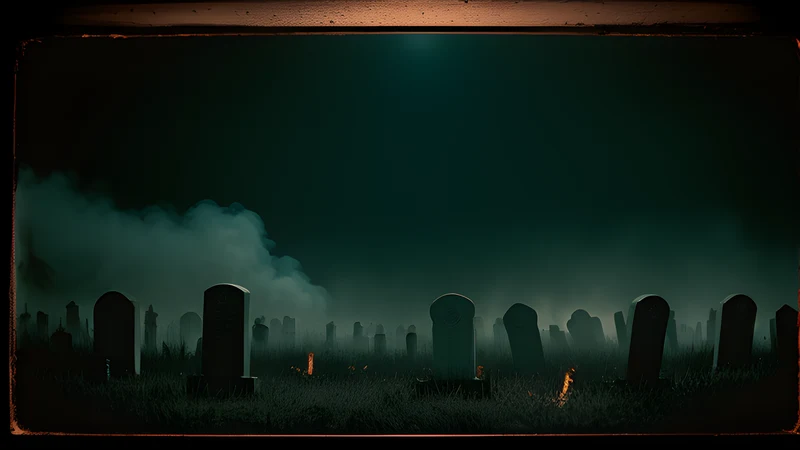
The film’s opening move is its best idea and it takes about forty seconds. A priest walks into a cemetery in the town of Dunwich, New England, at dusk, and hangs himself from a tree. Simultaneously, at a seance in New York, a medium sees it happen and dies of fright. That is the whole engine: a suicide on consecrated ground has torn open one of the gates of hell, and unless somebody shuts it by All Saints’ Day, the dead will rise everywhere.
Paura nella città dei morti viventi (1980) is the first panel of Lucio Fulci’s loose Gates of Hell trilogy, and the one where he worked out the method that would make The Beyond a surrealist landmark a year later. It is also the film that has to explain the least and gets away with the most, because it front-loads a metaphysical deadline and then spends the rest of its runtime doing whatever it likes.
Dunwich, Georgia
Fulci and his co-writer Dardano Sacchetti named their town Dunwich, which is a straight lift from H.P. Lovecraft’s “The Dunwich Horror” and a declaration of intent. This is a film about a wrongness in the fabric of the world rather than a monster with a motive. Nobody in it has a grievance. The priest’s reasons are never given. The dead do not want anything. Something is simply open, and reality is leaking.
The New England of the title was shot largely in Savannah, Georgia, with its Spanish moss and its above-ground tombs standing in for a Lovecraft town, and the mismatch does the film enormous favours — Dunwich looks like nowhere on any map, which is exactly right for a place that exists mainly as a wound. Sergio Salvati photographs it in the same soft, diffused, faintly sepia register he brought to the rest of the trilogy, so the entire film feels like something recalled rather than witnessed.
The cast is a proper Italian-horror ensemble. Christopher George, an American television lead in the last years of his career, plays the journalist Peter Bell with a hard-boiled bluntness that anchors the nonsense. Catriona MacColl, in the first of her three Fulci pictures, plays the medium Mary Woodhouse. Giovanni Lombardo Radice, billed as John Morghen because Italian genre cinema was still Anglicising everyone, plays the town’s designated outcast. Watch for Michele Soavi in a small role too — a decade later he would direct The Church, which is the same premise built in stone.
The pickaxe
The buried-alive sequence is the film’s finest piece of construction and the clearest evidence that Fulci could direct suspense when the mood took him.
Mary is pronounced dead and interred. She wakes in the coffin. Above ground, Peter is passing the cemetery and hears her muffled screaming. He fetches a pickaxe and starts swinging — and Fulci intercuts the blade coming through the coffin lid with Mary’s face directly beneath it, so the rescue and the killing are the same action. Each swing is a coin toss. The scene runs long past the point where a sensible director would have resolved it, and its horror is generated entirely by the geometry of two people who cannot see each other doing a violent thing together.
That is the trilogy’s signature in miniature. Fulci’s set pieces are almost always about duration and information: he shows you the outcome coming from a long way off, denies the characters the knowledge you have, and then refuses to cut away. The technique is closer to Nicolas Roeg’s use of premonition in Don’t Look Now than to anything in the American body-count cinema of the same years — the film keeps telling you what is about to happen and the telling is the terror.
Fabio Frizzi’s score does the rest. His Dunwich theme — mournful, chiming, built on a slow descending figure over choral washes — is one of the three or four best pieces of music Italian horror produced, and Fulci deploys it as weather rather than as underscore. It arrives before anything happens, stays after everything stops, and gives a film with no coherent plot a completely coherent mood.
The drill and the entrails
Two sequences made the reputation, and both are worth arguing about rather than merely enduring.
Radice’s character is strapped to a workbench by a father who has decided he is a menace to the town’s daughters, and killed with an industrial drill driven slowly through the side of his skull. Gino De Rossi’s effect is a dummy head and a real drill, staged in one unhurried take. What makes it unbearable is the framing: Fulci keeps the victim’s living, conscious face in shot for as long as the illusion will hold, so you spend the scene watching a person rather than a prop.
The other is Daniela Doria’s death, in which a young woman weeps blood and then vomits her own internal organs into her boyfriend’s lap. The effect was achieved with animal offal held in the actor’s mouth, which is a fact that has followed Doria around ever since, and the scene has no narrative function whatsoever. It happens because the gate is open. It is arbitrary, protracted and physically revolting, and it is also the purest statement of the film’s thesis: when the world’s rules fail, bodies simply come apart, without warning and without meaning.
Whether that thesis justifies the sequence is a live question. My honest position is that Fulci is doing something real here and doing it with no discipline at all. The maggot storm that buries an entire room, the zombies who materialise behind people to crush their skulls bare-handed, the dead who ignore doors and distance — all of it belongs to a film about the collapse of cause and effect, and all of it would land harder if the director had been willing to cut even one of them.
There is one more sequence that deserves rescuing from the film’s reputation, because it is the strangest thing in it and involves no blood at all. Gerry and Sandra are talking in a living room when the windows blow in and the room fills, floor to ceiling, with maggots — a blizzard of them, driven by wind machines, burying the furniture and the actors while they flail and scream. It is absurd and it is also the single best illustration of the film’s premise anywhere in the runtime. Nothing attacks. Nothing has intent. The world simply produces a weather system made of corruption, indoors, for no reason, and then stops. Christopher George plays the aftermath with the weary competence of a man used up by his own genre, which is exactly the right register: he has no theory, he just wants the room cleaned.
The real ancestor
The obvious comparison is Romero, and it is the wrong one. Fulci’s dead do not eat, do not spread by bite, and do not carry a social diagnosis; they are symptoms rather than a plague.
The genuine ancestor is Michael Winner’s The Sentinel (1977), a film in which the Catholic Church posts a guardian over a doorway to hell inside an ordinary building and the damned press against it from the other side. That is Fulci’s premise exactly, moved from Brooklyn to a fictional Lovecraft town and stripped of Winner’s institutional plotting. Behind both stands the post-Exorcist conviction that Catholicism is a load-bearing wall in the American horror imagination, and behind that, Lovecraft’s much colder idea that the wall does not care about you either. The general problem of getting that sensibility onto film is the subject of cosmic dread: adapting the unadaptable Lovecraft.
Fulci built the same machine twice more. The House by the Cemetery shrank it to one cellar; The Beyond dissolved it into pure dream. City of the Living Dead sits between the discipline and the delirium, which is why it remains the best entry point to the trilogy. In Britain it went out as The Gates of Hell, was duly listed among the prosecutable video nasties, and spent a decade circulating in cuts that removed precisely the sequences the film was built around.
Spoilers below
The last reel sends Peter, Mary and the local psychiatrist Gerry down into the crypt beneath the cemetery to find Father Thomas’s body and end it before All Saints’ Day expires. The priest is down there, and so are the risen dead of Dunwich. Gerry drives a shattered wooden cross through him. The corpse burns; every zombie in the crypt collapses into flame and ash; the gate closes. It is a functional, even conventional resolution, and the film has roughly ninety seconds left to run.
Then Gerry and Mary climb out of the tomb into the morning, and the boy John-John Robbins comes running across the graveyard towards them. Mary screams. The image freezes — and shatters, the frame cracking and disintegrating like breaking glass while the sound tears itself apart. End of film. No explanation, no reverse angle, no clue as to what she has seen.
Nobody agrees on what it means, and the production history explains why. The most widely repeated account holds that the intended ending could not be completed or salvaged in the edit, and the shattering optical was assembled in post to cover the gap. Fulci himself gave inconsistent answers about it for years. So the most notorious final shot in Italian horror is, on the balance of the evidence, an accident.
The accident is better than the plan. A film premised on a hole in reality closing itself has no business offering closure, and the shatter denies it in the crudest and most literal way available — the picture itself gives out. Everything the film has argued for eighty minutes is that cause and effect are optional and that the world can simply stop making sense in front of you. Then the world stops making sense in front of you. If Fulci arrived at that by running out of money, he still arrived at the only ending the film could honestly have. The same instinct, deliberate this time, would make The Beyond his masterpiece within a year.
Where to watch: any of the restored transfers, which finally give Salvati’s photography and Frizzi’s score the room they need. If you have only ever seen a Gates of Hell tape, you have not seen the film — the cuts took out the connective tissue as well as the offal.
Related Content