Christine: Carpenter and the Killer Car
The work-for-hire job that turned out to be a teenage werewolf film with a bonnet
Contents
John Carpenter took Christine because he needed a job. The Thing had opened in June 1982 against E.T., been reviewed as though it were a personal insult, and lost Universal money. The director who had spent five years as the most reliably interesting man in American horror was suddenly a risk. Producer Richard Kobritz — who had made the Salem’s Lot miniseries in 1979 and had wanted Carpenter for it then — handed him the galleys of Stephen King’s new novel. Carpenter read them and said yes fast enough that the film reached cinemas on 9 December 1983, roughly seven months after the book was published in April. Bill Phillips wrote the script. The whole thing was assembled at a run.
Carpenter has spent forty years telling interviewers the material didn’t grab him. He is a poor witness on his own work. Christine is tighter than its reputation, and the reason has nothing to do with the car.
The film is about the boy
Arnie Cunningham (Keith Gordon) is introduced getting his glasses knocked off in a school corridor. He is a specific kind of American teenage victim: bright, sour, chaperoned everywhere by his best friend Dennis (John Stockwell), who is a jock and who protects him in the way you protect a younger brother you are quietly embarrassed by. The parents are the real horror in the opening reel. Regina Cunningham (Christine Belford) manages her son’s life down to the timetable, and the scene where Arnie announces he has bought a car is played as a domestic explosion — the boy discovering that ownership of an object is the first territory his mother cannot enter.
Everything after that is transformation. Gordon plays the arc in stages you can date: the glasses go, then the posture changes, then the vocabulary curdles into fifties-greaser sneer, and by the time he is telling Leigh (Alexandra Paul) how it’s going to be, the sweetness has been replaced by something that talks like a man who owns things. Keith Gordon was 22 and had just come off Dressed to Kill; he understood the assignment completely, which is that the car is a costume the boy climbs inside and cannot take off.
That is the argument for the film. Read it as a monster picture about a Plymouth and it’s a decent B-movie with good rear-projection. Read it as a possession melodrama about male adolescence, where the demon arrives with chrome trim and a radio, and it clicks into a much older tradition.
What it’s actually descended from
The lazy genealogy runs Spielberg’s Duel (1971) to The Car (1977) to Christine: vehicles as unknowable predators, the driver’s seat left empty for the audience to fill. Carpenter shoots some of it that way, and the Darnell’s Garage sequences have the patient, low-slung menace of his own stalker geometry in Halloween — the camera holds, the thing arrives when it wants to.
The real ancestor is I Was a Teenage Werewolf (1957), and behind it the whole AIP teen-monster cycle that ran through the late fifties. Those films understood something the killer-car subgenre never bothered with: the audience for a monster is a fifteen-year-old who suspects the monster is already inside them. Arnie doesn’t get stalked by Christine. He gets promoted by her. The car gives him the girl, the confidence, the enemies-list, and the leather-jacket voice, and it charges the going rate. Carpenter even keeps the AIP structure intact — the concerned friend, the ineffectual authority figure (Harry Dean Stanton’s detective Junkins, who knows and can prove nothing), the girl who sees the change first.
King’s novel makes this literal via Roland LeBay’s ghost, a dead bigot whose personality soaks into the upholstery and rides Arnie like a horse. Phillips and Carpenter cut LeBay’s ghost out entirely and open instead on a Detroit assembly line in 1957, where the car is already killing before it has left the factory — a hand crushed under a bonnet, a worker who flicks cigar ash on the seat found dead in it. The change is the best decision in the adaptation. A haunted car needs an explanation. A car that was born wrong needs nothing, and it turns Arnie’s decline into a choice he keeps making rather than a curse he catches.
The mechanics
Two craft decisions carry the picture.
The first is the radio. Christine’s only voice is her push-button AM set, and Carpenter uses the fifties rock catalogue as running commentary — Thorogood’s “Bad to the Bone” over the assembly line, then a rotation of Little Richard, Buddy Holly, Danny & the Juniors, all of it cheerful and all of it aimed. The car sings at people while it kills them. Because the songs are period-authentic to the vehicle, the joke never breaks: this is simply what was on the air when she was built. Carpenter’s own score with Alan Howarth sits underneath in low synth pulses and stays out of the way, which is a discipline he did not always practise.
The second is the regeneration. Roy Arbogast’s team built car bodies with internal hydraulics that could crush themselves on cue; you film the collapse, run it backwards, and the metal appears to inflate. It’s a simple trick and it is shot with total confidence — long, unbroken, dimly lit, the panels breathing out into shape while Arnie watches and says nothing. Digital would have made it smoother and much worse. The thing that sells it is the audible strain of real steel under real pressure, which is the same reason the practical work in The Thing still outperforms its imitators.
Worth noticing too how the adults are cast. Robert Prosky’s Will Darnell runs the garage as a wheezing, half-crooked tyrant and gives Arnie the first workplace where he is treated as competent — the film’s only warm relationship, and it is with a man who is fencing stolen parts. Harry Dean Stanton turns up as Junkins with about eleven minutes of screen time and does what Stanton always did, which is imply an entire tired career in the way he accepts a cup of coffee. Roberts Blossom, who had played the recluse in Close Encounters and would later be the neighbour in Home Alone, plays George LeBay for one scene of pure malignant relish. Carpenter spent his budget on faces that arrive pre-loaded, which is how you buy depth on a seven-month schedule.
Collector’s footnote for the concours crowd: almost none of the cars are Furys. Production used roughly two dozen vehicles, mostly 1957 and 1958 Belvederes and Savoys dressed to match, because the Fury was too scarce to destroy at the rate the schedule demanded. And the real 1958 Fury came in Buckskin Beige with gold anodised trim — nothing else. The red is King’s invention, kept because a beige demon is not a demon.
The verdict, argued
Christine is minor Carpenter and better than minor filmmaking. It is too long by a reel, Dennis’s football-injury subplot exists mainly to remove him from scenes, and the finale trades the film’s psychology for a demolition derby. Set against that: a lead performance that maps a personality change with real precision, an adaptation choice that improves on King, and a director working at speed who still framed every garage interior like he meant it.
It sits in the middle of Carpenter’s imperial run — after The Fog and The Thing, before Starman — and it is the one where you can watch him work purely as a craftsman with no personal stake at all. That has its own value. The siege-and-scepticism throughline of his best work is absent here; what replaces it is a professional’s interest in getting a difficult effect right on the day.
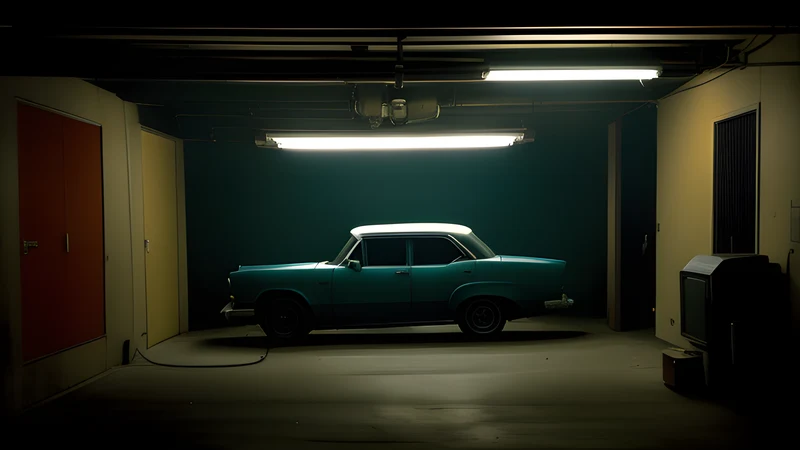
Watch it after I Was a Teenage Werewolf rather than after Duel. The double bill reorganises the whole film. Sony’s disc has kept it in print for years and the transfer respects Donald M. Morgan’s blacks, which matter — Darnell’s Garage is essentially one bulb and a lot of nothing.
Spoilers below
The final act moves the fight to Darnell’s Garage, where Dennis and Leigh use a bulldozer to break the car. It’s a strange, satisfying choice: the demon is beaten by heavier industrial equipment, which is to say by a bigger machine from the same country. Arnie dies going through the windscreen — killed by the car he is trying to save, in the middle of a manoeuvre he initiated. He gets no exorcism and no last lucid moment. Carpenter denies him the scene where the real boy surfaces to say goodbye, and the film is colder and better for it.
Christine’s regeneration in the garage is the sequence to rewatch. The car has been reduced to a cube of scrap. It reassembles itself while Arnie says “show me” — one of the very few lines in the film that lands as genuine incantation — and the panels unfold with that hydraulic groan. Read literally it’s a magic trick. Read as the film has been asking you to read it since the assembly line, it’s a boy watching his new self come back from the dead and finding it beautiful.
Then the closer: the crushed cube in the junkyard, and one fragment of trim twitching. It’s a stock eighties sting and it undercuts the ending Dennis narrates. Carpenter shoots it anyway, briefly, almost dutifully — a man delivering the beat the studio bought. The film’s real last image is Arnie’s mother identifying a body, and the recognition that she never once, in 110 minutes, asked her son a question.
Related Content