Censor: The Video-Nasty Editor's Breakdown
Prano Bailey-Bond's debut puts the woman with the scissors inside the film
Contents
Every country that had a video boom had a panic about it, and Britain had the loudest one. Between roughly 1982 and 1984 a combination of tabloid campaigning, the National Viewers’ and Listeners’ Association, and a Director of Public Prosecutions willing to draw up an actual list produced the peculiar spectacle of a nation deciding that its moral health depended on which Italian zombie films you could rent from a corner shop. The Video Recordings Act 1984 settled the matter by requiring everything to be classified. Somebody had to sit in a room and do the classifying.
That is the premise of Censor, Prano Bailey-Bond’s 2021 debut, and it is a very good premise, because it puts a horror protagonist in the one job where watching atrocity is a professional duty and cutting it is a moral one. Niamh Algar plays Enid Baines, an examiner at a British classification board, and the film’s opening movement is almost a workplace comedy: colleagues arguing over whether an eye-gouging can stay if the eye is obviously rubber, a man in a cardigan noting timecodes, the tea trolley. The banality is the joke, and the joke curdles.
The job as a nervous system
Bailey-Bond and her co-writer Anthony Fletcher understood something that most films about censorship miss. The interesting thing about the censor isn’t hypocrisy. It’s the mechanism: to decide what other people can bear, you must first bear it yourself, repeatedly, at eleven in the morning, with a notepad. Enid watches more atrocity in a week than the audience she’s protecting will see in a lifetime, and she does it soberly, and she believes she is doing good.
Algar’s performance is built on containment. She plays Enid as a woman with excellent posture and a locked jaw, someone whose competence is a load-bearing wall. When Enid defends a cut in a meeting, she is precise and unanswerable. When a tabloid names her personally after a killing is blamed on a film she passed, she absorbs it the way she absorbs everything, which is to say she doesn’t. The film’s first genuinely frightening scene has no gore in it at all — it’s Enid on a bus, being recognised.
Bailey-Bond keeps the period machinery accurate enough to hurt. The Director of Public Prosecutions maintained an actual list of titles considered liable to prosecution under the Obscene Publications Act; it ran to seventy-odd films and moved constantly as cases were won and lost, which meant distributors and examiners alike were working against a target that changed shape by the month. Some titles were seized, tried and acquitted. Some were cut into legality. Some vanished for a decade. Enid works inside that churn, and the film understands that the churn is the horror: a woman applying rigorous judgement inside a system with no stable definition of the thing she is judging.
Underneath sits the wound. Enid’s sister Nina vanished when they were children, in woods, during a game Enid cannot remember properly. Her parents have quietly decided to have Nina declared dead. Enid has not. She has instead built a career out of the proposition that harm can be identified, marked, and removed from the record, which is the most elegant piece of character construction in any British horror debut of the last decade.
Where the film starts eating itself
The turn comes when Enid is assigned a piece of schlock by a director called Frederick North, and something in it — a scene in woods, an actress’s face — matches the memory she doesn’t have. From there the film becomes an investigation, and Bailey-Bond starts editing Enid’s reality the way Enid edits tape.
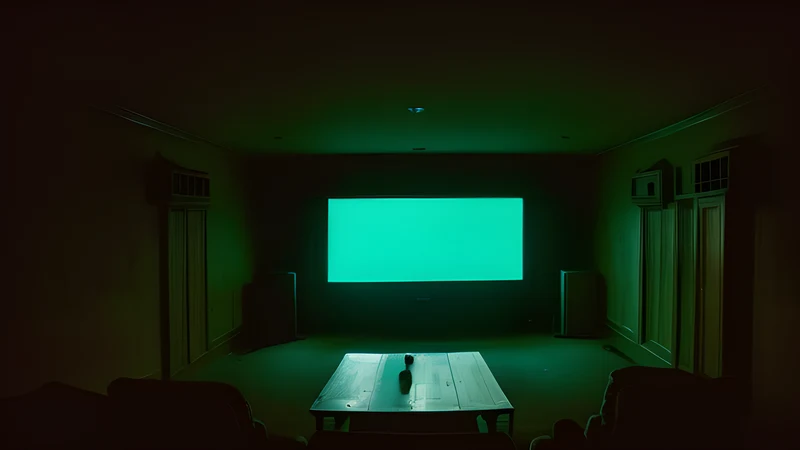
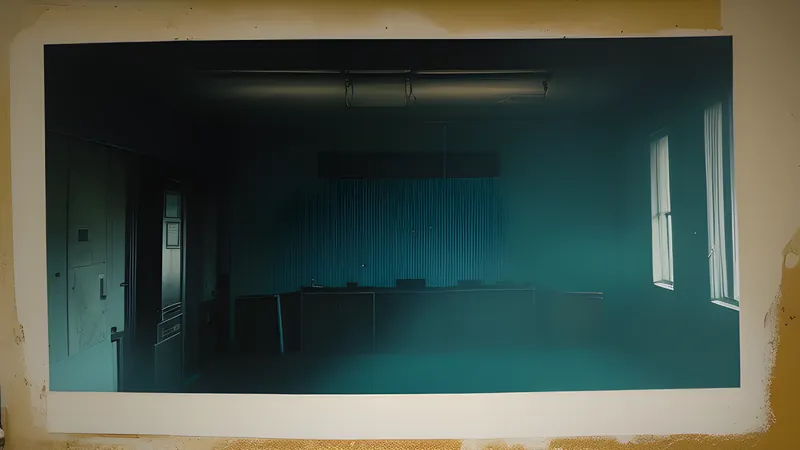
The craft here is worth being specific about, because it’s where the film earns its reputation. Annika Summerson’s photography begins in a flat, drab, fluorescent register: the browns and beiges of British institutional life, shot with the grain up and the contrast down. As Enid’s grip goes, the film’s own presentation degrades and mutates. The aspect ratio narrows toward the boxy shape of a television set. The palette floods with the kind of unmotivated red and green that no eighties classification board would have permitted a fictional world to have. Video artefacts crawl into images that are supposed to be reality.
This is a director using the medium as the symptom, and the reason it works — where the same trick fails in a dozen other films — is that Bailey-Bond establishes the rules pedantically first. You spend twenty minutes learning exactly what Enid’s world looks like, and exactly what the tapes look like, before the two start contaminating each other. The horror is in the drift between two visual grammars you have been trained to tell apart.
The sound works the same seam. Long stretches of Enid’s life play under the hum of strip lighting and the mechanical chatter of a tape deck — the noises of a workplace, tuned to be slightly too present. When the film slips, those same textures stay, so the tracking whine and the spool rattle follow her out of the viewing room and into her flat. By the time the score arrives properly it is doing what the drones in the best British horror do, which is to arrive from underneath the image and imply that the room has always been making this noise and Enid has only now started hearing it.
Note also what she does with the nasties themselves. The film-within-the-film clips are shot to be genuinely convincing period product: the wrong lens, the wrong blood, the specific ugliness of a thing made fast for money. Bailey-Bond loves this material and it shows, which is what stops Censor from being a sneer at its own genre. The film is written from inside the video shop.
The real ancestor
The obvious cousin is Berberian Sound Studio, Peter Strickland’s 2012 film about a mild English sound engineer who comes apart while post-producing an Italian horror picture. Both are about a British technician processing Continental excess through a professional apparatus until the apparatus fails. If you like one you owe the other an evening.
The grandparent, though, is Peeping Tom. Michael Powell’s 1960 film destroyed his career for the crime of pointing out that the camera is the weapon and the audience is holding it. Censor runs the same argument from the other end of the pipeline: Powell indicted the person who films, Bailey-Bond indicts the person who decides what you’re allowed to have filmed for you. Both films implicate you for watching, and both are careful to make the watching pleasurable first.
There’s a Cronenberg strand too — Videodrome’s conviction that a signal can rewrite the flesh receiving it — though Censor keeps its transformation psychological where Cronenberg made it literal.
And then there’s the material itself. The films Enid is cutting are, in the fiction, the same films the DPP was seizing in reality: the Fulci pictures above all, since Zombie Flesh Eaters and The Beyond were both prosecution targets, and Fulci’s whole body of work became the panic’s shorthand for European filth. The historical irony that Censor is quietly built on — that the banning made the reputations, and that a generation of British horror directors were formed by hunting down what the state had removed — is the argument I’ve made at length in how cuts made some films more notorious. Bailey-Bond is a product of that process making a film about that process.
The case against
The film is eighty-four minutes long and the last twenty of them are a different film from the first sixty. That shift is deliberate — the whole design is a controlled collapse — and it still leaves a real problem: the workplace material is so specific, so well observed, so funny about the bureaucracy of harm, that when the picture abandons it for stylised delirium you feel the loss of the better half. I’d happily have watched forty more minutes of examiners arguing about rubber eyes.
The second objection is that the psychology is neat. Trauma-shaped-like-a-job is a satisfying construction, and satisfying constructions can flatten a character into a diagram. Algar is good enough to keep Enid breathing, and there are stretches in the final act where you can see the mechanism through the skin.
What is not in question is that Bailey-Bond made a debut with an argument in it. Censor thinks censorship is a horror genre — that the act of deciding, on behalf of strangers, which images are survivable is itself a kind of possession, and that the person doing it is being changed by every frame they cut. That’s a real thesis, argued in images, by a director who did the reading.
It streams in most territories and has had a good disc release with the period grain intact, which matters: watching this one clean defeats the point. Pair it with Berberian Sound Studio and finish with Peeping Tom, and you’ll have spent a weekend inside the best argument British cinema has ever made about the person on the other side of the screen.
Spoilers below
The mechanism of the film is that Enid’s investigation is also her confession, and Bailey-Bond withholds which one it is until the end.
Enid tracks the actress from North’s film, convinced she is Nina grown up, and pushes her way onto a shoot. The final act plays the rescue as a horror climax — the woods, the violence, Enid killing to save someone who has not asked to be saved — and it is shot with the lurid grammar of the very films she has spent the picture cutting. She has become the product. The examiner is now the atrocity on the tape, filmed by the people she was policing.
The killing of North and the “rescue” of Alice are, in the film’s logic, Enid’s edit of her own life: excise the harm, mark the timecode, deliver a version fit for public consumption.
Then the ending, which is the reason the film matters. The image resolves into a sunlit reunion — Enid, Nina, the parents, the family restored, everything corrected — presented with the flat sincerity of a public information film. It is Enid’s own certificated cut. And underneath it the picture starts to break up: the tracking goes, the colour bleeds, the sound peels away from the image, and what you’re left with is the strong implication that the reunion is a fabrication laid over something Enid has never been able to look at directly, quite possibly her own part in what happened in those woods.
The film ends on the phrase that has been its subject all along. The version you are shown is the version somebody decided you could stand. Bailey-Bond spends the whole film demonstrating that the person who makes that decision is not qualified, has never been qualified, and is bleeding from the same wound as everyone else in the room.
Related Content