Cat People (1942): Val Lewton and the Terror You Don't See
How a cheap RKO horror picture invented the art of the thing left offscreen
Contents
In 1942 RKO handed a former story editor named Val Lewton a horror unit, a tiny budget, and a set of lurid titles thought up by the marketing department. The studio’s instruction was simple: make cheap scary pictures with those titles, keep each one under about $150,000, and do not argue. The first title on the list was Cat People. Out of that cynical, penny-pinching arrangement came one of the most quietly revolutionary films in the history of the genre, and the birth of a whole grammar of fear that the industry has been living off ever since.
Lewton could not afford monsters. He could not afford elaborate effects, star salaries, or the long shooting schedules that let a director cover a scene from every angle. So he turned scarcity into aesthetic. If you cannot show the beast, you refuse to show the beast, and you make the refusal itself the horror. Working with the director Jacques Tourneur — a stylist of shadow whose collaborations with Lewton would define the unit — he built Cat People around a creature the audience never quite sees, and discovered that the unseen thing, shaped by each viewer’s private imagination, is more frightening than anything a props department could deliver.
The woman who is afraid of herself
The story is deceptively simple. Irena Dubrovna, a Serbian fashion illustrator living in New York, is played by Simone Simon with a wary, feline delicacy that anchors the whole film. She meets and marries a pleasant, ordinary American engineer, Oliver Reed (Kent Smith), but she carries a terror out of her homeland’s folklore: a belief that she descends from a village of people who transform into great cats when roused to passion or jealousy, and who kill in that form. She will not let Oliver touch her. She is convinced that desire will unleash the animal, and the marriage curdles into a chaste, anxious standoff.
What lifts this above a folklore B-picture is that the film takes Irena’s fear seriously as psychology before it ever confirms it as fact. Is she a woman genuinely cursed, or a repressed immigrant terrified of her own sexuality and slowly cracking under the weight of it? The screenplay by DeWitt Bodeen holds both readings open with real discipline. Oliver’s colleague Alice (Jane Randolph) falls in love with him and becomes the wholesome alternative; a smug psychiatrist, Dr. Judd (Tom Conway), decides to cure Irena and treats her belief as mere hysteria. The film watches all of this with a cool, sympathetic eye, and it is always, quietly, on Irena’s side.
Simon’s performance is the reason the ambiguity works. She plays Irena as fragile and genuinely loving, a woman who wants the ordinary happiness everyone around her enjoys and is barred from it by something she cannot name or control. When jealousy of Alice begins to sharpen her, Simon lets a flicker of the predatory show through the sorrow, and you cannot tell whether you are watching a curse activate or a mind break.
The two scenes that taught Hollywood to hold back
Cat People contains two suspense sequences so influential that both entered the technical vocabulary of the industry. The first is the walk. Alice, leaving a late meeting, senses she is being followed through the park; the streetlamps pool light and then surrender it to long stretches of black; her heels click faster on the pavement; the editing tightens and the sound drops away until the tension is unbearable — and then a bus arrives at the kerb with a sudden pneumatic hiss of its brakes, exactly where your nerves expected a leaping panther. The relief and the fright land in the same instant. Filmmakers still call this manufactured false scare a “Lewton bus,” and you have seen a thousand descendants of it, the cat that jumps out of the cupboard before the real threat arrives.
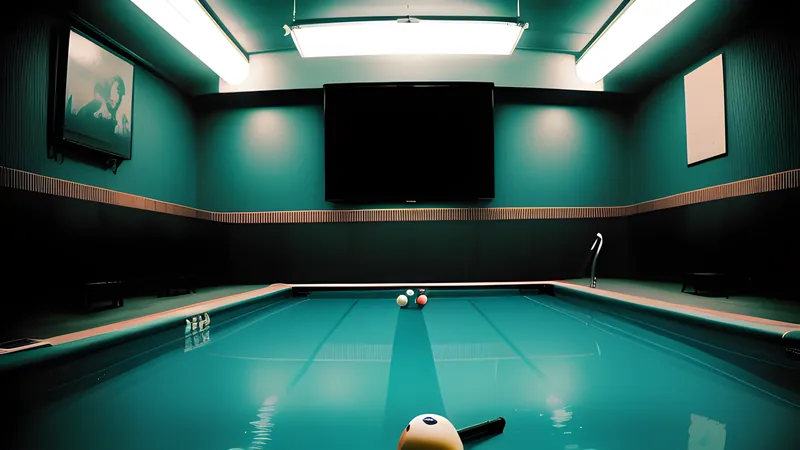
The second is the swimming pool. Alice, alone at night in the basement pool of her building, hears growling in the dark, sees shadows ripple across the tiled walls and the disturbed water, and treads water in a spreading circle of panic while something prowls the edges of the room just out of frame. Tourneur never shows the animal. He gives you rippling light, a low snarl, a shape suggested and withdrawn, and Alice’s terrified face — and the scene is far scarier than any shot of a real leopard could be, because the leopard your imagination supplies is stalking you.
This is the whole Lewton method, and it is worth stating plainly as craft: horror lives in the gap between what the film implies and what the audience’s mind is forced to complete. Show the monster and you cap the fear at the limit of your effects budget. Withhold it and the fear expands to the size of each viewer’s private dread. It is the exact principle that runs through the great ghost films that followed — the unseen presences of The Haunting and the unresolvable apparitions of The Innocents are Lewton’s children — and it reaches all the way back to the staircase shadow of Nosferatu, which understood the same truth two decades earlier.
Why the restraint still works
The temptation with a film this old is to file it under historical interest, admirable for its time and no longer capable of a scare. Cat People defeats that condescension every time it is watched properly, in the dark, with attention paid. The pool scene still tightens the chest. The reason is that Lewton and Tourneur were not hiding the monster to save money in some grudging way; they had grasped a permanent fact about how fear works in the mind, and a permanent fact does not date.
The film’s texture helps. Nicholas Musuraca’s cinematography treats the studio’s cramped standing sets as a labyrinth of pooled light and encroaching black, the same visual language that would become film noir a few years later — and it is no accident that noir and the Lewton horror unit grew up together, two sides of the same shadow. The film moves briskly, wastes nothing across its lean seventy-three minutes, and trusts the audience to be intelligent, which is perhaps the rarest quality in cheap horror of any era.
Lewton’s unit followed this with a run of the finest low-budget horror films ever made, and its immediate companion piece is essential viewing alongside it: I Walked With a Zombie, Tourneur’s next film for the unit, applies the same shadow-craft to a Caribbean gothic. Tourneur would carry the method into his masterpiece of the following decade, Night of the Demon, where the argument about whether to show the monster becomes, famously, a fight behind the camera. Paul Schrader remade Cat People in 1982 as a glossy, explicit, blood-and-flesh reimagining with Nastassja Kinski — a fascinating film in its own right that proves the point by inversion, because the moment it shows you everything, the particular dread of the 1942 version evaporates.
Watch the original. It is available in clean transfers, and it needs no updating. The verdict is that Cat People is the founding text of suggestion horror, a film that turned a lack of money into a discovery about the human mind and never once condescended to the woman at its centre. It is seventy-three minutes long, it cost less than a rounding error on a modern production, and it is still teaching directors how to frighten people. Below the line, the ending — and what it finally decides about Irena.
Spoilers below
The film ultimately confirms that Irena’s curse is real, and it does so with the same restraint it has shown throughout. After Dr. Judd, arrogant to the last, forces a kiss on her in an attempt to prove her fears are imaginary, Irena transforms and mauls him — we see the aftermath, the shadows, the panther loose in the room, and Judd’s death, without a clean look at the beast doing it. The transformation the whole film has withheld is granted, and even in granting it Tourneur keeps it half in darkness, so that the confirmation never feels like a cheap reveal.
Wounded by Judd’s sword-cane in the struggle, Irena goes to the zoo, where she has been drawn all film to the black panther in its cage. She unlocks the enclosure and releases the animal; it strikes her down as it bolts, and it is run over and killed in the road moments later. Oliver and Alice arrive to find Irena’s body — and, in the film’s final, devastating image, her corpse has reverted to human form, so that what lies there is a dead woman and not a dead monster. The curse was true, and it killed her, and the world will bury an ordinary young immigrant who was telling the truth the whole time.
That last shot is the film’s moral. Irena was never the villain of her own story; she was its victim, a woman destroyed by a nature she did not choose and a society — represented by the leering psychiatrist — that would not believe her until it was too late. Lewton and Bodeen give the horror an ache of genuine tragedy, and they refuse the comfort of a triumphant ending in which the nice American couple simply walk away happy. Oliver and Alice have their future, and it is built on the grave of a woman they never understood. The panther you never clearly saw turns out to have been the least frightening thing in the film. The cruelty of ordinary people who cannot imagine another person’s terror was the real monster, waiting in plain sight all along.
Related Content