Brainstorm: Trumbull's Consciousness-Recording Machine
The film where the screen changes shape when somebody else's memory starts playing
Contents
Most films about a fictional technology are content to describe it. Brainstorm (1983) builds one and then hands you the demo. A research team assembles a headset that records the full sensory stream of whoever wears it — sight, sound, touch, appetite, fear — onto tape, and lets a second person play the tape back and live it. The film’s problem is the one every such film has: how do you show an audience the difference between watching an experience and having one?
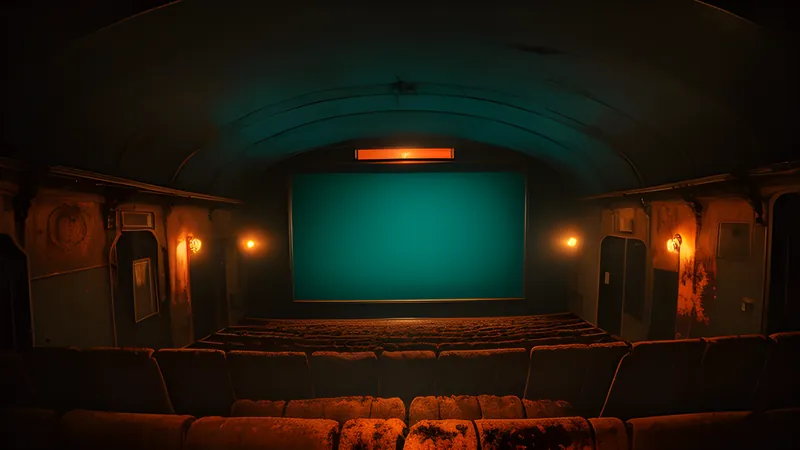
Douglas Trumbull’s answer was to change the shape of the screen. The scenes set in the lab, in the corridors, in the marriage that is quietly failing at the edge of the plot, are ordinary 35mm in an ordinary ratio. The moment a tape starts playing, the image widens, the grain vanishes, the picture cleans up and opens out, and you are inside somebody’s head. He shot those sequences in 65mm. The transition is the argument. You do not need a character to explain that playback feels more real than life, because the projector has already told you.
The inventor who kept inventing
Trumbull had earned this. He was the effects lead who bent light for 2001: A Space Odyssey, and his directorial debut, Silent Running, had already shown he cared more about a felt idea than a clean plot. Between the two he had been chasing a format called Showscan — 70mm running at sixty frames a second — on the theory, backed by his own testing, that higher frame rates produce measurably stronger physiological responses in viewers. He wanted Brainstorm to be the film that proved it in a cinema.
MGM would not carry the exhibition cost. So the ratio shift became the compromise: a film about a machine that delivers a more intense reality, made by a man who was building exactly that machine in the real world and had just been told he could not switch it on. That tension is on the screen. The playback sequences have a hunger to them that the drama around them never matches, because the director’s whole professional argument was riding on them.
The cast, and the production that fell in on it
Christopher Walken plays Michael Brace, the engineer, in one of the least mannered performances of his career — a man who is more comfortable with a soldering iron than a sentence. Louise Fletcher is Lillian Reynolds, his collaborator, a chain-smoking researcher with no patience for anything that is not the work; she is the best thing in the film and the reason its second half has any weight. Natalie Wood plays Karen, Michael’s estranged wife, and Cliff Robertson is the company man who understands what he is funding rather too well.
Wood died during production, in November 1981. What followed is a matter of studio record: MGM moved to shut the picture down and claim on the insurance, and Trumbull fought to finish it, arguing that the remaining gaps could be bridged. They were, with doubles, rewrites and reshuffled coverage, and the film sat on a shelf until a 1983 release that nobody was pushing. Watch it now and you can feel the seams — a conversation that resolves slightly too quickly, a scene that plays a beat wide of where it was aiming. The film that reached cinemas is a repair job around a real idea.
Why the good scenes are good
The best passage in Brainstorm is a small one, and it is pure craft. A technician gets hold of a tape of somebody else’s intimate encounter, loops the best few seconds, and runs it over and over. Trumbull does not moralise. He just shows you the loop shortening, and the man’s face going slack, and the film has made its point about what an unregulated pleasure device does to a person decades before anyone needed the word for it.
The other is Fletcher’s alertness to what the sponsors want. The military interest in the project is handled with an almost bored competence — of course they want it; a machine that records terror can transmit terror. Brainstorm gets there without a single speech, because it establishes early that everything on tape is copyable, and copyable is the whole horror. Videodrome, released the same year, went at the identical fear with a wetter imagination and better lines. Trumbull’s version is drier and, on the specific question of what happens to a recording once it leaves your hands, more accurate.
The machine looks like a machine
Production design is where sci-fi usually gives itself away, and Brainstorm holds the line. The headset starts as a cage — an ugly, weighty scaffold of sensors that a person has to be helped into, trailing cable to a rack of equipment the size of a wall. Over the course of the film it shrinks, because that is what hardware does, and by the last act it is a band you could wear under a hat. Nobody remarks on the progression. It just happens in the background of the frame, and it does more to establish that this is a real technology on a real development curve than any amount of dialogue could.
The tape is the other good decision. Experience here is a physical reel with weight and edges, an object that can be stolen, spliced, hidden in a drawer or handed to the wrong person. Every plot beat in the back half depends on somebody holding a specific object, and the film gets its tension from that scarcity. It is a choice that has aged strangely well: we now live with the frictionless version of this technology, and the friction turns out to have been the only thing protecting anyone.
Trumbull walked away
Brainstorm was the last feature Douglas Trumbull directed. He spent the decades afterwards on special-venue work — ride films, simulator attractions, the large-format and high-frame-rate research he had been unable to sell to a studio — and returned to conventional cinema mainly as a technical consultant. Two features in fourteen years, and then nothing.
That biography changes how the film reads. This is a picture about a group of engineers who build something remarkable and then watch the people funding it decide what it is actually for. Trumbull made it while losing precisely that argument to MGM, and finished it against a studio that would rather have taken the insurance money. The wonder in the playback sequences is not a stylistic choice. It is a man making the case for his life’s work in the only medium where he could still get a hearing, and the film is worth watching for that pressure even where the drama around it sags.
The case against
The domestic drama is thin. Michael and Karen’s marriage exists so that the technology has something to heal, and the film treats their reconciliation as a foregone conclusion the moment the hardware makes it possible — which drains the tension from every scene they share. The corporate-thriller machinery in the last half hour is stock: keycards, guards, a control room, a man typing quickly. And the film is fatally shy about the implication it raises and then walks away from. If experience is copyable, the question is not whether the military want it. The question is what a person becomes when their memories are assets. Trumbull raises it and reaches for wonder instead.
The ancestor, and the descendant
The collector’s line here runs forward more than back. Brainstorm’s real descendant is Strange Days (1995), which took the same premise — recorded first-person experience, sold and traded — gave it a black market, a dealer protagonist and a crime to solve, and in doing so found the plot Trumbull could not. Bigelow’s film is the better thriller by a distance. It is also standing on this one’s shoulders, and it knows it.
Behind Brainstorm sits Demon Seed (1977), the other film of its era to treat a laboratory as a domestic space where a marriage and a machine are competing for the same person. And behind both is the older idea that a research team will always contain one person who wants to know and one person who wants to sell, and that the film belongs to whichever of them is left alive at the end.
Watch it for Fletcher, for the ratio trick, and for the sensation — rarer than it should be — of a director using the physical properties of film stock to make an argument about consciousness. It is available in a decent widescreen transfer that preserves the format shift, which is the only way it makes any sense at all.
Spoilers below
Lillian dies alone in the lab, of a heart attack, and does the only thing her character could possibly do: she straps on the headset and records it. That is the film’s masterstroke and its justification. Fletcher plays the sequence with a scientist’s absolute steadiness — she is dying and she is taking notes — and the tape she leaves behind becomes the object everyone else in the film is fighting over.
Michael’s attempt to play it is the climax, and it is where Trumbull’s ambitions and his budget part company. The death tape becomes a rush of imagery: cellular, architectural, angelic, culminating in a vision of the beyond rendered with the tools of a man who had spent his career making light do things. Some of it is genuinely overwhelming. Some of it is a slide show. The film asks the biggest question available to it — what is on the tape after the heart stops — and then answers it, which is the mistake. Fletcher’s steadiness had already given us something better: the suggestion that the answer is recordable at all.
The military subplot resolves in the way these things do, with Michael commandeering the system remotely and flooding the facility’s own tapes back at its staff. It is a clean piece of plotting and it feels like it belongs to a different, smaller picture. And then the marriage is repaired, on tape, by shared memory, which is the ending the film needed and the one it least deserved.
Related Content