Blue Ruin: The Amateur's Revenge
Jeremy Saulnier's second feature takes the revenge thriller and removes the one thing every other example depends on — competence
Contents
The revenge thriller runs on a quiet lie, and the lie is competence. Somewhere between the inciting murder and the final reckoning, the wronged man acquires skills. He learns to shoot, or he turns out to have been able to shoot all along; he plans; he arrives at the right house at the right hour with the right weapon. The genre needs this because the alternative is a man standing in a car park with a knife he does not know how to hold, and that is not a film, that is a news item.
Blue Ruin is the news item. Jeremy Saulnier’s 2013 second feature hands its avenger no aptitude whatsoever. Dwight Evans, played by Macon Blair, is a soft, frightened man living out of a rusting car near the Atlantic shore, bathing in strangers’ bathrooms and eating out of bins. When he learns the man who killed his parents is being released from prison, he drives to meet him with no plan, no craft and no capacity for any of it. What follows is roughly ninety minutes of a person discovering, in real time and at close range, that killing people is difficult, disgusting and does not stop.
The first twenty minutes say almost nothing
Saulnier opens on silence and routine. Dwight scavenges. He sleeps. A police officer finds him — kindly, which is its own small shock — and gives him news in a patrol car. He weeps, and then he drives. There is barely a line of dialogue in the opening stretch, and the film is trusting the audience to read a man entirely from behaviour: the shoulders, the beard, the practised efficiency of someone who has organised his whole existence around not being spoken to.
This matters because it establishes the register before the plot arrives. By the time Dwight commits his first act of violence, we have watched him fail to do far simpler things well. The film has already told us who he is, so when the violence lands the audience is not asking whether he will win. We are asking whether he will survive the next ten minutes, and the honest answer the film keeps giving is: barely, and by luck.
Macon Blair’s performance is the engine. He and Saulnier have been friends since childhood in Virginia and had already made the low-budget horror comedy Murder Party together in 2007, and you can feel the shorthand — Blair plays Dwight with his eyes permanently slightly too wide, a man in a state of continuous low-grade panic that never resolves into resolve. He is scared during the killing and scared afterwards. Most avengers in this genre are transformed by their first murder. Dwight is only more frightened.
Funded on nothing, shot by the director
Blue Ruin was made outside the system in a way that shows on screen in the best sense. Saulnier part-funded it through a Kickstarter campaign that raised well under forty thousand dollars, with the rest cobbled together privately, and he shot the film himself — cinematography was his actual trade, and he took the camera credit. The result is a film with no coverage to waste and a very specific look: cold blues, wide compositions, a lot of empty American middle distance.
That self-shot discipline pays off in the way the film handles space. Saulnier likes to place a threat at a legible distance and then let you watch it close. He does not cut to a close-up to tell you to be afraid; he lets you see the whole room, including the exit Dwight has not noticed. The tension is architectural. It also means that when the film does go close, it means it.
It premiered in the Directors’ Fortnight at Cannes in 2013 and took the FIPRESCI prize there, which is a slightly comic fate for a film about a man who cannot work a gun — but Cannes has always had a taste for genre done with rigour, and rigour is exactly what this is.
The craft: violence with consequences and a running clock
The single best decision in Blue Ruin is that injuries persist. This sounds trivial and it changes everything. In the standard revenge film, a wound is a punctuation mark: the hero is hurt, he grimaces, the next scene proceeds. Here, damage is a logistical crisis. A wound has to be dealt with, badly, by a man with no medical knowledge, using whatever is in the boot of a car, and the sequence takes as long as it would take. The film keeps stopping to make Dwight solve the physical problem of his own body.
Saulnier compounds this with a second rule: nobody is good at any of it. Guns jam or are simply hard to obtain, doors are hard to get through, cars are loud, blood is everywhere and stays there. The film’s most sustained set piece is a home invasion in which almost nothing goes the way the invader intended, and the horror is not that Dwight is monstrous. The horror is that he is out of his depth and has already gone too far to stop.
There is a third element, subtler. Saulnier builds the whole film on information asymmetry. Dwight repeatedly does not know something the other party knows, and the film gives us his ignorance rather than the truth. That structure is borrowed straight from a very particular corner of American crime cinema, and it works here for the same reason it worked there — because a man acting decisively on a wrong picture is the most reliable tragedy engine in the genre.
The real ancestor is smaller than you think
The lazy comparison is Straw Dogs, and it is wrong: Peckinpah’s film is about a man discovering a capacity, which is the opposite of this. The more useful cross-reference is Blood Simple, where the Coens built an entire machine out of characters misreading a single act of violence — Saulnier is running that same engine at half the RPM and with one operator instead of four.
But the true ancestor is Blast of Silence, Allen Baron’s 1961 New York cheapie about a hit man who narrates his own dwindling. It has the same shape: one man, almost no money, no glamour, a lot of walking, an interior life the film refuses to dramatise, and an ending that treats the protagonist’s death or survival as a matter of weather rather than justice. Baron shot his film for pennies on real streets because he had no choice, and the poverty produced a moral tone that better-funded films could not buy. Blue Ruin is the same trick, fifty years on, with a Kickstarter instead of a favour from a friend with a camera.
For the closest tonal sibling in the modern era, Straight Time is worth pulling out: Dustin Hoffman playing an ex-con with a deflating, unheroic ordinariness that American film mostly stopped permitting after the seventies.
The case against
Blue Ruin has a structural weakness, and it is worth saying plainly. Once the film establishes its central joke — the avenger cannot do this — it has said its piece, and the back half has to find somewhere else to go. Saulnier’s solution is to widen the conflict, and the widening introduces exposition: characters arrive to explain the history that the first hour so elegantly withheld. The dialogue in these stretches is functional in a way the silence never was.
There is also a case that the film’s realism is selective. Dwight is hopeless at violence but consistently lucky in the specific ways the plot requires, and a couple of times the machinery is visible — a body found, or not found, on exactly the schedule the next scene needs. The film is honest about consequences and slightly less honest about probability.
Neither complaint sinks it. But Blue Ruin is a great sixty minutes and a very good thirty, and the join is audible.
Where it leaves you
Saulnier made Green Room next, and the two films are a matched pair: the same interest in ordinary people confronted with violence they have no vocabulary for, the same refusal to let anyone acquire competence, the same wounds that will not close. Watch them in order and you can see a director working out that his real subject is not revenge or survival. It is inadequacy under pressure.
Blue Ruin is easy to find on the usual services and has been given a proper disc release with Saulnier’s commentary, which is worth the time — he talks about the film the way a cinematographer does, in terms of where the light was and how little of it there was.
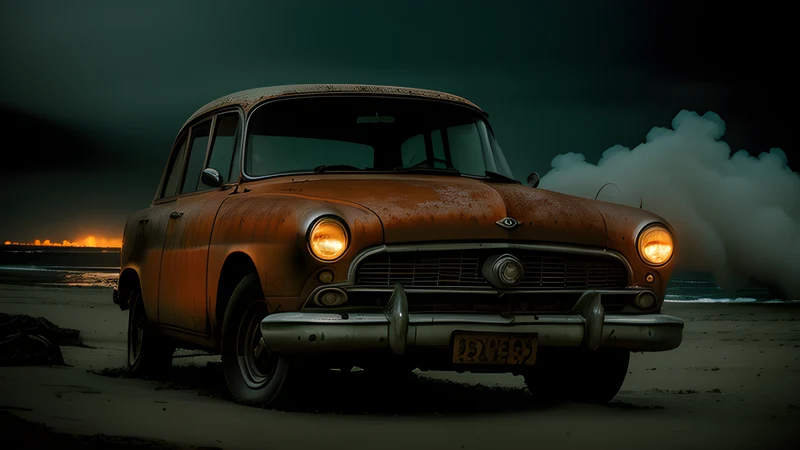
The film’s title is doing quiet work, incidentally. “Blue ruin” was nineteenth-century slang for the cheapest available gin: a thing you drink to obliterate yourself, named for the colour it leaves behind. It is also a car on a beach.
Spoilers below
The engine of the film’s second half is that Dwight has been avenging the wrong crime. He kills Wade Cleland Jr. in a bar bathroom — clumsily, at length, with a knife, in the film’s most sustained sequence of physical ineptitude — and only afterwards, from his sister Sam and then from the Clelands themselves, does the history assemble. Wade did not murder Dwight’s parents in the way Dwight has spent twenty years believing. Dwight’s father was having an affair with Wade’s wife; the shooting was Wade Sr.’s, and Wade Jr. took the sentence for his father. Dwight has therefore executed a man for a killing that man did not commit, on behalf of a marriage that was not what he thought it was, and the family he has now provoked knows all of this and he does not.
This is where the film’s information asymmetry stops being a technique and becomes the point. Dwight’s ignorance is not incidental to his incompetence. It is the same failing.
The final movement is a siege at the Cleland house that Dwight walks into knowing he will not walk out. He has already sent Sam and her children away — the one piece of planning he executes well in the entire film, and it is the one that requires no violence at all. Ben Gaffney, the old school friend played by Devin Ratray who supplies the guns out of a suburban cabinet with cheerful, terrifying ease, is the film’s clearest statement about American access to weapons: the hardware is trivially available and the competence is not included.
Dwight kills the family and is killed, more or less simultaneously, and the film ends without telling us whether anyone survives who might continue it. Teddy Cleland, the boy, is spared — and the sparing is the only forward-looking act in the film, which is to say the cycle is left running. Saulnier does not stage a catharsis. He stages an arithmetic in which everybody has now been subtracted, and the last shot is composed with the same flat, patient distance as the first, because nothing has changed except the number of people.
What lingers is Blair’s face during the final killings: the same wide-eyed alarm he had while eating out of a bin in the first reel, entirely unchanged by any of it. He never becomes the man the genre promised. That refusal is the film.
Related Content