Blade Runner: Which Cut Is the Film, and Why It Matters
Seven versions, one masterpiece, and the small change that decides everything
Contents
There is no single object called Blade Runner. There are at least seven, and the arguments over which one counts have outlasted most of the careers involved. Ridley Scott’s 1982 adaptation of Philip K. Dick’s Do Androids Dream of Electric Sheep? went out to American cinemas with a hard-boiled voiceover and a sunlit ending, flopped against E.T., and then spent forty years mutating in the dark like something in Tyrell’s lab. To love this film properly you have to know which one you love, and why the differences are load-bearing rather than cosmetic.
I want to walk through the versions that matter, because the gap between them is one of the great case studies in how editing decides meaning. Change three minutes of a picture and you change what the whole thing is about. Almost nobody’s first exposure to Blade Runner was the same object as their tenth, and that instability is part of why the film refuses to settle into a museum piece.
The versions, sorted
Seven cuts get counted, though most people only need to hold four in their head. The 1982 US theatrical version is the one with Harrison Ford’s voiceover and the closing drive into green countryside. The International cut (also 1982) is the same film with a few seconds of extra violence restored for overseas certification. A 1982 workprint, shown to test audiences and later screened in repertory, is rougher, has different music in places, and lacks both the voiceover and the happy ending.
Then comes the fork that made this a franchise of one film. In 1992 Warner Bros. released a Director’s Cut, assembled quickly and supervised only loosely by Scott, who was busy elsewhere. It dropped the voiceover, cut the tacked-on ending, and inserted a short shot of a unicorn galloping through a forest. And in 2007, for the film’s twenty-fifth anniversary, Scott finally got the version he wanted: the Final Cut, the only one over which he had complete control, with restored footage, corrected effects, cleaned-up continuity, and a remixed soundtrack. Five and a half hours of Blade Runner in various states also exists as a five-disc set, which is where the completists live.
The Vangelis score threads through all of them, and it may be the single most consistent argument for the film’s greatness: those synth swells and the saxophone are the sound of a future that feels lived-in and mournful at once. Whatever cut you watch, you are watching to that music.
What the voiceover did, and what it stole
The theatrical narration is the most famous “mistake” in the film’s history, and the received wisdom is that Ford deliberately phoned it in hoping the studio would drop it. Whether that story is exactly true, the effect is real. The voiceover explains. It tells you Deckard is tired, tells you what a replicant is, tells you how to feel about the woman he has just met. It treats the audience as passengers who need directions.
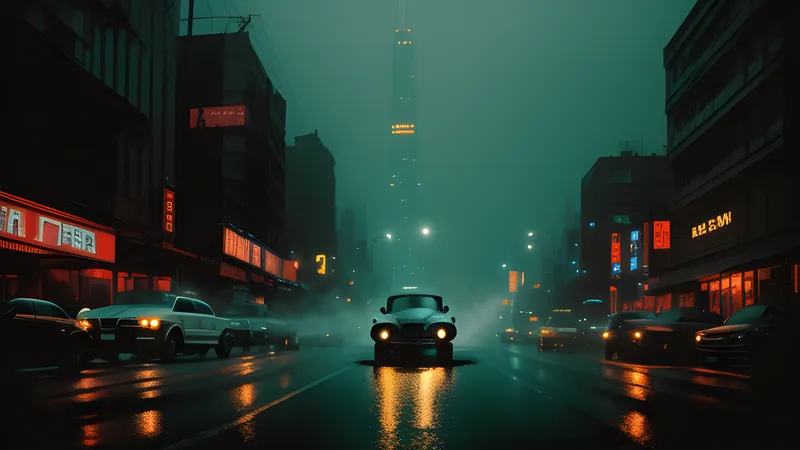
The picture Scott was actually making distrusts explanation. Its power comes from withholding: the long dissolves across a rain-lit Los Angeles, the eyes reflecting neon, the sense that every frame contains more information than any line of dialogue could carry. Narration over that imagery flattens it into a detective yarn. Remove the narration and the same footage becomes a tone poem about memory and mortality that happens to have a cop in it. The images were always doing the work; the voiceover kept apologising for them.
This is the craft lesson buried in the whole saga. Blade Runner is a film where the meaning lives in production design, lighting and cutting rather than in plot mechanics. Lawrence G. Paull’s sets and Douglas Trumbull’s effects built a world so dense that the script barely needs to function. When the studio panicked and bolted words onto it, they were trying to turn a mood into a story, and the mood was the point.
The unicorn, and the question it answers
The Director’s Cut’s most consequential addition is roughly four seconds long. Deckard sits at his piano, half-dreaming, and a white unicorn runs through green woodland. On first viewing it barely registers. On second viewing, once you know how the film ends, it detonates.
I will keep the payload below the spoiler line, but the structural point is worth stating in the open: a four-second insert, placed correctly, retroactively rewrites the film’s central ambiguity. That is editing as authorship at its purest. The footage reportedly existed from the shoot (some of it associated with Scott’s Legend), and simply dropping it into the right slot changes the answer to the question the whole story circles. No new scene, no reshoot, no dialogue. One dream.
The Final Cut then does the housekeeping the 1992 version couldn’t afford: it fixes a shot where you could see a stunt double’s face, corrects the number of replicants mentioned so the arithmetic finally lands, and cleans the composites. It is the film Scott would hand you if you asked for the film. For a first-time viewer, it is the correct starting point, and I would send anyone there before any other version.
The real ancestor of this
Everyone reaches for Metropolis when they place Blade Runner, and the vertical city and the towering industrialist earn the comparison. The deeper ancestor is film noir itself — specifically the rain-soaked, morally exhausted noir of the late 1940s, the world of Out of the Past and The Big Sleep, where a tired man in a coat moves through a corrupt city asking questions he will regret answering. Scott simply pushed that world forward two hundred years and let it rain harder. The voiceover was a noir reflex; the film underneath had already outgrown it.
The other lineage runs through Dick’s fiction and its obsession with the counterfeit self, which Scott’s contemporary Paul Verhoeven would mine differently in Total Recall, and which David Cronenberg had been chasing from another direction entirely — the body and its betrayals rather than the memory and its forgeries. If Blade Runner’s questions about manufactured identity grip you, the Cronenberg of The Fly and Videodrome is the essential parallel text: three films from the same decade, all asking what is left of a person when the flesh or the memory can be rewritten.
Villeneuve understood all of this when he took the sequel, which is why Blade Runner 2049 works as continuation rather than cash-in. He built his film out of silence and space, trusting the images exactly the way the theatrical Blade Runner was forbidden to.
So which cut is the film? My answer is below, with the spoilers, because you cannot make the case without spoiling the thing the case turns on.
Spoilers below
The unicorn matters because of Gaff. Edward James Olmos’s origami-folding cop trails Deckard through the whole film, leaving little paper figures. At the very end, after Deckard and Rachael flee the apartment, Deckard finds a folded origami unicorn on the floor, and Gaff’s earlier line about her floats back. Gaff knew what Deckard dreamed. If Gaff knew Deckard’s private dream of a unicorn, then that dream is not private — it is implanted, a manufactured memory, exactly like the ones that let Rachael believe she is human.
That is the reading the four-second insert forces: Deckard is a replicant. The theatrical cut has no unicorn dream, so the origami is just a parting gesture and Deckard stays a human blade runner having a bad week. The Director’s Cut and the Final Cut plant the dream, and the origami becomes proof. One shot converts the ending from a rescue into a horror: the hunter is the hunted category, and he may never know it.
Scott has said outright, more than once, that Deckard is a replicant. Ford has argued the opposite for decades, on the sensible grounds that a love story between two machines has less human stake than a man learning to love something he was built to destroy. That disagreement between director and star is, genuinely, the healthiest thing about the film. The Final Cut leans hard toward Scott’s answer, yet it never quite closes the door, because the tears-in-rain speech still belongs to Roy Batty, and it is Batty — the manufactured man choosing mercy in his last seconds, saving the person sent to kill him — who delivers the film’s actual thesis about what makes a life worth grieving. Rutger Hauer reportedly trimmed and reshaped that monologue himself the night before shooting, and it remains the greatest death scene in the genre.
Here is my verdict. The Final Cut is the film. It is the only version Scott fully controls, it repairs the errors that nag at the others, and it commits to the ambiguity that gives the story its ache without hammering it shut. The theatrical cut is a historical document worth seeing once, so you understand what the film was rescued from. The workprint is for obsessives. But if someone has never seen Blade Runner and asks where to begin, you point them at the 2007 Final Cut and you say nothing about unicorns. Let it do to them what it did to you.
Where to watch: the Final Cut is the version in most streaming libraries and on the standard 4K disc, usually labelled as such — check the runtime lands near 117 minutes and you have the right one. Follow it with Blade Runner 2049, then read Dick, then never trust a happy ending bolted onto a rainy city again.
Related Content