Black Sunday: Bava's Gothic Masterpiece of Two Faces
The 1960 debut that hammered a spiked mask onto Barbara Steele and made Italian horror possible
Contents
The first two minutes of La maschera del demonio are the most confident opening any director has ever managed on a first solo credit. A woman is condemned as a witch by a tribunal led by her own brother. She is bound to a stake. An executioner produces a bronze mask, its interior studded with spikes, positions it over her face, and a second man swings a mallet. Bava holds on the impact. Then he holds a moment longer, on blood coming through the eyeholes.
Italy had not made anything like this. Neither had anyone else. Black Sunday was released at home on 11 August 1960 and reached America the following year through AIP with a fresh Les Baxter score, an English dub and some judicious trimming. The BBFC refused it a certificate outright; British audiences waited until 1968 for an X-rated release, by which point the film’s reputation had done a lap of the world without it. That eight-year gap is the reason the film arrived in Britain as a rumour, and rumours are how gothic horror ought to travel.
A cameraman who had been waiting
Mario Bava was 46 and had spent two decades as one of Italy’s best cinematographers. He had shot I Vampiri in 1957 and finished directing it when Riccardo Freda walked off. He had done the same rescue job on Caltiki, the Immortal Monster in 1959. Galatea gave him Black Sunday as a reward for those uncredited saves, and he photographed it himself, which is the single most important fact about how it looks.
A director who arrives through the camera department composes differently. Bava lights for the lens he has chosen and stages the actors inside the pool of light rather than lighting whatever the actors happen to do. The crypt sequences are the clearest demonstration: he builds each shot around one hard source, usually low and to the side, and lets everything outside its reach go to absolute black. There is no fill. Faces are half-present, half-erased, and the erased half is doing the work.
He is also, by 1960, a practical-effects man of some cunning, and Black Sunday is full of tricks that cost almost nothing. The coach that carries Kruvajan and Gorobec through the wood travels in slow motion while the actors move at normal speed, which produces a floating, wrongly-weighted glide that the audience registers as dread without being able to name the cause. Foreground glass paintings extend a set that ends four metres from the lens. A tilt reveals architecture that does not exist. Bava’s whole career runs on the conviction that horror is an optical problem with optical solutions, an argument we follow into his colour period in Mario Bava: the father of Italian horror.
The face, and the other face
Barbara Steele was 22 when she made this, an English actress who had been under contract to Fox and had come to Italy after the studio system found no use for her. Bava cast her as Princess Asa Vajda and as Katia Vajda, her descendant two centuries on, and the film’s entire architecture rests on the fact that these two women share a face.
The casting decision is the script’s real thesis. A film about a witch returning could have used any actress for the victim. By making the intended victim identical to the predator, Bava turns every scene between them into a mirror, and mirrors are the gothic’s home ground. Katia is not being hunted by a stranger. She is being hunted by the version of herself that said yes.
Steele plays the difference with almost no makeup assistance in the Katia scenes. She simply changes what her eyes do. Asa looks at people as objects with a duration; Katia looks at people hoping they will stay. It is a young actress’s performance and it is not subtle, and neither of those things matters, because Bava photographs her as an icon rather than a character. He shoots her in the crypt with the light raking across the eye sockets, and the shot became so definitive that Steele spent the next decade unable to escape it — she made The Horrible Dr Hichcock, The Long Hair of Death and half a dozen more, the reigning face of Italian gothic, all of it downstream of one lighting setup.
The mask itself deserves the credit it gets. It is a piece of prop design that functions as the film’s entire theology in one object: a punishment that is also a brand, applied to the face because the face is what the film cares about. When it comes off, the damage is still there. The film’s cruellest idea is that the mask never really stops being on.
The Gogol problem
Black Sunday announces itself as an adaptation of Nikolai Gogol’s “Viy”, the 1835 novella, and the claim is close to fraudulent. Gogol’s story is about a seminary student made to read psalms over a dead witch for three nights in a country church. Bava keeps a witch, a resurrection, a young man out of his depth, and discards the rest — the chalk circle, the church, the structure, the whole comedy of the thing. The Soviet Viy of 1967, which we take up in Viy: the Soviet folk-horror fever dream, is what a faithful version looks like, and the comparison is instructive: Gogol’s actual plot is stranger and funnier than the sombre Moldavian revenge Bava built on top of the credit.
What Bava took from Gogol was permission. A literary source, however loosely honoured, gave Galatea cover for material that Italian censors would otherwise have refused, and it gave the film its Eastern European setting at a moment when Hammer had colonised Transylvania. Bava’s Moldavia is a studio backlot with the fog turned up, and it feels older than Hammer’s Carpathians because he shot it in monochrome while Hammer was busy selling the gothic in blood-red Eastmancolor. Black and white in 1960 was a commercial handicap. Bava turned it into the film’s claim to antiquity.
What it started
The immediate consequence was an industry. Black Sunday made money, and Italian producers spent the next five years commissioning gothics — Freda, Margheriti, Caiano, Bava himself — with Steele in as many of them as would fit. Bava’s own The Whip and the Body came three years later and pushed the same crypt-and-candelabra vocabulary somewhere far more perverse.
The longer inheritance is the reanimated-woman film, and it is everywhere. Coppola’s Bram Stoker’s Dracula borrows the doubled beloved and the centuries-old grudge. Burton’s Sleepy Hollow borrows the whole visual grammar, down to the milky sky and the black wood. The tightest descendant is the modern possession film’s core move — a dead woman who wants a living body and has picked one that looks like hers — which we chart in The possession film and the return of the religious.
There is also a quieter legacy in how the film treats its young hero. Gorobec, played by John Richardson, is useless for most of the running time — he is the handsome man who arrives late and understands last. Bava is faintly bored by him, and gives the film’s intelligence to the women and its authority to the dead. That imbalance became a structural habit of the Italian gothic: a male lead who exists to be outpaced by the material, while the film’s real attention sits with a woman who is either a victim or a monster and frequently both. Argento inherited the arrangement wholesale a decade later and never quite examined it.
Where to watch: the Italian cut runs about 87 minutes, keeps Roberto Nicolosi’s score and preserves the mask sequence intact. The AIP version is a genuinely different film with different music and a different rhythm, and it is a historical curiosity worth seeing second.
Spoilers below
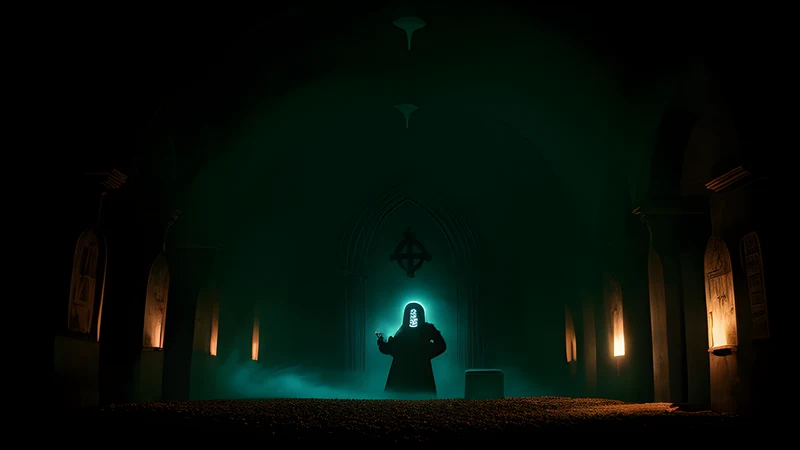
The prologue’s tribunal is led by Asa’s brother, the Grand Inquisitor, which makes the entire film a family matter. After the mask goes on, the intended burning is rained out — a detail that reads as divine indifference rather than mercy — and Asa is instead sealed in the Vajda crypt inside a sarcophagus fitted with a cross-shaped window above her face, the cross holding her down.
Two hundred years later, Dr Kruvajan and his young assistant Gorobec stop near the crypt. Kruvajan smashes the cross-window while fighting off a bat, and cuts his hand. His blood falls through the broken glass onto Asa’s face. This is the film’s best piece of engineering: the resurrection is caused entirely by an educated man’s carelessness with someone else’s superstition, and the specific act of destruction is the removal of a cross by a rationalist who found it in his way.
Asa raises Igor Javutich, her lover and co-conspirator, who claws out of his own grave in a shot Bava plays almost in real time. Javutich takes Kruvajan, who returns as a servant of the crypt and murders Prince Vajda — so the film’s ostensible expert becomes its instrument inside forty minutes, and Gorobec, the callow assistant, has to carry the rescue alone.
The endgame is the film’s cleverest cruelty. Asa drains Katia to restore her own body, and by the time Gorobec reaches the crypt the two women are lying side by side, one withered, one radiant, and he cannot tell which is which. He is a beat away from killing Katia. What saves her is the cross around her neck, which Asa cannot bear to wear — a detail planted an hour earlier and never underlined.
The villagers burn Asa properly this time, and Bava shoots the fire as a rhyme with the prologue, the same stake, the same crowd, the account finally settled two centuries late. Katia recovers in the last shot. The film does not quite let you believe her.
Related Content