Berberian Sound Studio: Horror About the Making of Horror
Peter Strickland's giallo without the giallo, built entirely from sound
Contents
Here is a horror film that never once shows you a horror. You hear all of them. Peter Strickland’s Berberian Sound Studio (2012) takes place inside a cramped Italian post-production facility in the 1970s, where a timid English sound engineer has been hired to do the audio for a lurid giallo — and Strickland’s camera stays glued to the mixing desk, the reels, the racks of equipment, and the faces of the people making the noises. The film on the screens is called The Equestrian Vortex, and we never see a frame of it beyond its own delirious animated title sequence. We only ever hear it, and hear the ordinary, faintly comic labour of faking it.
That is the whole conceit, and it is one of the smartest structural ideas in modern horror. Strickland understood that the scariest thing about a giallo is the assault of the sound — the shriek, the squelch, the stab of the score — and he built a film that isolates that layer and forces you to sit inside its manufacture. It should not work. It works completely.
A quiet man in a loud room
Toby Jones plays Gilderoy, and the casting is the film’s foundation. Jones has one of cinema’s great apologetic faces, and Gilderoy is a mild, buttoned English sound man more accustomed to gentle nature documentaries and the soundscapes of the Home Counties. He arrives in Italy to work on a project he seems not to have understood in advance — a violent horror picture directed by the pompous, self-mythologising Santini, who insists his film is a serious artistic statement about witchcraft and not, whatever anyone says, a horror film at all.
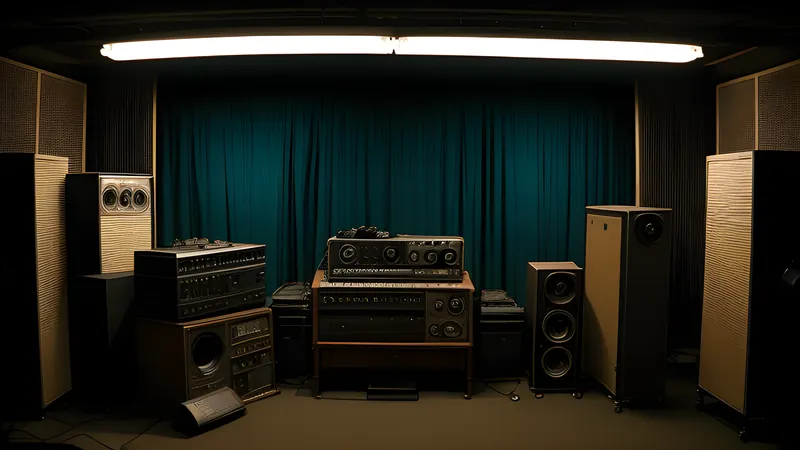
Gilderoy’s days are spent conjuring atrocity out of groceries. Watermelons are hacked and dropped to stand in for splitting skulls. Radishes are torn apart at the microphone. Vocal artists scream into the booth, take after take, while Gilderoy rides the levels and flinches. Strickland shoots the mechanics of Foley and dubbing with a documentarian’s fascination — the glowing valve amplifiers, the spinning tape, the reel counters, the little handwritten cue sheets — and lets the mundanity curdle. The horror of The Equestrian Vortex leaks out of the studio equipment and into Gilderoy, who has no armour against it.
The film also captures, precisely and painfully, the indignity of being the polite foreigner in someone else’s chaotic operation. Gilderoy cannot get his expenses reimbursed. The stony receptionist stonewalls him in Italian. The producer is a bully, the director a fraud, and the whole enterprise runs on humiliation. Strickland grounds the surreal in bureaucratic misery, which is exactly what makes the unravelling believable.
The real ancestor of this film
Every knowing viewer will clock the surface references — this is a love letter to Italian horror of the period, and the imaginary film inside it is stitched together from the tropes of Argento, Bava and their imitators. If you want the genuine article the pastiche is honouring, the perfect study text is Deep Red, where Argento’s murders are constructed as much from Goblin’s score and the shock of sound as from the black-gloved image. The Equestrian Vortex, with its witches and its stabbings, is a composite of exactly that school; even the Fulci-style village-of-suspicion cruelty of something like Don’t Torture a Duckling is somewhere in its bloodline.
But the deeper ancestor of Berberian Sound Studio is not a giallo at all. It is Peeping Tom, Michael Powell’s 1960 film about a man whose relationship to violence is mediated entirely through his equipment — a camera in Powell’s case, a mixing desk in Strickland’s. Both films are about the apparatus of cinema turning on the person operating it; both implicate the technician in the atrocity he is helping to produce; both are, finally, about looking and listening as forms of complicity. Strickland has simply moved the guilt from the lens to the loudspeaker. Where Powell’s Mark Lewis films death, Gilderoy amplifies it, and the film asks whether there is any moral distance between the two.
Why it works — the sound is the monster
The craft achievement here is that Strickland makes you afraid of a sound and then makes you afraid of the way it was made. The sound design, by Nick Fenton and the team, is the film’s true special effect. You hear the screams of The Equestrian Vortex over and over, in isolation, stripped of the pictures that would give them context, and repetition does something strange — it turns the scream into a pure object, obscene and unmoored. By the time Gilderoy is drowning in it, so are you.
The film’s masterstroke is the withholding of the image. Because we never see The Equestrian Vortex, our minds build it, and the version we imagine is worse than anything Strickland could have staged. This is the oldest trick in the horror book, the same principle that makes the suggested ghost of The Innocents more frightening than any rubber-suited apparition, but Strickland applies it at a formal extreme: he removes the picture from a horror film entirely and dares it to still terrify. It does, because he has weaponised your own imagination against you.
Strickland also refuses the reassurance of a soundtrack that tells you how to feel. The band Broadcast supplied a score that hums and flickers at the edge of the mix, so that music, effect and machine noise all blur into one anxious continuum; you often cannot tell whether a drone belongs to the film Gilderoy is scoring or to the film you are watching. The uncertainty is deliberate, and it keeps you leaning forward, straining to place a sound, which is precisely the state of listening the whole picture wants to induce. Every reel change, every hum of the valve amps, becomes another note in the same unresolved chord.
There is comedy in it too, and the comedy is load-bearing. The absurdity of grown professionals stabbing cabbages with total seriousness is genuinely funny, and the film needs that laughter, because it makes the later slide into dread feel like a betrayal of a place we had started to find cosy. Strickland lulls you with process and then dissolves the ground.
Verdict
Berberian Sound Studio is one of the most original horror films of the 2010s, and one of the very few that could be described as a film about film that actually generates dread rather than merely commenting on it. It is a demanding watch — deliberately claustrophobic, more interested in texture than plot, and structured to frustrate anyone waiting for a conventional payoff. For viewers who care about how horror is actually built, and who understand that the giallo was always a symphony as much as a spectacle, it is close to essential. Toby Jones has never been better used.
Where to watch: it appears on arthouse-leaning streaming services and is worth owning on disc precisely for the sound, which is the entire point and which streaming compression can flatten. Pair it with a real giallo first, so you know the noises the film is echoing, then let Strickland take them apart.
Spoilers below
The film’s structure is a slow dissolve of the boundary between Gilderoy and the film he is working on, and Strickland refuses to resolve it into a clean reality. As Gilderoy’s isolation and revulsion deepen — the endless screaming takes, the abuse of the vocal actresses, the producer’s cruelty, a letter from his mother back in England describing the swallows nesting in the porch — the film begins to fold in on itself.
The pivot is a sequence in which the film literally seems to catch fire and burn through, and after it the rules change. Gilderoy starts to lose his English; a scene plays with him speaking Italian, dubbed and out of sync, as though he has become a character inside a giallo rather than a man making one. The gentle nature documentary he pines for and the horror film he is trapped in bleed together. Strickland never confirms whether Gilderoy has broken down, been absorbed into the fiction, or simply been corrupted by proximity to what he has spent weeks amplifying. The ambiguity is the point.
The genuinely unnerving move is that the horror we finally get is not a monster or a murder — it is the moral collapse of the mild man himself. Gilderoy, who arrived unable to stomach the violence, ends the film complicit in the studio’s casual abuse of the women in the booth, having internalised the very cruelty he recoiled from. The atrocity of The Equestrian Vortex was never on the missing screen. It was in the room the whole time, in the way these people treated one another to make the noise, and Gilderoy has become one of them. Strickland’s closing suggestion — that listening to horror for a living might be its own quiet damnation — is the film’s real, unshowable monster, and it is the last thing you hear.
Related Content