Begotten: The Experimental Horror From the Abyss
E. Elias Merhige rephotographed a creation myth until it looked exhumed
Contents
There is a specific fear that comes from watching an image you cannot fully resolve. Your eye keeps trying to lock onto a shape, a face, a horizon, and the picture keeps refusing to let it. E. Elias Merhige’s Begotten runs for roughly seventy-two minutes on exactly that refusal. It has no dialogue, no title cards, no colour, and no recognisable place. What it has instead is a texture so degraded and so worked-over that the film seems less like something a camera captured and more like something a spade turned up.
Merhige shot it around 1989 and premiered it to almost nobody. Then the champions arrived one at a time. Susan Sontag reportedly pressed for it to be seen. Marilyn Manson took a look and hired Merhige for music videos and a tour. By the time Merhige surfaced in the mainstream directing Shadow of the Vampire in 2000, Begotten had already done its slow work through late-night festival slots and traded VHS dubs, gathering the reputation it still carries: the film that looks like it was buried before it was screened.
The image that will not resolve
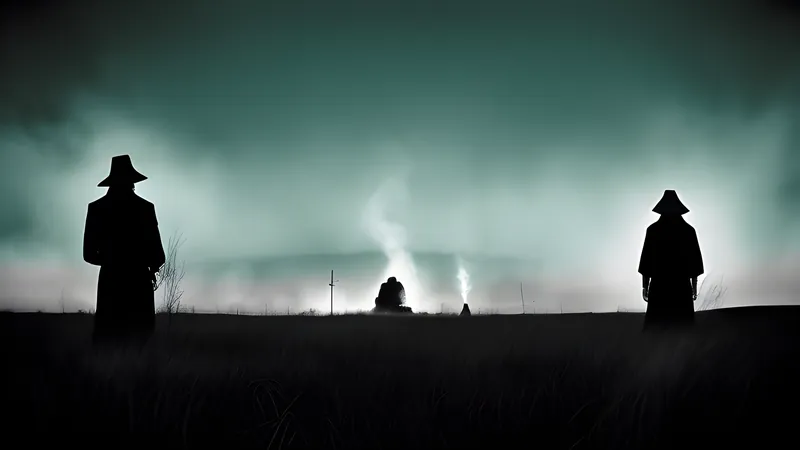
Start with what your senses actually do in front of it. The whole film exists in a scorched high-contrast register where whites bloom and blacks swallow. Faces smear. A figure walking across open ground reads as a stutter of grain rather than a body in motion. Sound does the same job from the other direction. There is no score in the ordinary sense, only an unbroken bed of crickets, wind, wet noises, and a low organic churn assembled by Evan Albam that never resolves into music or into speech.
The effect is a kind of sensory starvation that your brain fills in on its own terms, which is why the film feels far more graphic than anything it literally shows. You are doing the visualising. Merhige built a machine that hands the horror over to the viewer and steps back.
This is worth naming as craft rather than accident, because Begotten is frequently filed under “unwatchable” as though its difficulty were a failure of skill. The opposite is true. The film is fanatically controlled. Every frame has been treated to sit at the same abraded pitch, and the pacing is glacial in a way that only works if the director has calculated exactly how long an audience will hold its attention before the next slow event. Merhige holds you at the edge of legibility on purpose, and he keeps you there.
What Merhige actually did to the celluloid
The legend around Begotten is a technical one, and for once the legend is accurate. Merhige did not simply shoot on grainy stock and push the contrast. He rephotographed the film. He projected or lit his original footage and shot it again through a rig he devised, adding layers of manipulation frame by frame to strip out the midtones and bury the image in its own texture. The commonly cited figure is that a single minute of finished film could demand something on the order of eight to ten hours of this reprocessing. Across seventy-odd minutes, that is a labour measured in months.
That process is the film. Once you know it, the aesthetic stops reading as a filter and starts reading as an act of erosion performed by hand. The picture looks weathered because it genuinely was put through a punishing physical treatment, and the human effort embedded in each frame is part of why it feels alive in a way that a digital grain-plugin imitation never manages. The later films that borrowed the look — and there are many, from music videos to the whole “cursed footage” corner of horror — copied the surface and skipped the toil that made the surface mean something.
There is a second technical point worth flagging, because it explains why the film feels physically wrong in a way that is hard to place. Merhige stutters and slows the motion so that bodies never move at a natural human rhythm. Figures lurch, freeze, and jerk forward, partly a product of the reprocessing and partly a deliberate manipulation of the footage. The result reads to the nervous system as something between decayed silent film running at the wrong speed and a body caught mid-seizure. You spend the running time watching creatures that move like nothing you have seen alive, and the film never once lets the motion settle into anything reassuring. That un-human cadence carries as much of the horror as the scorched contrast, and it is the detail most imitators forget entirely.
If you want the useful comparison, it is to the silent avant-garde and the earliest horror experiments rather than to anything from Merhige’s own decade. Begotten sits closer to Benjamin Christensen’s Häxan than to any 1980s splatter picture, because both films treat the frame as a place to conjure rather than to record. Watch them together and the century between them collapses. I made that case at length in Häxan, the 1922 documentary-horror hybrid, and Begotten is its truest modern descendant.
The creation myth with the skin peeled off
There is a story here, though “story” oversells how it arrives. Begotten is a creation myth rendered as pure event. The opening movement, sometimes titled “God Killing Himself,” shows a robed, convulsing figure destroying its own body. From that death a second figure emerges, moves over the corpse, and becomes pregnant. She gives birth to a third figure, a trembling near-formless thing, and the film follows what a group of robed nomads do to that offspring across a barren landscape.
Told plainly like that, it sounds almost classical, and it is. Merhige is working the oldest material there is — a god dies, the earth conceives, a child suffers — and the degraded image is what keeps the material from curdling into a pageant. You are watching a birth-and-death cycle at the exact point before it hardens into a religion with rules. The ideas are legible; the pictures are not; and that gap is the whole experience.
This is where Begotten earns its keep as more than an endurance test. The film argues, wordlessly, that violence and creation come from the same place, and it makes the argument by refusing to let you look away cleanly. Compare the way David Lynch’s Eraserhead turns industrial dread and a monstrous birth into a private nightmare with its own grammar. Lynch gives you a world with plumbing and radiators; Merhige strips even that away and leaves only the myth and the mud. They are cousins in the same lineage of black-and-white anti-narrative horror, and they reward the same patient, submissive kind of watching.
Where it belongs in the collection
Begotten is a genuine outlier, and the honest thing to say is that it will lose some viewers inside ten minutes. That is not a knock. The film was built for the specific person who wants cinema to behave like a rite, and it is close to perfect for that person. If you have ever sat through the slow zones of Jodorowsky’s El Topo and wanted the film to go further into abstraction and further from plot, this is where that road ends.
Its proper company is the midnight circuit, the place where difficult films find the audience that meets them halfway. I mapped that tradition in the midnight-movie canon, and Begotten is arguably its most extreme entry — a film that offers none of the crowd-pleasing hooks that usually earn a picture its cult and gathered one anyway, purely on the force of its images.
Where to see it: seek out the best restoration you can find, because this is a film where source quality is the entire event. A muddy stream of a film that is already about degradation buries the deliberate degradation under accidental degradation, and the whole point drowns. On a good transfer, in a dark room, with the sound up, it is one of the few horror films that actually feels dangerous to watch.
Spoilers below
The film’s final movement is its cruellest and its clearest. The nomads who take the newborn Son of Earth do not simply kill it. They drag it, beat it, and eventually dismember and bury it, and from the ground it is worked into, new growth appears in the closing images. Merhige closes the loop he opened: the self-slaughter of the god at the start finds its answer in the burial of the child at the end, and the earth takes both back and begins again.
What makes the ending land is that Merhige withholds any consolation while delivering a genuinely redemptive idea. There is no music swell, no clarifying title, no relief in the image, which stays as scorched at the finish as it was at the start. The renewal is real and it is horrible, because the film has spent an hour teaching you that in this cosmos creation is simply the far side of a killing. You leave understanding the myth in your body rather than your head, which is the only way a film this abstract could hope to be understood at all.
That is the achievement, and it is why Begotten has outlasted almost every shock film of its era. It found a form for an idea that words flatten, and it paid for that form in months of hand-labour over the celluloid. Watch it once and you will not need to watch it again to remember it. It stays.
Related Content