Audition: Miike's Hour of Romance Before the Wire
Takashi Miike spends sixty minutes building a love story so he can take it apart
Contents
The most quoted thing about Audition is the sound, and if you have seen it you already heard it in your head reading that sentence — a bright, chirping, almost cheerful syllable repeated as a woman goes to work with a length of wire. Takashi Miike’s 1999 film has been filed for a quarter of a century under “extreme cinema”, shorthand for the final twenty minutes, and the filing does the film a quiet violence. Because the horror of Audition is not the wire. The horror is the hour of tenderness Miike builds before it, so carefully and so sincerely that the audience falls for the same trap the protagonist does.
This is a film with astonishing patience and even more astonishing nerve. It asks a horror audience to sit through what looks, for its entire first half, like a gentle drama about a lonely middle-aged widower learning to love again. It means the drama. It is not a parody or a slow throat-clearing before the real film. The romance is the film, and the reason the ending lands like a blow to the sternum is that Miike genuinely made you want these two people to be happy.
The con at the heart of it
The premise is a moral rot dressed as a meet-cute. Aoyama, a widower played with beautiful weariness by Ryo Ishibashi, is encouraged by a film-producer friend to hold a fake audition — casting sessions for a movie that does not exist — as a way of meeting eligible young women and selecting a new wife. It is a grim, faintly monstrous idea, and the film knows it. Aoyama is a decent man doing a deceitful thing, treating courtship as a casting call, and Audition never lets him off the hook for it even as it invites us to sympathise with his loneliness.
He chooses Asami, played by Eihi Shiina, a poised former ballet dancer with a stillness that reads at first as grace and later as something with no bottom. Their courtship unfolds with real delicacy. Miike shoots it soft and warm, patient dinners and careful phone calls, and Shiina plays Asami as demure to the point of blankness — a screen onto which Aoyama, and we, project a fantasy. The whole first hour is a study in a man falling in love with a woman he has invented, assembled from her silences.
The craft point is the deception’s symmetry. Aoyama runs a fake audition to find a fantasy woman. The film runs a fake genre on us to find a fantasy audience — one lulled into a romance so that the turn will hurt. Miike is doing to the viewer exactly what Aoyama does to the applicants: presenting one thing while concealing the real casting call underneath. When the film turns, it is not only Asami revealing herself. It is the movie revealing what it has been all along.
How the dread leaks in
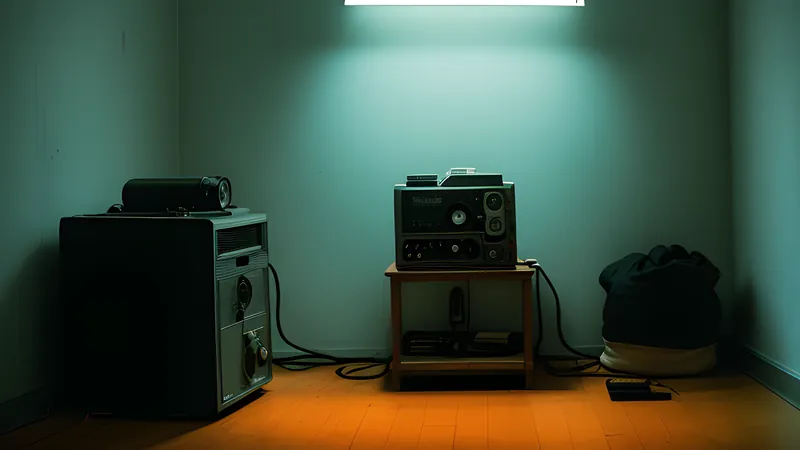
Miike is too disciplined to keep the first hour purely sweet, and the way he seeds the wrongness is a clinic in slow-burn construction. The unease arrives in details you almost dismiss. There is a long, static shot of Asami alone in her bare apartment, sitting on the floor beside a telephone and a large canvas sack, waiting for Aoyama to call — and when the phone rings, the sack lurches. It is over in a moment. The film does not underline it. But it has poured a drop of poison into the romance, and from that point the tenderness curdles even as it continues, because you are now watching two films at once: the love story on the surface and the thing moving underneath it.
This is the mechanism that makes Audition work where imitators fail. Miike does not switch genres at the hour mark; he runs the horror as a slow leak from the very beginning and simply raises the pressure until the dam gives. The infamous final act, when it comes, does not feel like a betrayal of the romance because the romance has been quietly rotting from within for forty minutes. And Miike destabilises the ground further by fracturing the timeline — dreams, memories and possible fantasies fold into the present without markers, so that by the climax you can no longer be certain what is happening and what Aoyama is dreading might happen. The confusion is the point. A man who built a fantasy is punished by losing his grip on reality itself.
What it is really made of
Audition is usually shelved with J-horror, and it shares that movement’s moment and some of its DNA. Released almost alongside Ringu, it represents the other pole of late-nineties Japanese horror — where Hideo Nakata built patient dread from a wronged ghost, Miike builds it from a wronged woman who is entirely, terribly alive. Both films centre a female figure shaped by male cruelty; one returns from a well, the other walks in through the front door.
But the real ancestor of Audition is not a horror film at all. It is domestic melodrama — the quiet, formal Japanese family drama of marriages and mismatches and the ache of the lonely home. Miike shoots the courtship in that register deliberately, invoking the tradition of gentle domestic cinema precisely so he can defile it. The film is a melodrama that has been infiltrated, its warm surfaces used as camouflage. There is a Western cousin in Roman Polanski’s studies of a psyche coming apart in a confined space, and a clearer sibling on this desk in Possession, Andrzej Żuławski’s operatic scream of a film in which a relationship’s collapse becomes literal apocalypse — both films understand that intimacy is the most dangerous setting for horror, because it is where we are least defended.
And for the strain of extreme cinema that uses the body as an argument rather than a spectacle, Audition is a crucial forerunner of Martyrs and the New French Extremity that followed a decade later — films with a thesis under the viscera, where suffering is made to mean something. Miike’s atrocity is not gratuitous. It is a woman’s history of abuse returning as method.
The verdict
Audition is a masterpiece of misdirection and one of the most genuinely upsetting films the genre has produced, and its greatness is inseparable from its patience. A lesser director would have front-loaded the horror or winked at the audience to reassure them. Miike does neither. He commits fully to the romance, makes it tender and sincere and a little sad, and lets us settle into it — which is precisely why the turn feels like a personal betrayal rather than a plot development. The film punishes the fantasy of the perfect, silent, mouldable woman by giving Aoyama, and us, exactly what that fantasy conceals.
It is not a film to recommend lightly, and the final act has cost more than one viewer their dinner. But taken whole, it is a serious and even moral piece of work, a horror film about the violence men do when they treat women as roles to be cast. Watch the first hour with full attention. Fall for it a little. That surrender is the film’s real subject, and its revenge.
Spoilers below
Everything below gives away the ending, so stop if you have not seen it.
Asami is not the demure fantasy Aoyama cast. Her history, glimpsed in fractured flashback, is one of severe abuse — a childhood of cruelty that has left her incapable of the ordinary love Aoyama imagines and desperate for a devotion so total it must be extracted by force. When she discovers evidence of his dead wife and the possibility that his affection is divided, she acts. She drugs him, and in the film’s notorious climax she tortures him while he lies paralysed, working at his body with acupuncture needles pushed into precise nerve points and a length of piano wire drawn across his ankle, chirping her soft, singsong syllable of pleasure with each cut. It is filmed with a clinical calm that is far worse than frenzy.
What elevates the sequence above shock is its psychology and its refusal of clean chronology. Miike stages part of the horror inside Aoyama’s drugged, collapsing mind, so that a possible dream of the torture precedes the real thing, and the viewer, like Aoyama, cannot tell rehearsal from event. Asami’s monologue reframes the whole film: the “audition” was always a two-way deception, and she is punishing the entire apparatus of men auditioning women for a fantasy, a system that has brutalised her since childhood. Her demand — total devotion, a love with no rival — is the fantasy of the perfect wife turned back on the man who wanted it, made literal and lethal.
The film’s final ambiguity is a last twist of the knife. Aoyama’s son returns home and helps subdue Asami, who falls down the stairs and dies; but Miike has so thoroughly dissolved the boundary between event, memory and dream that we cannot be sure how much of the horror “really” happened and how much is a guilty man’s nightmare. That uncertainty is the ending’s cruellest gift. Whether or not the wire ever touched him, Aoyama has been shown the cost of the deceit at the film’s heart, and the fantasy of finding love by casting call lies bleeding on his floor. The chirping stays with you longest of all, because Miike made it the sound of tenderness before he made it the sound of the wire.
Related Content