Arrival: The Sci-Fi Film That Rewires Its Own Grammar
Villeneuve, Ted Chiang and a first contact story built out of language itself
Contents
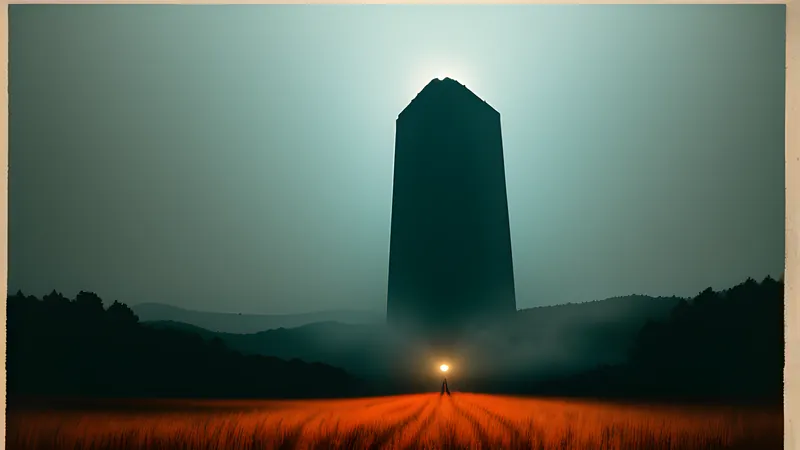
Most first-contact films are about the gap between us and them being crossed by force — a weapon, a virus, a signal, a war. Denis Villeneuve’s Arrival (2016) proposes that the gap is crossed by grammar. Twelve enormous curved shells arrive and hang silently over twelve locations around the world, and the crisis the film dramatises is linguistic rather than military: how do you talk to a mind so unlike yours that even the shape of a sentence is foreign? It is the rare science-fiction blockbuster whose central action is a woman learning to read, and it is one of the smartest films the genre produced in its decade.
Adapted by screenwriter Eric Heisserer from Ted Chiang’s novella Story of Your Life, and anchored by an Amy Adams performance that should have won every award going, Arrival runs a lean 116 minutes and hides its entire design in plain sight from the first frame. It is a film that rewards the second viewing so completely that describing why, above the spoiler line, is nearly impossible. I will do what I can, and then, below the line, take the machine apart.
The setup
Louise Banks (Amy Adams) is a linguistics professor, quietly grieving, who is recruited by the US military — Forest Whitaker’s Colonel Weber — after the shells appear, because she is the best translator the country has. She is paired with theoretical physicist Ian Donnelly (Jeremy Renner), and the two are helicoptered to the Montana site, where every eighteen hours a door opens in the underside of the shell and the human team ascends into a chamber to face the visitors through a transparent barrier.
The aliens, nicknamed heptapods for their seven radial limbs, communicate by expelling inky circular symbols — logograms — that hang in the air like smoke rings of language, each one a complete thought with no beginning and no end. Louise’s task is to learn to read them before the world’s nerve fails, because the twelve nations hosting the shells are sharing less and trusting each other less by the day, and at least one government is starting to read the visitors’ intentions as a threat. That is the ticking clock: the danger comes from human panic and the collapse of cooperation, with the possibility of a war nobody needs.
Everything above is safe to read. What makes Arrival extraordinary is a structural decision I cannot describe without ruining it, so I will hold it.
Why the design works
The craft achievement here is that Villeneuve and Heisserer built the film’s form out of its idea, and the idea is the Sapir-Whorf hypothesis — the contested notion that the language you think in shapes the way you perceive reality. The heptapods’ written language is non-linear, circular, all-at-once, and the film argues that learning to think in it changes how a mind experiences time. Rather than explaining this in dialogue, the film enacts it in its editing. The way Arrival is cut is itself the thesis, and the audience is put through the same rewiring as Louise without being told it is happening.
Bradford Young’s cinematography is the mood-engine. Everything is low-lit, misted, desaturated, shot in soft greys and dim greens that make the shell interiors feel like the inside of a lung. The heptapods are kept half-obscured in fog behind the barrier, which is both a budget-wise choice and a thematic one: we see them the way we understand them, partially, through a haze. Jóhann Jóhannsson’s score, all groaning low strings and human voices used as texture, does more to sell the alienness than any effect. And the framing device — Max Richter’s “On the Nature of Daylight,” a pre-existing piece, bookending the film — plants an emotional signature at the start whose full meaning only detonates at the end.
The performances hold it together. Adams plays Louise as a woman carrying a grief the film keeps returning to in fragments, and the restraint is total; she does the film’s most complex work in silence and stillness, a face processing a truth the audience has not been given yet. Renner is the warm rationalist foil, Whitaker the pressured pragmatist. Nobody overplays. The film trusts its idea to be the spectacle.
The twist that is not a twist
Arrival has a reputation as a “twist movie,” and I want to push back on that framing even above the spoiler line, because it undersells what the film is doing. A twist is a trick played on the audience for the shock of the reversal. What Arrival does is structural rather than deceptive: it shows you everything from the first minute, arranged in an order you are trained by a lifetime of cinema to misread, and the revelation is the moment you understand you have been reading it wrong the whole time. The pleasure on rewatch is not “how did they fool me” but “it was all there, and it means something different now.”
That distinction matters because the film’s emotional and moral payload lives entirely in the structure. The reveal is not a gotcha about the plot. It is a question about whether you would make a certain choice knowing exactly how it ends, and that question is the reason the film lingers for years. Below the line, then, because there is no honest way to finish.
The real ancestor of this
Everyone reaches for Close Encounters of the Third Kind and Contact when placing Arrival, and the lineage of the awed, non-hostile first-contact film is real — Spielberg’s wonder and Zemeckis’s Carl Sagan adaptation are both in its blood. But the truer ancestor of Arrival’s actual method is Chris Marker’s La Jetée (1962), the great short film built almost entirely from still photographs, about a man haunted by an image from his own past who turns out to be haunted by his future. Marker filmed a story where memory and premonition are the same act, told in a form that breaks linear time, and Arrival is that same conjuring trick performed with a linguistics professor and a spaceship. If the ending of Arrival grips you, La Jetée is twenty-eight minutes that will show you the blueprint.
Within Villeneuve’s own work, Arrival is the hinge. It is the film where he proved that a patient, sad, formally ambitious science-fiction film could also be a hit, and it bought him the licence to make Blade Runner 2049 the very next year with the same contemplative confidence. Both films descend, in temperament, from the Tarkovsky of Solaris and Stalker — science fiction as an interior, grieving, almost religious form. Villeneuve is the director who dragged that sensibility into the multiplex and made it pay.
Spoilers below
The structure is the whole film, so here it is. The fragments of Louise’s daughter that recur throughout — a girl born, a girl playing, a girl dying young of an illness, Louise grieving in an empty house — read on first viewing as Louise’s past, a dead child she is mourning as she works. They are not her past. They are her future. As Louise learns the heptapod language, she begins to think in it, and thinking in it unlocks a perception of time as the heptapods experience it: a simultaneous whole, all of it present at once, rather than a line running from past to future. The “flashbacks” are flash-forwards. She is remembering things that have not happened yet.
Villeneuve builds the entire film so that the audience decodes this at the same moment Louise fully does, which is why the cutting is the argument. The film taught you to read its images in linear order, and the revelation retrains you, exactly the way the language retrains Louise. The heptapods came to Earth, it emerges, to give humanity this gift of language — this new way of perceiving time — because in three thousand years they will need humanity’s help, and a species that can see the whole of time is a species that can be a partner across millennia. The immediate crisis is defused by Louise using her glimpses of the future to prevent the present-day war: she reaches a Chinese general using information she will only be given at a party years from now, closing a causal loop.
And then the film asks its real question, the one that makes it more than clever. Louise now knows that if she has a child with Ian, that child will die young of an incurable disease, and that the marriage will end when Ian learns she knew all along and chose to have the daughter anyway. She sees the whole arc — the joy, the loss, the grief that opened the film — laid out in advance. And she chooses it. She walks into the life knowing precisely how much it will cost, because the love and the years are worth the grief that is built into them.
That is why “twist movie” is the wrong frame. The reveal is a moral proposition. Given foreknowledge of loss, would you still say yes to love? Chiang’s novella poses it more coolly; Heisserer and Villeneuve warm it into something almost unbearable, and Adams carries it in a final expression that holds joy and grief in the same face. The Max Richter piece that opened the film returns, and now you understand it was never scoring a memory — it was scoring a decision made with open eyes.
My verdict: Arrival is that rare thing, a genuinely intelligent blockbuster whose intelligence and its emotion are the same mechanism, a film about language that is written in the language of cinema at the level of the cut. It is Villeneuve’s finest hour to date, better even than his Blade Runner sequel, because its ambition and its feeling are perfectly matched and it wastes not a frame. Watch it, then watch it again to see the architecture, then chase Blade Runner 2049 and Marker’s La Jetée, and marvel that a studio paid for a film whose hero’s weapon is a verb tense.
Related Content