Antonio Margheriti: The Journeyman of Gothic and Space
Anthony M. Dawson made four space films in three months and one of the finest Italian gothics ever shot
Contents
In Inglourious Basterds, Eli Roth’s character has to pass himself off as an Italian and announces his name as “Antonio Margheriti”. Tarantino put it there because he knows exactly what a Margheriti credit means: a fake name on a real film, an Italian production wearing somebody else’s flag, and a director who could deliver anything the market wanted by Friday. The joke lands hardest for the few thousand people who understand that the real Antonio Margheriti spent most of his career billed as Anthony M. Dawson, which is a made-up Englishman.
Margheriti was born in Rome in 1930, had a technical education and an early obsession with model-making, and entered the industry through the effects department and the typewriter. He directed roughly fifty features between 1960 and 1996 across every genre Italy ever exported — space opera, gothic horror, eurospy, spaghetti western, war action, jungle adventure, cannibal picture, sword-and-sorcery — and he did it with a small permanent crew, a workshop full of miniatures, and a working method that ought to be taught.
Italy goes to space
His debut, Assignment: Outer Space (1960), was Italy’s first science fiction film, made for almost nothing and sold to America as a domestic product. Battle of the Worlds followed in 1961 and starred Claude Rains, a genuine Hollywood name in the last years of his career, giving a magnificently committed performance as a misanthropic professor in a film that could not afford him and got him anyway.
Then came the run that fixed his reputation among people who care about this sort of thing. In 1965 and 1966 Margheriti shot four science fiction features back to back for MGM’s Italian arm — Wild, Wild Planet, War of the Planets, War Between the Planets and The Snow Devils — sharing sets, costumes, models and most of a cast, in a total of roughly three months. They are known collectively as the Gamma One cycle. Wild, Wild Planet is the deranged one: kidnappers who miniaturise their victims and carry them off in handbags, four-armed henchmen, a villain assembling a composite human, and a colour scheme borrowed from a nightclub. The mind-boggling part is the production maths. Four films. Three months. One crew.
He achieved it partly through a technique he defended his whole life and which most directors regard as heresy: he shot with multiple cameras running simultaneously — often three — covering a scene from wide, medium and close at once. It means the lighting has to be a compromise, since a set lit beautifully for one angle cannot be lit beautifully for three. It also means a scene is finished when the actors have done it once. Margheriti took the deal.
The gothics
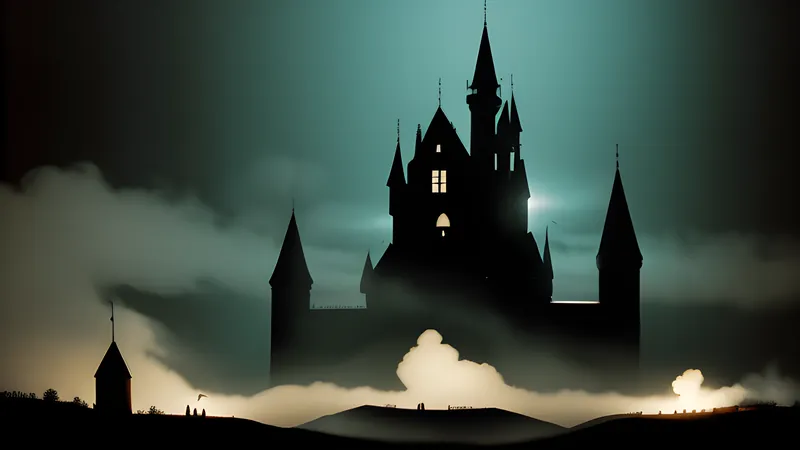
The astonishing thing about Margheriti is that in the middle of all this he made Castle of Blood (Danza macabra, 1964), which stands with anything in the Italian gothic.
A journalist bets Edgar Allan Poe that he can spend the night of the Day of the Dead in Blackwood Castle. He can. The dead in the castle re-enact their own murders every year and require the blood of the living to do it, and Barbara Steele, at the height of her powers, plays a ghost who falls in love with the man she is going to kill. Margheriti shoots it in a fluid, mobile black-and-white that keeps discovering rooms, and the film’s melancholy is genuine — the ghosts are exhausted by their loop, and Steele plays love and predation as the same gesture. He remade it himself in colour in 1971 as Web of the Spider, with Klaus Kinski playing Poe, and the remake proves the original’s quality by falling short of it in every department.
The production facts make it more impressive rather than less. It was written by Sergio Corbucci — two years away from Django — with Giovanni Grimaldi, from a premise attributed to Poe that Poe never wrote, and shot in roughly two weeks in a Roman villa with a fog machine and a very small number of rooms. Margheriti’s answer to the shortage of space was to keep the camera moving through it, so the castle acquires an architecture it does not possess; you finish the film convinced you have seen a building, when what you have seen is four sets and a corridor filmed from every angle a dolly can reach. That is a poverty solution, and it produces the film’s central effect, which is the sensation of drifting.
The Virgin of Nuremberg (1963) and The Long Hair of Death (1964) belong to the same stretch and to the same Steele-and-cobwebs economy that Riccardo Freda had opened and Bava’s gothic of two faces had made bankable. Margheriti was the third man in that room, and the one who has been most thoroughly forgotten, largely because he kept moving.
The name game
The pseudonyms deserve unpacking, because they were an industrial policy rather than a personal quirk. Italian genre cinema of the sixties and seventies survived on export, and the export markets — America especially — had been trained to believe that horror was British, science fiction was American and westerns were both. An Italian name on the poster cost money at the box office. So the whole industry adopted an English-language phone book: Margheriti became Anthony M. Dawson, Bava became John M. Old, Freda became Robert Hampton, Lenzi became Humphrey Humbert, Fulci occasionally became Louis Fuller. Composers, cinematographers and entire casts did the same. The credits of a 1966 Italian space film read like the manifest of a ship that never sailed.
The consequence is a permanent archival mess. Films exist in three cuts under four titles with two directors credited, and the version a viewer encounters depends on which territory’s negative survived. It also robbed the men who did the work of the thing that builds a reputation over time, which is a name that accumulates. Bava and Freda were eventually reassembled by critics who cared enough to do the detective work. Margheriti made too many films in too many genres under too many spellings, and the reassembly has never really happened.
The miniatures
Here is the craft argument, and it is the reason Margheriti deserves a career piece rather than a footnote.
He built his own models, and he built them to engineering standards. A Margheriti miniature is a rigged, wired, internally lit construction hung from a gantry, with squibs and smoke charges routed through it and shot at high frame rates, so that when it flies apart the debris falls at a speed the eye reads as massive. He understood that the entire illusion of scale is a matter of time — small things fall fast, big things fall slowly, and a camera overcranked enough will make a two-foot spacecraft break up like a cathedral. He kept the workshop for forty years and the models followed him from genre to genre. The wires are frequently visible. The films work anyway, because the movement is right.
That skill is why he outlived the cycles. When Italian space died, the models became burning helicopters for the Vietnam pictures. When the war films died, they became the collapsing temples of the Indiana Jones knock-offs. Producers hired Margheriti because he arrived with a second unit already inside his head, and by the eighties he was doing miniature work for other people’s films as well as his own. The industry called him a journeyman. The word for what he actually was is engineer.
Everything else
The middle career is a survey of Italian genre economics. Eurospy in the sixties. And God Said to Cain (1970), a gothic western with Klaus Kinski as an avenger arriving inside a tornado, which is genuinely one of the strangest and best things in the spaghetti canon. Killer Fish (1979), a piranha heist picture with Lee Majors and Karen Black shot in Brazil. Cannibal Apocalypse (1980), in which Vietnam veterans bring an infection home to Atlanta and John Saxon bites a woman on a bus — a picture that sits awkwardly beside the Italian cannibal cycle’s nastier business precisely because it has no jungle and no animal cruelty in it, being a war-trauma film wearing a cannibal poster. The Last Hunter (1980) and the jungle adventures. And Yor, the Hunter from the Future (1983), a caveman-on-a-hang-glider epic assembled from a four-part Italian television serial, which is beloved for reasons its director never intended and is genuinely, gloriously insane.
He worked until the mid-nineties, mostly for television, and died in 2002. His son Edoardo, who grew up in the workshop, directs.
The honest case against
He never made a masterpiece and he never tried to. Margheriti took what was offered and delivered it at the price, and the cost is that outside Castle of Blood and the strangest half of Wild, Wild Planet there is very little in fifty films that anyone would defend on aesthetic grounds alone. The multi-camera method that made the arithmetic work also flattened his images: a scene lit for three angles at once is lit for none of them, and you can watch the difference in Castle of Blood, where he plainly slowed down and lit for the lens, against the Gamma One films, where everything is bright and even and dead.
His actors are frequently stranded, since one take is one take. His scripts were whatever arrived. And the pseudonym habit that Tarantino found funny had a real cost — a director who spends thirty years as Anthony M. Dawson has systematically dismantled his own filmography, and the critical apparatus that rebuilt Bava and Freda from the French magazines never quite bothered to reassemble Margheriti.
Where to start
Castle of Blood, in one of the restorations that includes the footage the export cuts removed — it is the film that would be famous under a different name. Then Wild, Wild Planet, which needs no defence and no sobriety. Then And God Said to Cain for Kinski in the wind. He belongs beside Bava in any honest account of what Italy built in that decade, and if his best work is thinner, his workshop kept the whole industry flying for twenty years on wire, balsa and an overcranked camera.
Related Content