Angel's Egg: Oshii's Wordless Apocalypse
A revisit of the 1985 Oshii and Amano collaboration that emptied a film of dialogue and nearly ended a career
Contents
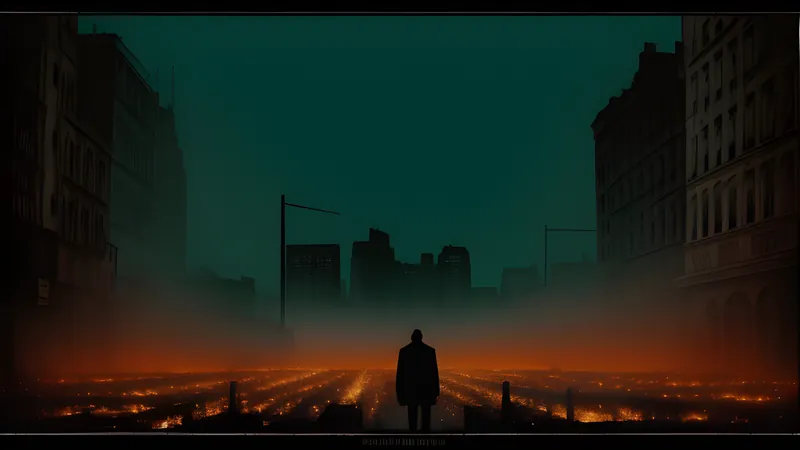
A girl walks through a flooded city carrying a large egg under her coat. A young man arrives with a cross-shaped object slung over his shoulder. They talk a little. That is very nearly the whole of Angel’s Egg, a film that runs about seventy minutes and spends most of them refusing to explain itself. Mamoru Oshii made it in 1985, at the exact moment his career was supposed to consolidate, and instead of consolidating anything he produced the most beautiful act of professional self-harm in Japanese animation.
The premise is the whole synopsis
There is no exposition, no voice-over orientation, no title card telling you the year or the catastrophe. The city is drowned and gothic, all cathedral ribs and dead machinery, and it appears to be uninhabited apart from the girl, the young man, and a population of shadows. The girl protects the egg with an unwavering, entirely unexplained devotion. The young man asks her what is inside it. She does not know. He does not know either. Neither does the film, and it never pretends to.
That refusal is the reason people either surrender to Angel’s Egg or bounce off it within ten minutes. The dialogue could be printed on a postcard. Almost every stretch of the film is a girl walking, or water falling, or light moving across stone, held for far longer than any commercial instinct would allow. The film is asking you to read images the way you would read a painting, at your own pace and with your own associations, and it declines to reward the part of your brain that wants a plot to grip.
Anyone approaching this expecting the Oshii of the mecha thrillers is in for a shock. This is Oshii before the police procedurals, before the philosophy-in-a-helicopter mode of his later work — a director handed an unusual amount of freedom and using every centimetre of it.
What Amano brought
The film’s look belongs substantially to Yoshitaka Amano, who did the character designs and much of the visual conception. Amano is an illustrator by temperament, and his line — spidery, elongated, closer to Art Nouveau and Symbolist painting than to any animation house style of 1985 — sits strangely and wonderfully inside a moving image. The girl has the proportions of a Mucha figure. The architecture has the density of a Piranesi engraving. Nothing in the frame looks like it was drawn to be animated efficiently, which is precisely the point.
The result is a film that constantly threatens to stop being animation and become a series of paintings, and the tension between those two states is where a lot of its dread lives. When a figure moves through one of Amano’s compositions, the movement feels like an intrusion on something that would rather be still. Oshii shoots the stillness as though it were the natural condition and motion the anomaly, which inverts the basic contract of the medium.
The palette does similar work. The film lives in blacks, sea-greens and a few sickly ambers, with the occasional shock of pale flesh or white feather. Light in the drowned city arrives from nowhere identifiable and behaves like a liquid. The effect is not naturalism and makes no attempt at it — the illumination is doing symbolic work, picking out what matters and drowning everything else, in a way live-action photography could achieve only with enormous effort.
The sequence that explains the method
If you want one passage that shows what the film is doing, take the fishermen. Shadowy figures move through the flooded streets with harpoons, hunting enormous fish. The fish are not there. What passes across the walls of the city are the shadows of fish — vast, serene, gliding over stone — and the men fling their harpoons at the walls, striking nothing, over and over, with total conviction.
It is the whole film in one setpiece. Oshii gives you men expending real violence on an absent object, and he neither underlines the metaphor nor lets it go. He holds on it. He lets you notice that the men are as convinced as the girl is about her egg, and that conviction in this world has nothing to do with the existence of its object. Yoshihiro Kanno’s score — choral, liturgical, deliberately drained of melody you could hum — refuses to tell you how to feel about it, which is a discipline most composers cannot manage.
The craft point worth making is about duration. The sequence works because Oshii gives it more screen time than it needs to communicate its idea. A tighter cut would have made the image a clever symbol and moved on. By holding, he turns a symbol into an experience: you have time to get bored, then uneasy, then to notice the rhythm of the harpoons, then to feel something you cannot name. Oshii is one of very few directors in the form who understood that boredom is a usable material.
The career it cost
Angel’s Egg arrived directly after Oshii had proved he could deliver. He had run the Urusei Yatsura television series and made Beautiful Dreamer in 1984, a comedy feature so structurally strange that it upset the property’s own rights-holders while announcing a serious director. The obvious next move was a bigger, more legible film. He made this instead.
The reception was, by the accounts that have circulated ever since, brutal — a film with no market, no genre and no answers, released into an industry that needed all three. Oshii went several years without directing another animated feature, and he has spoken in later interviews about the film emerging from a collapse in his own religious conviction, the residue of a Christianity he had studied and could no longer hold. Whether or not you take that at face value, the film behaves exactly like something made by a person who has lost a belief and kept the shape of it: the imagery is drenched in Noah, in arks and doves and waiting, and every one of those references is left standing without the belief that would once have held it up.
What makes the episode more than an anecdote is what came next. The Oshii who returned — the Oshii of the Patlabor films and Ghost in the Shell — kept the long held silences, the water, the birds, the willingness to stop a thriller dead for three minutes of a city breathing. He simply learned to smuggle them inside a plot. Every famous Oshii pause has its origin here, in the film that was nothing but pauses.
The strangest afterlife in animation
Now the collector’s footnote, and it is a genuinely absurd one. In 1988, an American production called In the Aftermath took footage from Angel’s Egg, cut it together with newly shot live-action post-apocalyptic material, and released the hybrid through Roger Corman’s New World Pictures. Oshii’s drowned cathedral city, made as an uncommercial hermetic art object, was quietly repurposed as the dream-sequence filler in a low-budget American genre picture. It is the funniest thing that ever happened to a film this solemn, and it says something true about how animation travelled westward in that decade: as raw material, valued by the metre.
The real ancestors are elsewhere. The obvious one is Fantastic Planet, René Laloux’s 1973 film, which also treats animation as a moving illustration and also declines to be a story in the ordinary sense. The other is Stalker — Tarkovsky’s ruined landscape, its faith held by people who cannot say what they believe in, its conviction that duration is meaning. Oshii has never been shy about the Tarkovsky debt, and Angel’s Egg is where it is nakedest.
The verdict, argued
The case against is real and should be stated plainly. Angel’s Egg is an inert film for long stretches. Its symbolism is available to any reader with a Bible and a free afternoon, and the film’s refusal to develop those symbols can read as evasion dressed up as depth. If you dislike it, you are not missing anything; you have simply declined an invitation that the film makes exactly once, in its first five minutes, and never repeats.
The case for is that almost nothing else in animation trusts an audience this much. Every commercial reflex — clarify, motivate, resolve — is switched off, and what remains is a director and an illustrator building a mood with total authority and no safety net. It is the purest thing Oshii ever made, and the fact that it broke his career for years is the proof that he meant it. Watch it late, alone, with the lights off and the phone in another room. It rewards attention and punishes nothing else.
Spoilers below
The ending is where the film’s private argument finally shows itself.
The young man, who has spent the film asking what is in the egg, waits until the girl sleeps and then breaks it open with his cross. It is empty. She wakes, finds the shattered shell, and runs; her flight ends in water, where she drowns, and as she sinks a stream of eggs rises to the surface around her — she is returned to the world as the thing she was carrying, multiplied and inert.
The cruelty of the gesture is the point, and Oshii declines to make the young man a villain for it. He does what any of us would do with an object of faith that will not declare itself: he opens it. The film’s position is that the opening and the emptiness were always going to be the same event, and that the girl’s devotion had value only for as long as she never checked. This is what a lost faith looks like from the inside, drawn by a man who had recently mislaid one.
The final image widens the frame and shows the world containing all this — the drowned city revealed as a structure on a vast scale, drifting, and the young man standing on it among rows of stone figures, the girl’s likeness now one of them. It is an ark that has been sailing for a very long time with nobody aboard who remembers why. Read that as a joke or as a wound; the film supports either, and one of Oshii’s defining traits is that he never tells you which he meant.
If this lands for you, the next step is Ghost in the Shell, where the same silences carry a thriller on their back, and after that Fantastic Planet for the other great animated film that would rather be a painting.
Related Content