Angel Heart: Noir That Curdles Into Damnation
Alan Parker's 1987 detective story is a horror film wearing a trench coat
Contents
Angel Heart is a detective film that slowly realises it is a horror film, and it lets the audience realise it a beat before the detective does. Alan Parker’s 1987 adaptation of William Hjortsberg’s novel Falling Angel runs the machinery of hardboiled noir — the missing-person case, the shabby office, the femme fatale, the trail of corpses — while a second, older machine hums underneath it. That second machine is the folk tale of the man who sells his soul and forgets the terms.
Harry Angel, played by Mickey Rourke at the height of his rumpled charisma, is a low-rent New York private eye in 1955. A lawyer summons him to a Harlem church-turned-office and introduces him to a client, Louis Cyphre, played by Robert De Niro with slicked hair, sculpted fingernails, and a stillness that curdles the air. Cyphre wants Angel to find a crooner named Johnny Favorite, who went missing after the war owing Cyphre a debt. The case takes Angel south, to New Orleans, and downward, into voodoo, murder, and a truth he has been running from without knowing it.
The genre trap it builds
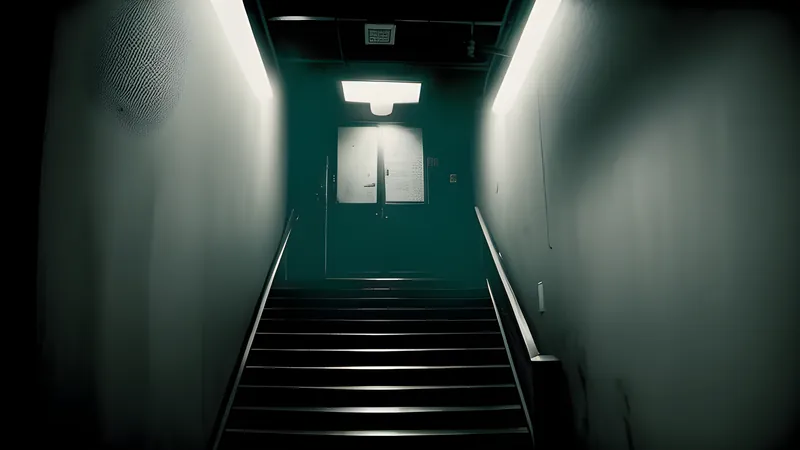
What makes Angel Heart more than a stylish curio is the precision of its double structure. Parker and cinematographer Michael Seresin shoot the first act as immaculate period noir — rain on windows, ceiling fans, shafts of hard light through blinds, the whole visual grammar of the form. Then they start corrupting it. Elevators descend a beat too long. A recurring motif of stairs going down. Blood where blood should not be. The imagery of Catholic and voodoo ritual begins to leak into the frame, so that by the New Orleans passages the detective story has been fully colonised by something liturgical.
This is the film’s central trick, and it is a genuinely sophisticated one. Noir is already a fatalistic genre; its heroes are usually doomed by their own appetites. Angel Heart takes that built-in fatalism and literalises it into damnation. The detective’s doom is not metaphorical bad luck. It is a contract. In doing so the film joins the small, potent tradition of horror built around a Faustian bargain and a slow-closing trap, the tradition Night of the Demon refined into a masterclass of restraint two decades earlier. Jacques Tourneur’s cursed man spends his film trying to pass a fatal token back to the sorcerer who condemned him; Parker’s cursed man spends his film investigating a curse that turns out to have his own name on it.
Rourke, De Niro, and the pleasure of dramatic irony
Rourke is perfectly cast because his Harry Angel is a genuinely good detective who is also, fatally, incurious about himself. He reads every room but his own history. The performance is all sweat and forward motion, a man solving a puzzle whose final piece is his own face, and Rourke plays the mounting dread with a physical exhaustion that feels like a body remembering what a mind refuses to.
De Niro, in a handful of scenes, does something rarer. His Louis Cyphre is patient to the point of leisure, and the joke of the name — say it aloud and it resolves into Lucifer — is the film’s entire thesis delivered as a wink the hero never catches. There is a celebrated scene involving eggs and a slow monologue about the soul that works precisely because De Niro underplays it into a lecture, a devil so certain of the outcome that he can afford to be bored. The horror is not in threat. It is in the certainty. De Niro reportedly modelled the look partly on the director Martin Scorsese, a private joke that only sharpens the sense of a man in total control of the room.
The film also gives us Lisa Bonet as Epiphany Proctor and Charlotte Rampling as Margaret Krusemark, and both are woven into the trap rather than decorating it. Bonet’s casting was scandalous at the time because of her wholesome television image, and the film’s most notorious sequence earned it an initial X rating in the United States before Parker trimmed it for an R. Seen now, the controversy looks like the least interesting thing about her role, which is structurally essential to the horror underneath the noir.
Why it works
The reason Angel Heart holds up when a lot of eighties occult horror has dated badly is that it trusts its form. Parker does not pause to explain the supernatural machinery. He lets the audience assemble it from imagery — the recurring fan blades, the descending motion, the blood, the ritual objects — so that the dread accumulates below the level of dialogue. This is the same faith in accumulated visual logic that drives a paranoid unravelling like Jacob’s Ladder, released three years later, where a veteran’s reality corrodes through images before any character names what is happening. Both films understand that horror lands hardest when the audience has done the assembling.
There is also the sheer texture. Parker was a maximalist, and the New Orleans of Angel Heart is thick with heat, decay, and religion — a place where the membrane between the living and the damned is already thin. The film’s supernatural logic feels earned by its geography. You believe a soul could be traded here because the whole world looks mortgaged.
Where the film shows its seams is in its occasional heaviness of hand. Parker cannot always resist a shock cut or a blast of score where silence would do more, and a couple of the ritual sequences tip toward the lurid. But these are the excesses of a director committed to atmosphere over restraint, and the commitment is what makes the film’s slow-motion damnation feel inevitable rather than clever.
Hjortsberg’s novel deserves a share of the credit for the architecture. Falling Angel is one of the cleverest genre hybrids of 1970s American fiction, and Parker’s real achievement is finding a visual language for a book whose whole effect depends on a first-person narrator who is lying to himself and, therefore, to the reader. Prose can hide a man from his own memory through what he chooses to describe. Film has to do it through what it chooses to show, and Parker’s decision to seed the imagery of the ending throughout the film – the descent, the ritual objects, the fan blades that anticipate a later horror – is the cinematic equivalent of Hjortsberg’s unreliable narration. On a rewatch the film is not withholding. It has told you everything, in pictures, from the start.
That is the mark of a horror film built to be seen twice. The first viewing is a mystery; the second is a tragedy you cannot stop, and every scene plays differently once you know what Harry Angel is. Few noir-horror hybrids survive that second pass. This one deepens under it.
Where to watch and what to pair it with
Angel Heart is widely available on disc and through streaming rentals, and it rewards a good transfer, because Seresin’s shadow-work is half the film. Pair it with Night of the Demon for the deal-with-the-devil tradition done with restraint, Jacob’s Ladder for a companion in eighties dread and a hero who cannot trust his own perceptions, and Rosemary’s Baby for another film where the occult conspiracy is polite, patient, and already won.
Spoilers below
The revelation Angel Heart has been building toward is that Harry Angel is Johnny Favorite. The crooner, having sold his soul to Louis Cyphre for stardom, tried to cheat the contract with a black-magic ritual that transplanted another man’s identity onto himself, burying his own memory so deep that he became a genuinely different person — a detective hired, by the devil, to hunt himself. Every corpse Angel has found along the trail is someone he killed to protect the secret he no longer knows he keeps. The investigation is the debt collection. Cyphre did not need to find Johnny Favorite. He needed Johnny Favorite to find himself, so that a soul could be delivered with full knowledge of what it was.
The horror of the design is that free will is preserved and useless. Angel does every deductive thing correctly. His competence is the instrument of his damnation. The film’s final act layers on a further devastation — the identity of Epiphany Proctor and the nature of what Angel has done with her — that pushes the story from tragedy into genuine abjection, and Parker holds the camera on Rourke’s face as the last piece drops and the good detective understands, all at once, the whole shape of his forty-year sentence.
The closing image is that descending elevator, carrying Angel down past the floors of an ordinary building toward a destination the film has been diagramming from its first frame. There is no escape written into the story, because escape was never on offer. That is what separates Angel Heart from the noir it imitates: a noir hero is destroyed by the world, and this one was owned before the film began. The detective story was only ever the devil’s way of collecting on time.
Related Content