Alphaville: Godard's Noir at the End of the Future
A secret agent, a talking computer, and a dystopia built entirely out of 1965 Paris with no effects at all
Contents
Jean-Luc Godard made a science-fiction film in 1965 without building a single set, hiring a single effect, or admitting for a moment that the future needs to look futuristic. Alphaville is set in a distant technocratic city on another world, ruled by a sentient computer, and Godard filmed all of it in Paris — the real Paris, at night, using the coldest, most modern architecture the city had to offer. Glass towers, fluorescent corridors, motorway underpasses, the brutalist hotels going up around the edges of the capital: shoot them in high-contrast black and white, keep the camera moving, and 1965 becomes the year 3000 without a franc spent on illusion. The trick is so confident it comes round to profound. The dystopia is already here. Godard just had to point at it.
The full title is Alphaville, une etrange aventure de Lemmy Caution, and the joke starts in the name. Lemmy Caution was a pulp hero, an American private eye out of Peter Cheyney’s novels, played across a run of cheap French thrillers by the gravel-faced Eddie Constantine. Godard took that worn-out B-movie tough guy, kept the actor, kept the trench coat and the lighter and the revolver, and dropped him into a philosophical science-fiction nightmare. The result is one of cinema’s great genre collisions, a hard-boiled detective story wearing the skin of dystopian sci-fi, and it works because both traditions are secretly about the same thing: a lone man moving through a corrupt city that wants him to stop asking questions.
The city that outlawed feeling
Caution arrives in Alphaville posing as a journalist, “Ivan Johnson” of Figaro-Pravda, on a mission to find a missing agent and to locate — and stop — Professor von Braun, the scientist who built and now serves the city’s ruling machine. That name is not an accident. Von Braun was the German rocket engineer who built the V-2 for the Reich and then the Saturn rockets for the Americans, and Godard hands the name to the architect of a society that has perfected control. The film keeps its politics on the surface: this is a story about technocracy as the inheritor of fascism, about the dream of a perfectly rational, perfectly administered life turning out to be a death.
The machine is Alpha 60, and it is one of the eeriest presences in science fiction because Godard refuses to give it a body. Alpha 60 speaks in a rasping, mechanical drone — provided by a man who had lost his larynx and spoke through an oesophageal voice, so the computer’s every pronouncement sounds like a corpse learning to talk. It governs by logic and by subtraction. Emotion is a crime. Love, tears, poetry and conscience have been declared irrational and progressively deleted, and so has the vocabulary that names them: each day the city’s dictionary — its bible — is reprinted with more words removed. People who weep are executed. The population answers “I’m very well, thank you, you’re welcome” like a stuck recording, the grammar of a society that has swapped feeling for procedure.
Into this Godard drops Natacha von Braun (Anna Karina), the professor’s daughter, a woman raised inside the machine’s logic who has never been permitted the words for what she is beginning to feel. Karina, Godard’s wife and muse, gives the film its warmth and its stakes, and the plot resolves into a question Alpha 60 cannot compute: whether a human being conditioned out of love can be taught the language of it again.
Why it works with nothing
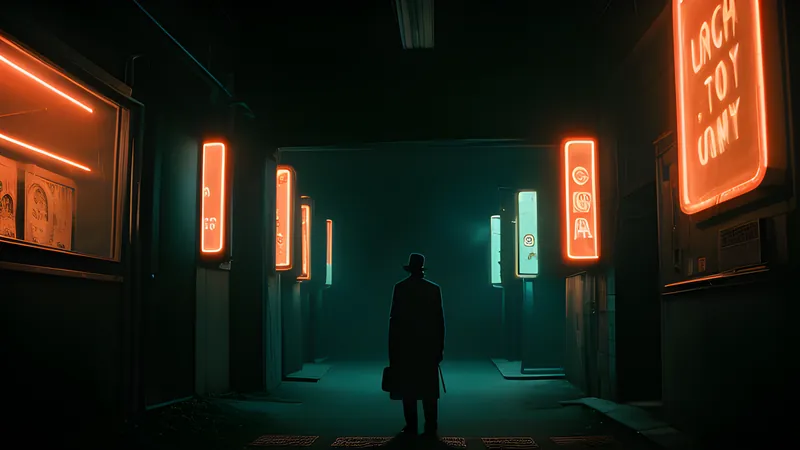
The lesson Alphaville teaches, and the reason low-budget filmmakers still study it, is that atmosphere beats apparatus. Raoul Coutard’s cinematography is the whole special-effects department. He shoots practical light sources — flashing signs, bare bulbs, the sweep of car headlights — as if they were the pulse of a living, hostile machine, and he lets the blacks go pure and deep so the city seems to be dissolving at its edges. Godard films Alpha 60’s utterances over a throbbing, blinking light, an image of pure menace assembled from a lamp and an idea. Where a conventional science-fiction film would spend its money making the future look strange, Godard spends his ingenuity making the present look strange, which is far more unsettling because you cannot dismiss it as fantasy.
The genre-splice is the other engine. By keeping the full furniture of film noir — the voiceover, the femme fatale, the interrogations, the gun in the coat, the world-weary detective who has seen too much — Godard smuggles emotion into a story about the abolition of emotion. Noir is a genre of doomed men and impossible feeling; setting it in a city that has banned feeling turns every hard-boiled convention into a resistance. When Caution behaves like a pulp detective in Alphaville, he is committing a political act, because the detective’s stubborn individualism is exactly what Alpha 60 exists to erase. The film is playful and severe at once, tossing off gags and pulp violence while conducting a genuine argument about what a life without poetry costs.
The company it keeps
The collector’s move is to place Alphaville in its family, and it sits at a crossroads. It is French New Wave science fiction, cousin to Chris Marker’s time-travel masterpiece told in stills, made three years earlier and just up the road — two Parisian films that built the future out of the present, one by freezing it into photographs, the other by shooting its concrete after dark. Watch them together and you see a whole national tradition treating science fiction as a branch of philosophy.
Its deeper legacy is the marriage of noir and sci-fi that would define the genre’s most serious later work. Every rain-soaked, neon-drowned future owes something to Godard’s insight that the detective story and the dystopia are the same story, and the clearest heir is Ridley Scott’s endlessly re-edited masterpiece, where the question of which cut is the real film is itself the subject. Alphaville is the black-and-white grandfather of that rain. And its central horror — a city engineered to breed obedience by controlling memory and language — runs directly into Alex Proyas’s older cousin the Matrix never credited, another metropolis where an inhuman intelligence rearranges human minds after dark. For the same anxiety in a sunlit, gene-sorted key, there is Gattaca and its quiet dystopia, where the machine doing the sorting is biology.
The verdict
Alphaville is a landmark, and it remains startlingly watchable in a way plenty of its imitators are not, because Godard never lets the ideas smother the pulp pleasure. It moves like a thriller even while it argues like a seminar. Sixty years on, the vision has curdled from prophecy into something closer to documentary: a society that measures worth by data, deletes the language it finds inconvenient, and asks its citizens to report that they are very well, thank you. Godard saw the shape of that world in the architecture going up around him and simply refused to pretend it was fiction.
Watch it for the audacity of the method — a whole dystopia conjured from a city and a camera — and for Karina, who supplies the human pulse the machine keeps trying to switch off. Then chase it with La Jetee for the New Wave’s other face and Blade Runner to watch the neon inherit the black and white.
Spoilers below
Godard’s endings work as arguments rather than surprises, but the climax turns on a specific move, so stop here if you want the film cold.
Caution defeats Alpha 60 the only way a machine of pure logic can be defeated: with something it cannot process. Interrogated by the computer, he answers its questions with riddles and with poetry — the language of feeling the city has spent years deleting — and the machine, confronted with meaning it has no category for, begins to fail. As Alpha 60’s logic collapses, so does Alphaville. The citizens, whose entire functioning depended on the machine’s governance, lose their bearings and die in the corridors, clawing at walls, a whole population that had outsourced its inner life to a computer and kept nothing in reserve. It is a genuinely disturbing image of dependence, and it plays now less like fantasy than like a warning about what happens when a society forgets how to hold its own meaning.
Caution takes Natacha and drives out of the dying city along the night motorway — the interstellar journey rendered, once again, as headlights on a French road. The last beat belongs to her. Freed from the machine and struggling to reassemble a vocabulary she was never allowed, she turns to him and manages the sentence the city had erased: she tells him she loves him. Godard withholds any triumphal swell. The victory is one small woman relearning three words on a dark road, which is exactly the scale at which he believes freedom actually operates. Whether you accept that a person conditioned out of feeling can be conducted back into it is the argument the film leaves in your hands.
Related Content