Alone in the Dark (1982): The Escaped-Patient Siege
New Line's early horror, four great character actors, and a joke about psychiatry
Contents
Four years before Freddy Krueger paid for the building, New Line Cinema made a horror film with Jack Palance, Donald Pleasence and Martin Landau in it. This is worth sitting with for a moment. In 1982 New Line was a distributor with ambitions and very little money, and the film it chose to produce assembled a cast that a studio picture would have been pleased with, gave it to a first-time director, and set the whole thing in a blackout.
Alone in the Dark is the result, and the reason it endures has almost nothing to do with the slasher shelf it got filed on. It is a siege film with a very good joke buried in it, and the joke is about the psychiatric profession.
The premise, which is better than it sounds
The Haven is a private psychiatric hospital run by Dr. Leo Bain, who does not believe his patients are ill. He believes they are travellers on a journey the rest of us are too frightened to take. The third floor holds four men who are, by any measure Bain refuses to apply, extremely dangerous.
A new doctor, Dan Potter, arrives to replace a departing colleague. The four on the third floor decide the previous doctor has been murdered and that Potter did it. Then a regional power cut takes out the grid — and The Haven’s security is electronic. The locks open. The four walk out, and go to Potter’s house.
That is a clean machine. It gives the film a motive that is entirely coherent from inside the killers’ logic, which is a rarer thing in this genre than it should be. These men are not an unstoppable shape. They are four people acting rationally on a false premise, and the film treats their reasoning as reasoning.
The anti-psychiatry joke
Bain is the film’s argument. Pleasence plays him as a beatific hippie with a beard and a joint and an unshakeable conviction that madness is a form of insight — which is a direct, unmistakable send-up of the anti-psychiatry movement that had dominated the intellectual conversation about mental illness through the sixties and seventies. R.D. Laing’s position, roughly, was that psychosis could be a journey toward healing rather than a disease to be suppressed. Bain has read the pamphlet and believes every word.
The film’s structure is a demolition of that belief. Bain’s patients escape and immediately do exactly what the theory says they will not do. Every scene of Bain being serene while the town is being hunted is the film making the same point again, and it makes it with a straight face.
The casting is the whole gag. Pleasence had spent 1978 and 1981 playing Sam Loomis, the psychiatrist who tells everyone within earshot that his patient is pure evil and must never be released — the most hardline anti-therapeutic figure the genre had. Four years into that identity, he plays the exact inverse: the doctor who believes his monsters are misunderstood. Anyone who had seen Halloween is watching Loomis argue against himself. It is a genuinely witty piece of casting and Pleasence plays it without a wink, which is why it works.
Palance and Landau are not messing about
Jack Palance plays Frank Hawkes, and he underplays. That is the surprise. Palance’s screen identity by 1982 was granite and menace, and here he gives Hawkes a quiet, watchful strategic intelligence — the man is the group’s planner, and Palance plays him as someone doing arithmetic. Hawkes is the most frightening thing in the film because he is the most lucid.
Martin Landau plays Byron Sutcliff, a former preacher, and goes the other way — jittery, wired, all surface. Landau was in a career trough at this point, a decade before the Tim Burton film that resurrected him, and he attacks the part with the energy of a man who has decided that a horror film is still a film. There is a scene of him mid-episode that is genuinely uncomfortable in a way the material had not earned.
Erland van Lidth is the third, a huge man playing a child killer, and the film uses his size without turning him into a joke. Dwight Schultz — a year before The A-Team made him famous — plays Potter as a decent, unremarkable man, which is exactly right for a siege film. The house needs an ordinary person inside it.
What Sholder does with a dark house
Jack Sholder had come up as an editor, and Alone in the Dark is his first feature. He would go on to make A Nightmare on Elm Street 2 and then The Hidden, which is one of the best American genre films of the eighties and deserves its own argument.
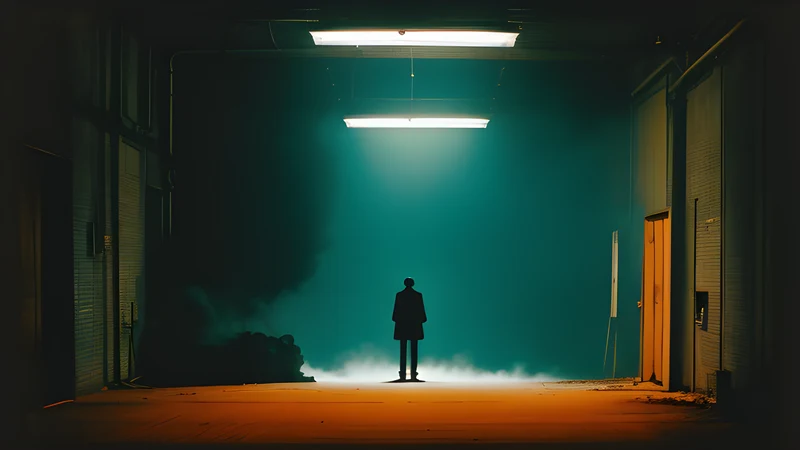
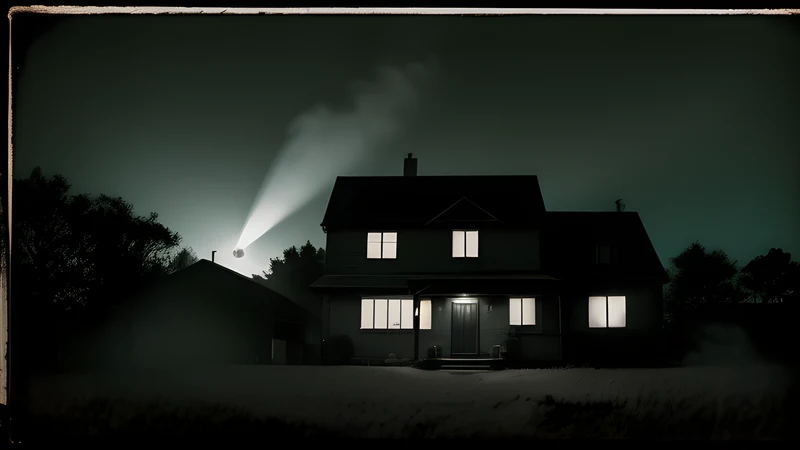
The craft here is about withholding. The blackout is not decorative; it is the film’s lighting design and its plot at once. Once the power is gone, Sholder shoots the house almost entirely in torch beams and candlelight and the blue of a night exterior through a window — and the crucial thing is that he keeps the frame legible while showing you almost nothing. You can always tell where you are. You can rarely tell who else is there.
The best sustained sequence is the invasion of the house itself, and its intelligence is in the sound. The four outside are not screaming or roaring. They are moving deliberately, occasionally talking to each other, and the film lets the audience hear them think. That reverses the usual charge of a home-invasion scene, where the threat is animal. These men are having a conversation about how to get in, and it is much worse.
Sholder also uses the blackout to make a wider point that the film never says aloud. The whole town is in the dark. There is looting in the streets, and the film cuts to it. The four from the third floor are walking through a city where everyone else has also stopped behaving well the moment the lights went out, which quietly undercuts the line between the hospital and everywhere else.
The real ancestor is a Romero film and a Peckinpah film
The obvious filing is slasher, because of the year. The real lineage is the siege. Night of the Living Dead established the American grammar of it: a house, a group inside, a group outside, and a long night in which the people indoors destroy each other faster than the threat does. Alone in the Dark runs that structure with the dead replaced by four men with knives and a coherent grudge.
The second ancestor is Straw Dogs — the ordinary professional man, the house, the mob outside, the discovery of what he will do to hold the door. Potter is Dustin Hoffman’s mathematician with a psychiatric qualification.
And John Carpenter’s Assault on Precinct 13 is the film Sholder is closest to in temperament: a stripped-down siege where the besiegers are silent and organised and the tension comes from competence on both sides. Carpenter’s own work with the form — see Escape from New York and The Fog — shares the same instinct for making a small space feel like a whole world under pressure.
There is also a small, delicious piece of history here. New Line produced this in 1982; in 1984 it made A Nightmare on Elm Street and became a studio. Alone in the Dark is a snapshot of the company two years before the lightning struck, already working out how to buy real actors with unreal money.
The honest case against it
The tone wanders. The Sic F*cs turn up as a punk band and the film swerves into a completely different register for the duration, and the anti-psychiatry satire never quite reconciles with the siege. Sholder is holding two films together and the seam shows.
The first act is slow, and the film spends a long time on hospital business that Pleasence could have established in one scene. And Potter’s family are underwritten — his wife and sister exist largely to be endangered, which is exactly the shortcut the rest of the film is smart enough to avoid.
Where to find it
Scream Factory’s disc is the way in, and the transfer matters more than usual: this film is dark by design and a bad copy erases half of it. Watch it late, with the lights off, and let the sound do the work.
The verdict: Alone in the Dark is a siege film wearing a slasher’s coat, and it is smarter than nearly everything it shared a shelf with in 1982. It has three great character actors taking it seriously, a first-time director with a real feel for withheld information, and a satirical thesis about mental health care that the genre has still barely touched since. It got buried. It should not have.
Spoilers below
The reveal that Hawkes has been the intelligence behind the whole thing from the start — that he engineered the escape and steered the others toward Potter while presenting himself as the reasonable one — is the film’s payload, and it lands because Palance has been playing it from the first frame. Watch him again knowing it and the performance is a different one.
The best joke in the film is saved for the end. Hawkes, the planner, walks away. He simply integrates. He goes out into a world that has spent the night looting and burning and he passes through it without anyone noticing, because the world outside The Haven has been indistinguishable from the third floor since the power died. Bain’s theory turns out to be right for exactly the wrong reason: the patients are not different from us.
The blackout as satire also pays off structurally. The Haven’s security depended on electricity, which is to say it depended on a civilisation Bain kept insisting was the sick one. When the current stops, both propositions fail at once, and the film’s final image is of the institution and the town in the same darkness.
The material with Potter’s daughter is the sequence people remember, and Sholder shoots it with a restraint that the era did not require of him. The threat is present, understood and never dwelt on, and the film gets out of it clean. That instinct — knowing when the audience’s imagination is doing better work than the camera could — is the whole reason this one lasted.
Related Content