All the Colors of the Dark: Martino's Satanic Giallo
Edwige Fenech adrift in a fish-eyed London, a coven in a country house, and the giallo's most successful raid on Rosemary's Baby
Contents
Rosemary’s Baby made a great deal of money in 1968, and the Italian film industry responded the way the Italian film industry always responded, which was to make eleven of them within four years. Most are forgettable. Sergio Martino’s Tutti i colori del buio, released in 1972 and dumped into American cinemas under the title They’re Coming to Get You!, is the one that survived, and it survived because Martino and his writers understood something the other imitators missed. Polanski’s film works because the audience knows Rosemary is right and watches her fail to convince anyone. Martino’s film works by taking that certainty away from everybody, including the audience, and declining to give it back.
Edwige Fenech plays Jane Harrison, an Italian woman living in London with a partner who sells pharmaceuticals and believes that most of what ails her can be addressed with vitamins. Jane is recovering from a car accident that cost her an unborn child. She is having nightmares. She is seeing a man with pale blue eyes and a knife, in the street, in her flat, in her sleep. And the film spends ninety minutes making the case for four mutually exclusive explanations of what is happening to her, all of them plausible, none of them safe.
The problem with the vitamins
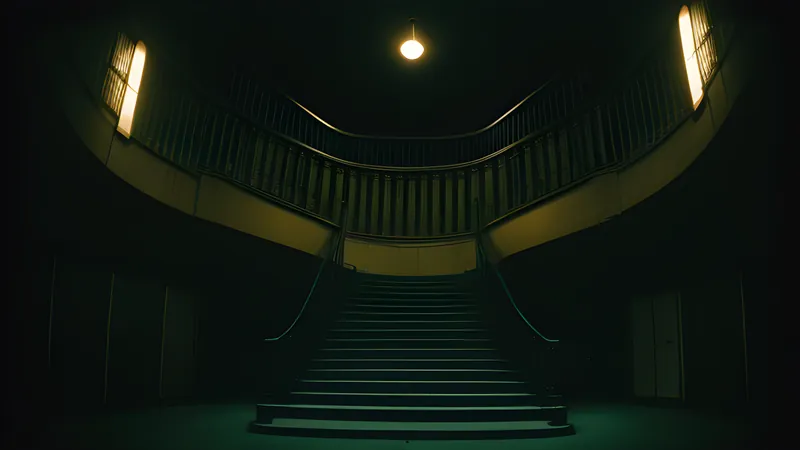
The opening sequence is a statement of intent — a nightmare of a pregnant woman, a mirror, an old crone and a blade, staged in a shallow void with a wide-angle lens and no attempt at spatial logic. Martino puts it first, before any story exists, so that when the film settles into a naturalistic London of terraced streets and net curtains you have already been told the rules do not hold.
Jane’s situation is then arranged with genuine cruelty. Her partner Richard, played by George Hilton with an unnerving reasonableness, insists she is physically fine and needs supplements. Her sister Barbara insists she is psychologically unwell and needs a psychiatrist. Her neighbour Mary insists she is spiritually afflicted and needs a black mass. Each of these people is offering help. Each is offering a completely different diagnosis. And each diagnosis, if accepted, requires Jane to hand her judgement to someone else.
That is the film’s real engine, and it is sharper than its reputation suggests. All the Colors of the Dark is about a woman being offered three competing authorities — pharmaceutical, psychiatric and occult — and discovering that all three want the same thing from her, which is submission. The coven she eventually joins is the most honest of the three, because it says out loud that it wants her surrender. The vitamins and the analyst want it quietly.
Ferrando’s lens, Nicolai’s strings
Giancarlo Ferrando shot this, and the same year he shot Torso for Martino — which makes the contrast instructive, because Torso’s achievement is restriction and this film’s is distortion. Ferrando works the nightmare sequences on wide-angle and fish-eye glass, so faces bow outward and rooms curve away at the edges, and he keeps just enough of that grammar in the “real” scenes to poison them. A corridor in Jane’s building is filmed at a focal length that makes it a fraction too long. The film never announces the transition into unreality; it simply changes lenses and lets you notice or fail to.
The black mass sequence is the set piece, and Martino stages it with a straight face that most directors could not have managed — a country house, a robed congregation, a chalice of dog’s blood, and Julián Ugarte presiding with a performance of glassy, courteous menace. What makes it land is the editing. Martino cuts it fast, in fragments, with the camera inside the ritual rather than observing it, and the effect is closer to a panic attack than a ceremony. You do not get a coherent view of the room. Neither does Jane.
Bruno Nicolai’s score is the film’s third weapon and the most underrated element in it. Nicolai — Ennio Morricone’s longtime conductor and collaborator, working here in his own idiom — writes a main theme of real beauty, a woozy, circling thing with a female wordless vocal, and deploys it against the horror rather than with it. The prettiness is the threat. When Jane is most endangered, the music is most seductive, which is precisely the film’s argument about the coven: the surrender is being offered as a kindness.
And then there is Ivan Rassimov, whose blue-eyed knifeman is the single most durable image Martino ever created. Rassimov barely speaks. He simply arrives — in daylight, in crowds, in a park — and the film never explains how, because explanation would ruin him. He is the giallo’s black-gloved killer stripped of the glove and the mystery and reduced to a face that should not be there.
The ancestor is older than Polanski
The obvious reference is Rosemary’s Baby, and the debt is real and unhidden: the urban apartment, the too-helpful neighbours, the pregnancy lost, the conspiracy of the respectable. Martino is working from Polanski’s blueprint and knows the audience knows.
The more interesting ancestor is thirty years older. Val Lewton produced The Seventh Victim in 1943 — a film about a young woman searching for her sister in New York and finding a genteel Satanic cult of well-dressed people who conduct their evil over polite conversation and never raise their voices. It is the first film to understand that the terror of a coven is its ordinariness, and that a devil worshipper who owns a nice house and a good coat is more frightening than a monster. Lewton’s whole method, which I’ve written about in the poetry of the low budget, was to suggest rather than display, and All the Colors of the Dark is what happens when that idea is handed to an Italian director with a fish-eye lens and permission to show everything. Martino’s coven is Lewton’s coven with the restraint removed and the colour turned up. The bones are identical: the mundane setting, the recruitment disguised as care, the sister.
There is a third strand, and it is the giallo’s own. Martino had already made The Strange Vice of Mrs Wardh with Fenech and Hilton the previous year — the same trio, the same premise of a woman whose grip on reality is being worked at by the people closest to her. All the Colors of the Dark is that film with the supernatural bolted on and the plausible deniability doubled.
The case against
The plot does not survive scrutiny, and pretending it does is the standard failure of writing about this film. Ernesto Gastaldi and his co-writers construct a machine of considerable elegance and then, in the last twenty minutes, are obliged to explain it, and the explanation is where the whole thing sags. Motivations arrive in a rush. Coincidences are asked to carry structural weight. A character’s behaviour across the entire film becomes retrospectively absurd the moment you know why they were doing it.
The London material is also a fudge. The film is shot in London by an Italian crew with a largely Italian cast dubbed into English, and the city never quite exists — it is a set of exteriors standing in for a country nobody involved seems to have visited emotionally. That works in the film’s favour more than it should, since Jane is meant to be adrift in a place that will not hold her, and an unconvincing London is a decent metaphor for one. It remains an accident.
And Fenech is asked to do very little beyond be frightened beautifully, which is the deal the industry offered her repeatedly and which she was capable of transcending when a director bothered. Martino, to his credit, gives her more here than most did. The film’s interest in her interiority is genuine, even if its interest in her body is more reliably funded.
What holds it together is nerve. Martino keeps four explanations alive for eighty minutes with no visible strain, and for those eighty minutes it is the most unstable and most beautiful film the giallo produced.
Spoilers below
The rational solution arrives, and the coven is revealed as an instrument. The occult apparatus that has been terrorising Jane turns out to have been assembled — hired, staged, directed — as the cover for a mundane crime with a mundane motive: her inheritance. The ritual, the robes, the blue-eyed man, the neighbour’s kindness, all of it is theatre paid for by people from Jane’s own intimate circle, who have spent the film in the chairs closest to her, offering diagnoses.
That reveal completes the inversion of Polanski, and it is worth being precise about how. Rosemary is correct and nobody believes her; the horror is epistemological isolation, and I’ve made that case in full elsewhere. Jane is incorrect — the supernatural was a production — and the people around her have been believing her enthusiastically the entire time, feeding her conviction, encouraging her to trust her worst instincts. Polanski’s horror is being disbelieved by everyone. Martino’s horror is being agreed with by everyone, because the agreement is the trap. In a decade of Rosemary’s Baby knock-offs, that is a genuinely original thought.
The trouble is that Gastaldi’s machinery cannot bear the weight. The unmasking is delivered at pace, with a confession doing most of the labour, and it retroactively converts several of the film’s most disturbing sequences into logistics — someone had to arrange the crowd, hire the celebrant, brief the knifeman. A film that has been operating on dream grammar for eighty minutes suddenly has a budget and a call sheet, and the deflation is real.
Martino seems to have known. The film’s closing movement declines to fully seal the rational explanation, leaving a residue that the plot has no room for — a final beat that reopens the question of whether the theatre was ever entirely theatre, and whether something was summoned by people who were only pretending to summon. It is a hedge. It is also the correct hedge, because the film’s power was never in the solution. Rassimov’s blue-eyed man remains unexplained in every way that matters. You can be told he was hired. You have still seen him standing in a London park in broad daylight, looking at a woman who has done nothing wrong, and no amount of inheritance law makes that go away.
Where to watch: Shameless and Severin have both restored the uncut version under the original title; the old They’re Coming to Get You! prints are cut and mistitled and misrepresent the film completely. Follow it with The Seventh Victim to meet the polite coven that started it, or with Torso for Martino and Ferrando solving the opposite problem the following year.
Related Content