Alice, Sweet Alice: The Communion-Veil Slasher
Alfred Sole's 1976 Catholic nightmare smuggled a giallo killer into a New Jersey parish two years before Halloween
Contents
There is a moment about twenty minutes into Alice, Sweet Alice when a twelve-year-old girl in a white communion dress is throttled in a church anteroom by a figure in a yellow rain slicker and a translucent plastic mask, and the body is stuffed into a bench and set alight while the Mass carries on a wall away. The girl is played by Brooke Shields. It was her first film. Alfred Sole killed her off before the first act was done, and American horror has been quietly borrowing from what he did next ever since.
The film came out in 1976 under the title Communion, went nowhere, and was reissued as Alice, Sweet Alice once Shields became famous — a distributor’s cynicism that accidentally preserved one of the strangest American horror films of the decade. Later prints call it Holy Terror, which tells you how confidently its owners understood what they had.
A parish, a communion, a raincoat
Paterson, New Jersey, 1961. Catherine Spages (Linda Miller) is raising two daughters alone after the collapse of her marriage to Dominick (Niles McMaster). Karen (Shields) is the pretty, favoured younger one, about to take her First Communion. Alice (Paula Sheppard) is twelve, watchful, resentful, and given to putting on a mask and frightening people for reasons the film is in no hurry to explain. When Karen is murdered in the church, the family’s grief collapses immediately into suspicion, and the suspicion has one obvious address. Alice was seen. Alice had the mask. Alice had, everyone agrees, always been strange.
What follows is a murder mystery conducted entirely inside the pressure system of a working-class Catholic parish: the priest, the housekeeper, the aunt, the psychiatrist, the detectives, the grotesque landlord downstairs with his cats and his sweat, all circling a child nobody likes. Sole grew up in Paterson and shot in it, and the film has a specific, unglamorous density — vinyl kitchen chairs, wallpaper, the parish hall, the particular light of a north Jersey autumn — that no soundstage supplies.
The mask is the idea
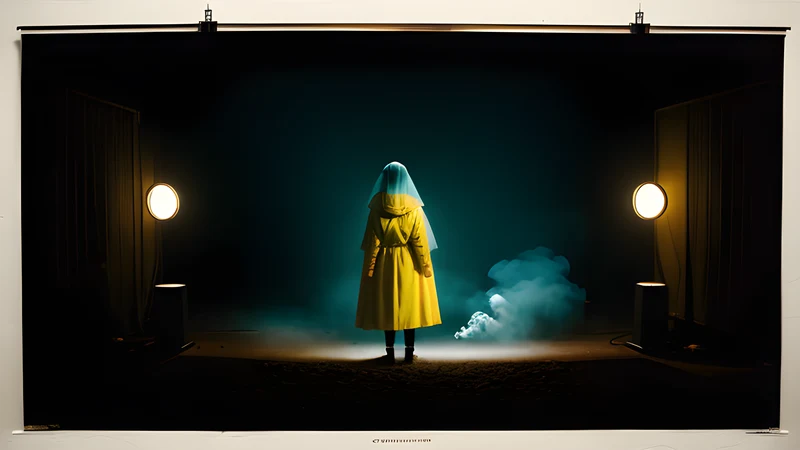
The killer’s costume is the film’s masterstroke, and it works by inversion. The Italian tradition Sole was drawing from had spent a decade dressing its murderers in black: black coat, black hat, black leather gloves, a figure that resolves into shadow. Sole put his killer in a yellow raincoat, which is the loudest thing in any frame it enters. You can see it coming from a hundred yards. It does not help.
Over the face goes a translucent mask — a soft, waxy, half-smiling child’s face, moulded and slightly too pink, with the wearer’s real eyes visible somewhere behind it. This is the detail that gets under the skin and stays there. A rigid mask makes a blank; you read nothing off it, which is the whole engine of Halloween two years later. Sole’s mask is worse because it is semi-transparent. You can almost see the person. The face reads as a face, wrongly, in the way a shop mannequin does at night, and the eye keeps trying to resolve it and keeps failing. Horror has spent fifty years learning that the uncanny sits precisely in that gap, and Sole found it on a budget of about four hundred thousand dollars with a mask that cost nothing.
The staging around it is equally shrewd. Sole and his cinematographers, John Friberg and Chuck Hall, keep putting the camera at a child’s height and letting adults loom into it, so the film’s default sightline belongs to somebody small, angry and disbelieved. Stephen Lawrence’s score leans on nursery-box chimes and strings that saw rather than swell. There is no reassurance anywhere in the sound design.
The real ancestor is Venice
The film everyone reaches for when describing Alice, Sweet Alice is Don’t Look Now, and for once the comparison earns itself. Nicolas Roeg’s 1973 film had established, three years earlier, the single most useful image in modern horror: a small figure in a bright coloured raincoat, glimpsed at a distance, that the grieving parent reads as their dead child. Sole takes that figure and gives it a knife and a full film. The debt is structural — both are about a family that has lost a daughter and keeps seeing her silhouette — and Sole never pretends otherwise.
The other bloodline is Italian. The masked killer, the elaborate set-piece murders, the amateur investigator, the fetishised weapon, the whodunit skeleton with a psychosexual reveal at the bottom: this is the grammar Mario Bava wrote in Blood and Black Lace and Dario Argento refined through the early seventies. What Sole did was translate it. The giallo runs on glamour — models, architects, Roman apartments with good furniture. Sole moved the whole apparatus into a parish where everyone is poor, devout and unhappy, and discovered that Catholic guilt does the same narrative work as Freudian trauma while costing less to stage. The result sits in the archaeology of the American slasher as a genuine missing link, arriving between the Italian template and the Carpenter model. I traced that inheritance more broadly in the twelve films that invented the slasher; this is the entry most people have to be told about.
Two careers that didn’t happen
Paula Sheppard was nineteen when she played twelve-year-old Alice, and the mismatch is the performance. She is too big, too still, too knowing, and it reads exactly as a child who has grown into her own hostility a few years early. She hulks in doorways. She holds eye contact past the point of comfort. Casting an adult made the child uncanny, and the film’s central question — is this girl a murderer or merely unloved — stays live because Sheppard refuses to soften either possibility.
She made one more film. Paula Sheppard’s entire screen career consists of Alice, Sweet Alice and Liquid Sky, Slava Tsukerman’s 1982 New Wave alien picture, in which she plays Adrian and delivers a rap about a mean and tough sister. Two films, six years apart, both of them permanent cult objects, and then nothing.
Sole’s trajectory is nearly as odd. Before this he had directed a hardcore feature called Deep Sleep, been prosecuted for it in his home town, and — by his own account — been excommunicated for his trouble. Alice, Sweet Alice is what a man makes immediately after the Church throws him out: a film in which the Mass is a murder scene and the most devout person on screen is the most dangerous. He directed a couple more pictures, then moved sideways into production design and spent decades building the look of American television, including Veronica Mars and Castle. The most Catholic horror film of the 1970s was made by an excommunicant who then went and had a perfectly nice career doing something else.
Why it works
Alice, Sweet Alice works because its mystery and its subject are the same organism. The plot asks who is killing people. The film asks what happens to a child that a family has collectively agreed to find repellent — and the answer, delivered through two hours of adults shouting accusations at a twelve-year-old, is that the community’s certainty is itself the horror. Every character is so sure. The aunt is sure, the father is sure, the police are sure, and their sureness is what lets the actual violence keep moving unobserved. That is a real idea, argued in staging rather than dialogue, and it is why the film survives while most of its 1976 shelf-mates have not.
The thing to watch for on a revisit is how little Sole cheats. The clues are placed early and fairly, the geography of the church is established before it is exploited, and the mask is deployed sparingly enough that each appearance still lands. Where to watch: the film fell into a public-domain swamp for years and circulates in genuinely wretched transfers, so seek the restored Arrow edition, which recovers the grain and the sick yellow of the slicker that cheap prints turn to mud. If it takes, follow the two threads out: Don’t Look Now for the raincoat and the grief, and the giallo canon for the tradition Sole was quietly naturalising in New Jersey.
Spoilers below
Alice is not the murderer of her sister, and the film’s real cruelty is how long it lets you join the mob that thinks she is.
The killer is Mrs Tredoni (Mildred Clinton), the parish housekeeper — the drab, devoted woman who feeds the priest and keeps the sacristy and has been standing at the edge of every scene, unremarked, because she is an unglamorous middle-aged servant and the film correctly assumes nobody is looking at her. Her motive is a dead daughter of her own and a lifetime of religious mania metabolised into ownership of Father Tom. Karen, on the day of her First Communion, was a rival for something Tredoni believed was hers. So the pretty child dies and the ugly-tempered one takes the blame, which is precisely how the parish’s own instincts were always going to allocate guilt.
Alice is guilty of real things, and this is what keeps the film honest. She has the mask. She terrorises her aunt on the stairs and puts her in a cast. She is a genuinely frightening child. Sole’s argument is that being a frightening child and being a murderer are separate facts, and that a family which cannot hold both in mind at once will destroy the daughter it has left.
The finale returns to the altar rail, mid-communion, and lets Tredoni’s mania out in public where the congregation has to watch it — the sacrament and the knife in the same frame, the film’s thesis stated as bluntly as it can be. What lingers afterwards is the last beat with Alice and the concealed blade: whatever she was before, the parish has now spent a whole film explaining to her what she is, and children believe what they are told.
Related Content