Absentia: Mike Flanagan's Tunnel of Disappearances
A Kickstarted debut that turned a pedestrian underpass into the mouth of something old
Contents
Mike Flanagan is now a brand. He has the Netflix deal, the repertory company, the Poe and King properties, the reputation as the man who made the horror show your mum finished. All of that arrived after 2011, and all of it can be traced back to a film he made for about seventy thousand dollars, most of it raised on Kickstarter, shot in and around a concrete underpass in Glendale.
Absentia is a bad calling card and a very good film. It’s grubby where his later work is handsome, underlit where his later work is gorgeously lit, and it has almost none of the emotional articulacy — the long, well-written monologue about loss — that became his signature. What it has instead is a proper idea, executed with the specific brutality of a director who cannot afford to hedge.
Seven years and a form
Tricia (Courtney Bell) is about to have her husband declared dead in absentia. Daniel has been missing seven years. She’s pregnant by another man, she’s packing up the house, and she is being visited — perhaps — by Daniel, who appears in doorways looking like a photograph left in the sun. Her sister Callie (Katie Parker) arrives to help, fresh out of addiction and running the neighbourhood at dawn.
Callie runs through a pedestrian tunnel. There’s a man in it, gaunt and starving, who asks her for help. She brings him food. And then the film’s engine turns over, because people have been going missing near that tunnel for a very long time, and the police file — held by Detective Mallory (Dave Levine), who’s in love with Tricia in a way the film handles with real tact — is thicker than a suburban underpass should justify.
The legal concept does an enormous amount of work here, and it’s the sort of detail that separates a film with an idea from a film with a monster. Declared dead in absentia is a phrase from probate law about the administrative resolution of an absence. The film hears it as a horror premise: an institution agreeing to pretend a man is dead because the alternative is admitting nobody knows.
The mechanics: what Flanagan does with an unlit concrete box
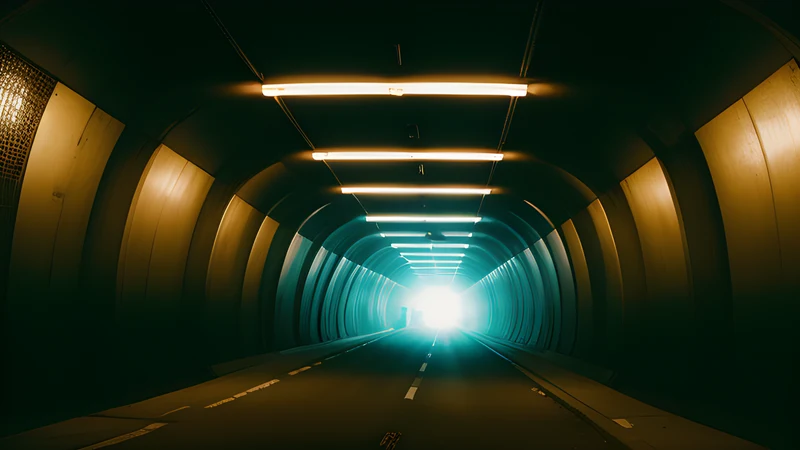
The tunnel is the film’s whole visual argument, and Flanagan shoots it four or five ways in a running time that barely clears ninety minutes.
At dawn it’s mundane — a wet, tagged, litter-strewn pedestrian underpass of a kind that exists within a mile of anyone reading this. He shoots it flat, in available light, from the mouth, so you see straight through to daylight on the other side. That’s crucial. The tunnel is short. You can see the exit. There is nowhere in it for anything to hide.
Which is exactly why what happens in it works. Flanagan’s discipline is to keep the geometry legible and honest, so that when the space stops obeying, you have no explanation available. He shows you the empty box, repeatedly, and then something occurs in the empty box. Compare the standard approach — shadowed depth, unmotivated darkness, a space that could hold anything — and you can see how much scarier the truthful version is.
The other choice is the offerings. Small objects appear at the tunnel mouth: trinkets, keys, a watch. Beautiful, cheap production design that carries the film’s entire mythology without a syllable of exposition. Somebody has been paying a toll here. Somebody has been paying it for a long time.
And then the sound. Flanagan’s later films are scored to within an inch of their lives, often gorgeously. Absentia is close to bare — room tone, traffic, footsteps in a concrete resonator. There’s a scraping, snapping quality to the creature audio that suggests an insect the size of a horse, and it’s used with real parsimony. The film is at its best when you’re listening to a tunnel that should be empty.
The performances hold this up. Bell and Parker, both Flanagan regulars in the making, play a sibling relationship with a genuine history of grievance — Callie’s addiction, Tricia’s exhaustion at having been the responsible one. Doug Jones turns up as Walter Lambert, a man who went missing decades earlier, and does what Doug Jones does with a body.
The real ancestor
The film tells you itself: Three Billy Goats Gruff. Callie reads it, and the film’s monster is a troll under a bridge, taking a toll from whoever crosses. It’s a startlingly literal source and Flanagan plays it absolutely straight, which is the move that makes it land — this is folk horror in a car park, the old bargain relocated to municipal infrastructure. It belongs on the same shelf as the films in ten essential folk horror films, even though there isn’t a field or a wicker effigy anywhere near it.
The true cinematic ancestor is Val Lewton. Absentia is a Lewton film — a 1940s RKO production made for pennies, where the monster is a shape and a sound and an absence, and where the film’s real subject is a woman’s grief being pathologised by everyone around her. I’ve written about Lewton and the poetry of the low budget; Flanagan is running the same economics to the same conclusion. When you can’t afford the creature, you photograph the space where the creature is.
There’s a second ancestor, and it’s The Vanishing — Sluizer’s 1988 original, the great film about the unbearable arithmetic of not knowing. Both films understand that the missing-person film’s horror is administrative: the forms, the seven years, the moment someone suggests you move on.
And the restraint puts it firmly in the tradition I’ve argued for in the creature restraint principle — the discipline of the thing barely seen.
The case against
It looks cheap. Genuinely, distractingly cheap in places — some daylight interiors are flatly lit in a way that reads as television, and there’s a digital thinness to the image that the later films never have. If you bounce off Absentia, this is usually why, and it’s a fair reason.
The pacing is uneven. There’s a stretch in the second act, largely procedural, where the film treads water while it assembles its case-file backstory, and Flanagan hadn’t yet learned how to make exposition play as character. Mallory’s investigation is the weakest strand: functional, a bit soapy.
The creature effects, when the film finally commits, are the limit of the budget showing. Wisely, Flanagan barely commits.
And there’s a structural problem the film never quite solves — it has two protagonists and swaps between them, and the swap costs it momentum at precisely the point it can least afford it.
Why it matters now
Because you can see the whole later career in it, in negative. Every Flanagan project since has been about grief and about the way a family’s private mythology metabolises a loss — Oculus with its siblings and their agreed-upon story, Hill House with its Crain children, Gerald’s Game with a woman handcuffed to her father. Absentia is the seed: two sisters and a hole in the ground where a man used to be.
It’s also the last time he made something this unresolved. Success gave Flanagan the resources to explain, and he loves to explain — the monologue, the reconciliation, the earned catharsis. Absentia has none of that on offer. It ends in a place his later work would gently talk you out of.
It rotates through streaming services and turns up cheap. Ninety minutes. Watch it in the dark and pay attention to the tunnel.
Spoilers below
The thing under the underpass takes people, and it has been taking them for at least a century. Walter Lambert vanished in the 1980s; the file goes back further. What comes back is wrong — starved, insectile, half-in-the-world. The offerings at the tunnel mouth are the toll, and the film’s cruellest joke is that the toll works. Pay it, and you cross.
Daniel returns. He’s been there for seven years, and he comes back to a wife who has just legally buried him and is pregnant by the detective who took his file. Flanagan stages the reunion with no relief in it at all — Bell plays a woman who’s been given the thing she prayed for and cannot process it as anything except an accusation. And then it takes him again.
The last act belongs to Callie. She has been the one who understood, the one who fed the man in the tunnel, the one whose reading of the Billy Goats Gruff was a warning rather than a whimsy. She works out the bargain — that the thing will trade, that it takes instead of, that a toll is a transaction with two sides.
And it takes her. Tricia survives, has the baby, moves on; the film’s final movement gives her the ordinary future the whole film has been about her being denied, and the price of it is her sister. Callie’s disappearance is barely investigated. She was an addict with a history of leaving. The file will say she relapsed.
That’s the ending, and it’s why the film outlives its budget. Every institution in the film — the courts, the police, the neighbours — has a procedure for converting an unbearable absence into a manageable story. Daniel was declared dead. Callie will be presumed gone back to her old life. The tunnel keeps eating, and the paperwork keeps up, and the paperwork is the horror.
Flanagan has never ended a film that coldly since. He got better at almost everything and he lost this.
Related Content