A Tale of Two Sisters: The Prettiest Nightmare in Korean Horror
Kim Jee-woon turns a folktale and a doll's-house of a home into a study in guilt
Contents
Some horror films are ugly on purpose. A Tale of Two Sisters goes the other way, and it may be the most beautiful horror film to come out of the early-2000s Asian wave. Kim Jee-woon’s 2003 ghost story is all lacquered wood and floral wallpaper, tailored costumes and honeyed light, a home so meticulously dressed it looks like a page from an interiors magazine. Then it teaches you that a house this composed is a house working very hard to hold something down, and the pressure of that effort is the whole film.
A homecoming that feels wrong from the door
Two sisters, Su-mi (Im Soo-jung) and the younger, frailer Su-yeon (Moon Geun-young), come back to their father’s country house after a stay in a psychiatric hospital. Waiting for them is their stepmother, Eun-joo (Yum Jung-ah), brittle and bright and instantly hateful, and their father (Kim Kap-soo), a soft, absent man who seems to have surrendered the house to his new wife’s moods. The sisters cling to each other. The stepmother needles and punishes. Something is very wrong under the floral surface, and the film lets you feel the wrongness long before it will name it.
Kim adapts an old Joseon-era folktale, Janghwa Hongryeon jeon — a story of two murdered sisters and a wicked stepmother that Korean audiences would have known in their bones — and he uses that familiarity as a lever. You think you know the shape of this: cruel stepmother, doomed girls, vengeful spirits. The film keeps that outline visible while quietly pouring a different, sadder story into it. The folktale is the mask; grief is the face.
The house as the real character
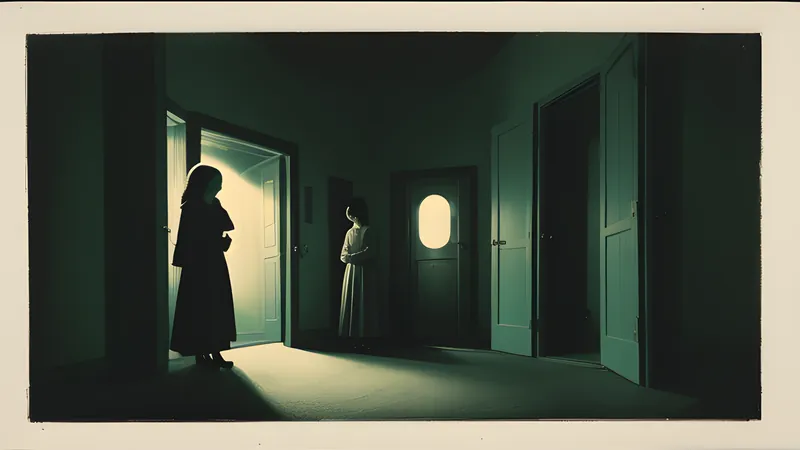
The production design is not decoration, it is the argument. Cinematographer Lee Mo-gae shoots the house as a place of unbearable prettiness — the reds of the wallpaper, the greens of the garden, the warm interior lamps — so that when horror arrives it arrives as a violation of good taste, a stain spreading across a surface too lovely to bear it. Kim understands that a beautiful frame makes an audience relax, and a relaxed audience is easier to ambush. The film’s best scares work because your eye has been lulled by the same loveliness that lulls the family into pretending everything is fine.
That’s the craft worth studying. Where a cheaper film signals dread with grime and shadow, Kim signals it with symmetry and colour, then breaks the symmetry a fraction at a time — a figure where a figure shouldn’t be, a sound under the dinner table, a menstrual-red bruise of colour bleeding into a clean composition. The horror is a design flaw in a room that was supposed to be perfect. By the time the film unleashes its set-pieces — a thing crawling from under a sink, a hand where no hand should be — you have already been trained to read this house as a lie, and the images only confirm the dread the décor planted.
Why it works: grief wearing a ghost story
A Tale of Two Sisters belongs to the strain of Asian horror that uses the supernatural to carry unbearable feeling. The Japanese wave built its dread from technology and the drowned dead — the tape and the well of Ringu, the damp ceiling of Dark Water — and its curses tended to be impersonal, a contagion that spreads to anyone unlucky enough to be near. Kim’s horror is the opposite in one crucial way: it is entirely personal. Every terror in this house is generated by the people who live in it, by what they did and what they cannot say to one another.
That makes it a close cousin of Spain’s The Orphanage and the moral fog of The Wailing — ghost stories where the haunting is a form of unresolved love. Yum Jung-ah’s stepmother, in particular, is a performance that repays a second viewing entirely; watch her early scenes again once you know the film, and the shrillness reads completely differently, less villainy than something far more frightening. Im Soo-jung, as the fierce older sister who appoints herself her sibling’s protector, gives the film its aching centre. The two of them are running a duet whose real subject you only understand at the end.
The Japanese and Korean waves crossed the Pacific in the same years, and Hollywood remade this one too, as The Uninvited in 2009 — a competent, hollowed-out version that keeps the twist and loses the grief. The reasons those remakes so reliably flatten their originals are the subject of the J-horror crossover essay, and A Tale of Two Sisters is one of its clearest case studies: a film whose power lives entirely in tone and reticence, the two things a studio remake is least equipped to reproduce.
Kim Jee-woon deserves a word as the shaping intelligence here, because he is one of the least categorisable directors of his generation, a filmmaker who has never repeated himself and has rarely stayed in one genre long enough to be claimed by it. He would go on to a revenge epic (I Saw the Devil), a Kim-Ki-duk-scale western (The Good, the Bad, the Weird), and a Schwarzenegger action picture in Hollywood, and the through-line across that scattered filmography is control — a stylist who never lets a frame get away from him. A Tale of Two Sisters is his most controlled film precisely because control is its theme, a story about a mind desperately keeping a lid on, told by a director who keeps a lid on his images the same way. The famous dinner-table sequence, where the film’s most violent scare erupts out of a perfectly ordinary meal, works because Kim stages the ordinary meal with the same care as the horror; the calm and the shock are made of the identical material, which is what makes the shock feel earned rather than cheap.
Where it sits now
More than two decades on, A Tale of Two Sisters remains the high-water mark for beauty in the genre and one of the finest Korean horror films ever made — the film that proved the country’s new wave could match Japan’s for dread and beat it for feeling. It rewards patience and a second viewing, and it pairs best with the quieter ghost stories linked above rather than with anything that trades in gore.
Where to watch: it has circulated on physical media and streaming internationally since 2003; seek the Korean original with subtitles, give it your full, undivided attention, and plan to sit for a few minutes afterward while it quietly rearranges everything you saw.
Spoilers below
The film’s structure is a magic trick, and like all good tricks it is fair — every clue is on screen. Much of what you have watched has not been happening. Su-yeon, the younger sister, is dead, and has been for the whole film; she died in an accident in the house — trapped under a fallen wardrobe during a struggle involving the stepmother — and Su-mi, unable to bear it, has fractured. The cruel stepmother Eun-joo you have watched terrorise the girls is largely Su-mi’s own projection, a role she has been unconsciously playing, and the real Eun-joo has been elsewhere for stretches you attributed to the fiction Su-mi’s mind constructed.
The devastation is retroactive. Su-mi built the whole haunted-house drama — the protective older sister, the wicked stepmother, the living younger sibling — to keep her guilt at bay, because she was in the house when Su-yeon died and did not save her. The ghost story is a coping mechanism given cinematic form. When the film finally shows you the accident straight, the horror curdles into grief so complete that a second viewing plays as an entirely different film, the record of a mind refusing a fact it cannot survive, its every scare recast as a symptom of denial.
This is why the remake could never work by keeping the twist alone. The revelation is not a gotcha; it recontextualises every earlier scene into a portrait of denial, the same move The Orphanage pulls with its own buried child. The real Eun-joo, glimpsed at the end still living in the house, is left to the coda’s final scare — a suggestion that guilt, once made this concrete, does not stay buried for anyone. Kim closes on the image of a beautiful house that will keep its secret, and a family that has already been destroyed by it.
Related Content