A Nightmare on Elm Street: The Slasher That Broke the Rules of Sleep
Wes Craven found the one place a teenager can't run to safety
Contents
By 1984 the slasher had rules, and the rules had become a cage. A masked man stalks teenagers who have transgressed; you survive by being watchful, virtuous and quick on your feet. Wes Craven’s A Nightmare on Elm Street looked at that machine and asked the one question that dismantles it: what if the killer waits for you in the only place you cannot stay awake to guard? Made for about $1.1 million and released by a struggling New Line Cinema — the outfit later nicknamed “the house that Freddy built” because the film’s success kept the lights on — it took the stalk-and-slash template and ran it through the physics of a dream.
I keep coming back to it because it’s a genuinely idea-driven horror film, which the slasher rarely was. Most entries in the cycle are about staging; this one is about a premise so clean you can explain it in a sentence and so nasty you can’t unthink it. Sleep is not a refuge. Sleep is the door.
An idea Craven found in a newspaper
The premise didn’t come from a monster comic. Craven has said he was struck by a cluster of Los Angeles Times reports in the late 1970s and early 1980s about young men, many of them Hmong refugees who had survived the horrors of Southeast Asia, dying in their sleep after nights of terrible nightmares — some reportedly having stayed awake for days because they were frightened to close their eyes. Doctors called it sudden unexpected nocturnal death syndrome. Craven took the real dread underneath those stories — that a nightmare might be able to reach out and stop your heart — and built a villain to embody it.
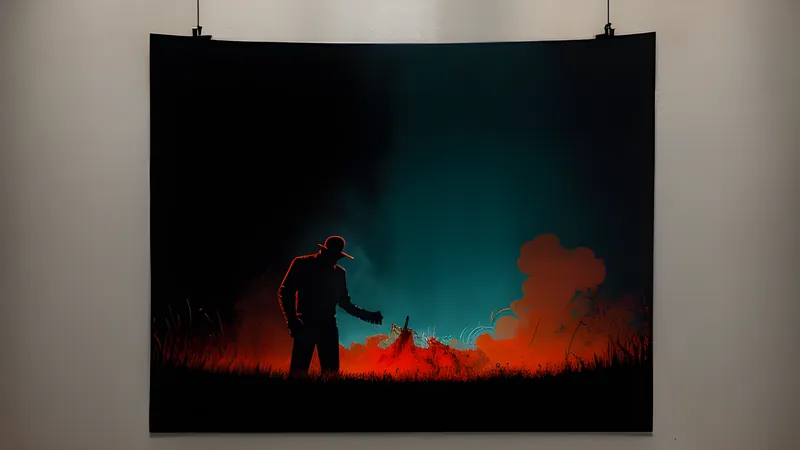
That origin is the film’s spine. Freddy Krueger, played by Robert Englund under Kevin Yagher’s burn makeup, is not a hulking silent slab in the mould of Michael Myers or Jason Voorhees. He is a burned man in a striped sweater and a battered fedora, with knives fixed to a workman’s glove, and he talks. He taunts, he jokes, he savours. The talkativeness is the tell: this killer lives inside your head, so of course he addresses you personally. The later sequels would let Freddy degrade into a vaudeville comedian cracking one-liners over each kill, but in the first film the wit is a scalpel. It makes him intimate, and intimacy is the whole terror of the concept. You cannot lock a door against something that is already in your subconscious.
The craft: dissolving the floor beneath the audience
What makes the film work is that Craven doesn’t merely tell you the boundary between dreaming and waking is porous; he removes your ability to know which side you’re on. Scenes slide from a bedroom into the grimy boiler room of Freddy’s underworld without a clean cut to announce the crossing. A character wakes with relief, and the relief is a trap because the film has taught you that waking is not a safe frame. By the second act, every quiet domestic shot carries a low charge, because you can no longer trust the ordinary.
The set-pieces are engineering marvels made on pocket money. Freddy’s glove stretching the bedroom wall into a rubbery bulge was achieved with a spandex membrane. The film’s most quoted image — a body dragged up a wall and across a ceiling, blood following gravity’s rules in the wrong direction — was shot in a rotating room, the camera and crew bolted down while the whole set turned, an old Royal Wedding technique repurposed for slaughter. And the geyser of blood erupting from a bed is a practical gag run, again, in a rotating rig so the “up” of the fountain is really sideways. These are magic tricks, and their handmade physicality is exactly why they still unsettle. There is a weight to a real rotating set that no clean digital effect replicates.
Charles Bernstein’s score does the quieter work — a lullaby motif and a nursery rhyme (“One, two, Freddy’s coming for you”) that colonise the film’s silences. Craven understood that the dream logic needed a sound you’d carry out of the cinema and into your own bed.
Nancy, and the final girl who fights back
The slasher’s survivor archetype was codified around watchfulness and endurance; the final girl typically outlasts the killer more than she defeats him. Nancy Thompson, played by Heather Langenkamp, is a decisive upgrade. She researches her enemy, she experiments, she sets traps, she turns her own house into a booby-trapped battlefield out of Home Alone by way of Hell. She is a strategist, and the film respects her intelligence enough to let the plot turn on it. Where Halloween gave us a babysitter surviving by nerve, Elm Street gives us a teenager conducting a campaign.
There’s a fine grim irony in the adult world of the film, too. Nancy’s mother medicates and drinks; her father, a policeman played by John Saxon, deals only in the physical and the provable and is therefore useless against a threat that lives in dreams. The parents’ failure is the point. This is a horror about a generation left to face a buried adult sin that the grown-ups would rather not name — and about a girl who has to become her own protector because no authority in her life can even perceive the danger. (A very young Johnny Depp, in his film debut as Nancy’s boyfriend Glen, gets one of the franchise’s most notorious deaths for his trouble.)
Where it sits in the collection
Elm Street is the third pillar of the American slasher’s founding trinity, and the most conceptually ambitious. Where Halloween drew the blueprint in shadow and Friday the 13th mass-produced the body count, Craven added a metaphysics. Freddy is the first major slasher villain who is fundamentally an idea rather than a body, which is why the franchise could get away with the surreal excess that followed — once your monster lives in dreams, anything can happen and the film owes you no realism.
You can also feel Craven wrestling with the same instincts that drove Sam Raimi’s The Evil Dead three years earlier: both films locate horror in a loss of bodily and mental sovereignty, and both use handmade, physically-real effects to make the impossible feel present in the room. And the film’s deeper lineage runs to any horror about the monster that lives in the mind’s basement — the tradition The Babadook would refine decades later into pure psychological allegory. Freddy is where the modern genre learned that the scariest house to be trapped in is your own head.
Why it still works
The concept is durable because it’s undefeatable in principle. You can outrun a man with a machete; you cannot decide to never sleep again. Craven built a villain out of the one biological certainty every viewer shares, and forty years later the trick still lands the moment the lights go down and someone in the film starts to yawn.
Spoilers below
Stop here if you haven’t seen it.
The film’s back-story is its darkest engine. Freddy Krueger was a child murderer who escaped justice on a legal technicality, whereupon the parents of Elm Street tracked him down and burned him alive in the boiler room where he’d worked. The teenagers being killed are the children of his executioners. This is why the adults cannot help: to explain the danger they would have to confess a lynching. The sins of the parents are being visited, quite literally, on the children as they sleep.
Nancy’s plan for the finale is the film’s cleverest move and its most argued-over. Having worked out that objects can be pulled out of dreams — she drags Freddy’s hat into the waking world — she resolves to grab him in her sleep and haul him bodily into reality, where he can be fought and, crucially, where she can then deny him his power. Her final gambit is psychological: she turns her back on him and declares that she takes back every ounce of the fear she gave him, arguing that Freddy is only as real as the terror that feeds him. Stripped of it, he seems to dissolve.
Then Craven, ever the trickster, refuses to let the victory hold. The bright, safe morning that follows curdles — the convertible carrying Nancy and her friends slams its top shut in Freddy’s stripes and speeds off out of control, and her mother is snatched back through the front door’s window. It’s an ending New Line reportedly pushed for, over Craven’s own preference, precisely to leave a hook for a sequel. Thematically it’s a cheat, because it undercuts Nancy’s hard-won thesis that fear is a choice. But as a final jolt it works exactly like the boiler-room set-pieces: it teaches you, one last time, that the safe frame was never safe. The film ends where it began — in the sunlit ordinary, with the nightmare grinning underneath it.
Related Content