A Field in England: Wheatley's Monochrome Bad Trip
Alchemy, mushrooms and the English Civil War, shot in black and white
Contents
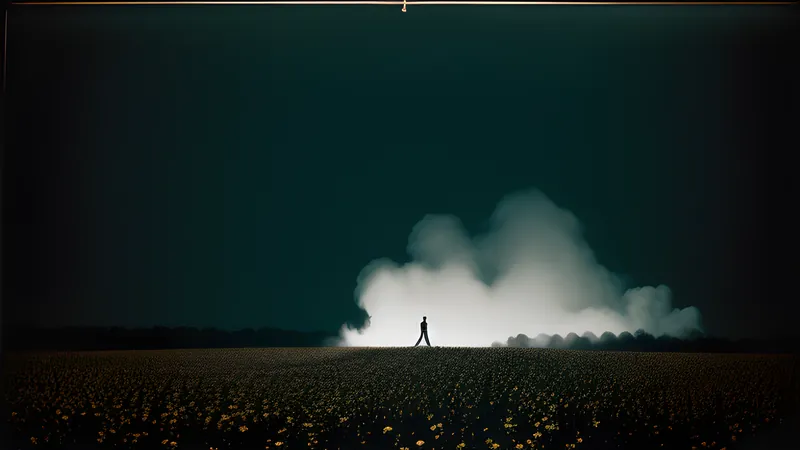
Ben Wheatley’s A Field in England (2013) is the film he made when nobody could stop him, and you can feel that freedom in every frame. Shot in twelve days, in black and white, for very little money, released the same day across cinemas, television, DVD and video-on-demand in a distribution stunt that Film4 dressed up as an experiment, it is the most purely formal thing Wheatley has done. There is a hedge, a field, a rope, some mushrooms, and five men in seventeenth-century clothes who walk into the frame sane and stagger out of it wrecked. That is nearly the whole plot. The film is a machine for turning an English meadow into hell.
The setting is the English Civil War, some unnamed skirmish in the 1640s. Whitehead, a twitchy scholar’s assistant played by Reece Shearsmith, flees a battle he never wanted to be near and falls in with three deserters. They are looking, vaguely, for an alehouse. Instead they are captured by O’Neil, an Irish occultist played with velvet menace by Michael Smiley, who has his own reasons for being in this field and forces Whitehead to divine the buried treasure he believes lies beneath it. Somewhere in the walk the men eat mushrooms boiled into a stew, and the ground opens under the film.
The field is the whole horror
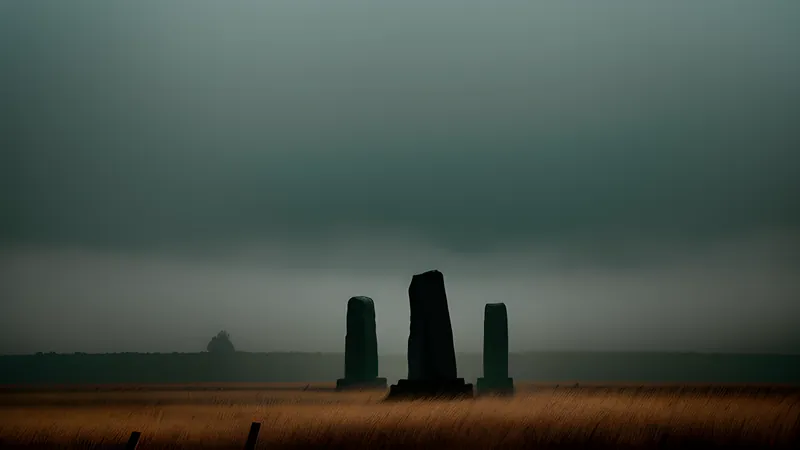
The single boldest choice Wheatley and his writer Amy Jump make is to trap the entire film in one location and dare it to run out of terror. It never does. A hedgerow, an open sky, a rope stretched taut, and the flat English light are all they have, and they extract more dread from that hedge than most horror films find in a haunted house. The confinement is the point. These men cannot leave the field, cannot see past its borders, cannot be sure the field is not moving them in a circle, and the longer the camera holds on the same grass the more the ordinary becomes unbearable.
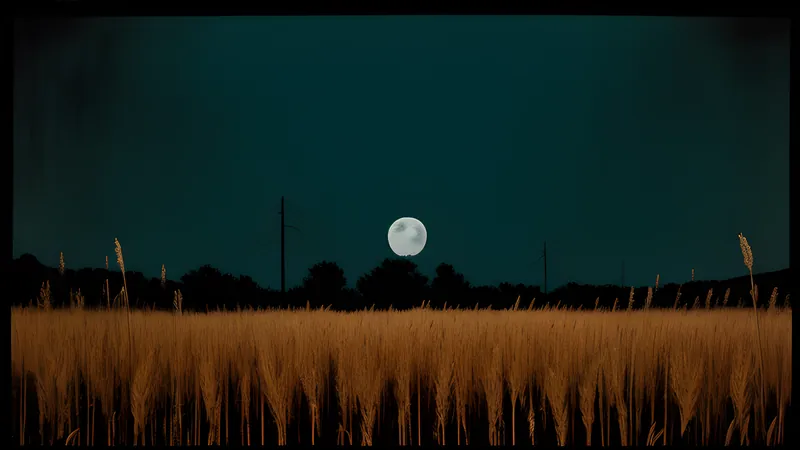
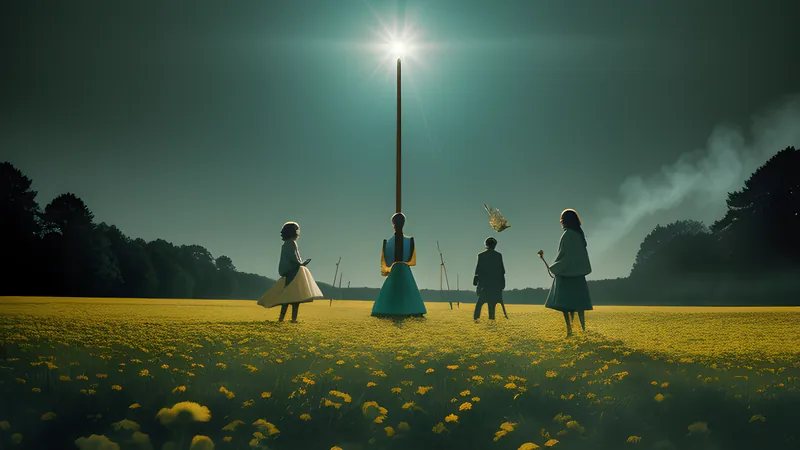
Wheatley shoots it like a nature documentary that has lost its mind. Long lenses flatten the men against the sky. Sudden tableaux freeze the actors into living paintings, holding a pose while the wind moves the grass around them, so the film keeps stopping to look at itself. Laurie Rose’s monochrome photography turns the sky into a hard white slab and the men into smudges of charcoal, and the black and white is doing real work: it strips the England of period drama out of the image and leaves something older and stranger, a woodcut, a broadside, a devil printed on cheap paper. This is a country that believes in witches because you would too, standing in that light.
Then there is the strobe. The film’s most notorious passage is a stroboscopic assault of flickering, mirrored, stuttering images that arrives as the mushrooms take hold, backed by Blanck Mass’s clanging drone score, and it goes on far longer than comfort allows. Some viewers hate it and I understand why. It is a genuine physical event, a sequence designed to make you feel poisoned. That is exactly its function. Wheatley refuses to describe the trip from outside and instead drops you into the middle of it, so the film stops being a story about men who eat mushrooms and briefly becomes the mushroom itself.
The lineage: folk horror, Powell, and the acid-Western field
Here is where the collector reshelves the film. A Field in England belongs to the British folk-horror revival, the same current that runs through Wheatley’s own Kill List and its bait-and-switch into the dark, where the ancient English soil turns out to have been waiting for the modern man who walks across it. Both films share the conviction that this landscape is haunted from underneath, that the tarmac and the hedgerow sit on top of something patient. Kill List hides that idea inside a hitman thriller; A Field in England strips the disguise away and lets the folk horror stand naked in the sun.
But the deeper ancestor is older and odder. Wheatley has spoken of Michael Powell, and you can see A Matter of Life and Death and the visionary English strangeness of the Powell and Pressburger films in the way the sky becomes a character. There is Witchfinder General too, Michael Reeves’s 1968 Civil War nightmare, the film that first understood that the 1640s were the perfect setting for English horror, a moment when the whole country was killing itself over invisible things.
And there is the acid Western. Watch the way the treasure hunt curdles into a metaphysical ordeal and you are close to the desert delirium of Alejandro Jodorowsky, whose midnight-movie template I traced in El Topo and the birth of the midnight movie. Both directors treat a landscape as a psychic space and a journey across it as an alchemical trial. Wheatley even structures the film around alchemy openly, the transformation of base men into something refined by suffering, gold pulled from the dirt. Set his monochrome field beside German’s medieval mud in Hard to Be a God and you have two black-and-white films that use filth and confinement to argue that history is a swamp we are still standing in.
Does the obscurity earn itself?
The fair objection is that A Field in England can feel like a student’s idea of profundity, all portent and no payoff, a film that mistakes bewilderment for depth. The dialogue is dense with period cadence and occult riddle; the plot dissolves in the second half; the final movements will read, to an impatient viewer, as arty noise. If you want a story that resolves, this film will insult you.
My defence rests on the rigour under the chaos. Wheatley is not improvising his way to a vague ending. The alchemical structure is deliberate and complete, Whitehead’s ordeal follows the stages of a transformation with real precision, and the film’s images rhyme and return in ways that reward a second, calmer viewing once the strobe has stopped ambushing you. The obscurity is a texture laid over an armature that holds. This is a director in total command of a small, strange machine, using the freedom of a tiny budget to make something no committee would ever have approved.
The verdict: it is minor Wheatley by scale and major Wheatley by nerve, the purest distillation of his method, which is to take the everyday English world and open a trapdoor in it. Come for the folk horror. Stay for the vision of England as a poisoned garden where the treasure was always a trap.
Where to find it: it turns up on the arthouse and horror-forward streaming services and has a fine physical release from the BFI. Watch it once for the trip and once for the design. The second pass is where the film reveals its craft, because once the strobe has stopped ambushing you the tableaux read as deliberate punctuation and the alchemical scheme snaps into focus. It is a small film that grows every time you return to it.
Spoilers below
The engine of the film is O’Neil’s use of Whitehead as a human divining rod. O’Neil ties a rope around Whitehead and sends him into the field to locate the treasure, and the sequence that follows, Whitehead heaving on the rope and then emerging from behind the tent with a fixed rictus grin, screaming, having been subjected to something offscreen we never fully see, is the most disturbing thing in the film precisely because Wheatley withholds it. Whatever O’Neil did to him inside that tent has broken and remade the man, and Shearsmith plays the aftermath as a soul that has been turned inside out.
The treasure, when it is dug up, is a skull, or nothing, or the idea of gold, the film stays ambiguous. What matters is the reckoning. Whitehead, transformed by his ordeal from a coward into something harder, turns on O’Neil, and the two men face each other in the film’s alchemical climax. Whitehead survives; O’Neil is destroyed. The meek scholar has been refined by suffering into a man who can kill his tormentor, the base metal turned to gold, which is the alchemical promise the film has been making all along.
The closing image returns the survivors to the edge of the field, walking out into the same white light they walked in from, and Wheatley freezes them one last time into a tableau, and then repeats it, so we cannot be sure whether anyone has escaped or whether the field simply keeps replaying the men who wander into it. The war goes on somewhere beyond the hedge. The field remains, patient, waiting for the next set of frightened men to cross it looking for an alehouse and find the underneath instead.
Related Content