Winter Games: The Ski Jump and the Held Breath
Epyx traded raw joystick punishment for something closer to timing, and found the series' best event doing it
Contents
Winter Games shipped in 1985, the same year as Summer Games II, and it’s tempting to read it as the same formula in a different season — swap grass for snow, swap javelin for biathlon, keep the carnival ceremony, ship it. What actually happened is more interesting: winter sports don’t have an obvious equivalent to the raw joystick-wiggling that made Epyx’s summer events so hard on hardware, because most of winter’s signature disciplines are about balance, timing and a held moment rather than sustained explosive effort. Epyx built its seven events around that difference, and the result is a game whose best moments are about anticipation rather than exhaustion.
Seven events, and almost none of them want speed alone
Winter Games offers hot dog aerials, biathlon, speed skating, figure skating, ski jump, free skating and bobsled — a spread that looks superficially like the summer format but plays according to a different logic almost throughout. Speed skating is the one event that asks for something close to the old wiggle-mechanic effort, a straightforward test of how fast a player can drive alternating input, and it’s telling that it’s also the event with the least memorable design in the set, a leftover instinct from the earlier games rather than something built specifically for winter sport. Everything else in the roster asks for a different kind of attention. Biathlon layers a held-breath aiming moment onto cross-country stamina, penalising missed rifle targets with time added rather than points lost outright, which means the event is really testing whether a player can slow their own input down at exactly the moment speed stops being the priority. Figure skating and free skating ask for a sequence of timed inputs executed in the right order and rhythm rather than raw speed at all, closer to a dance game’s logic than a sprint’s.
The ski jump as the format’s clearest argument
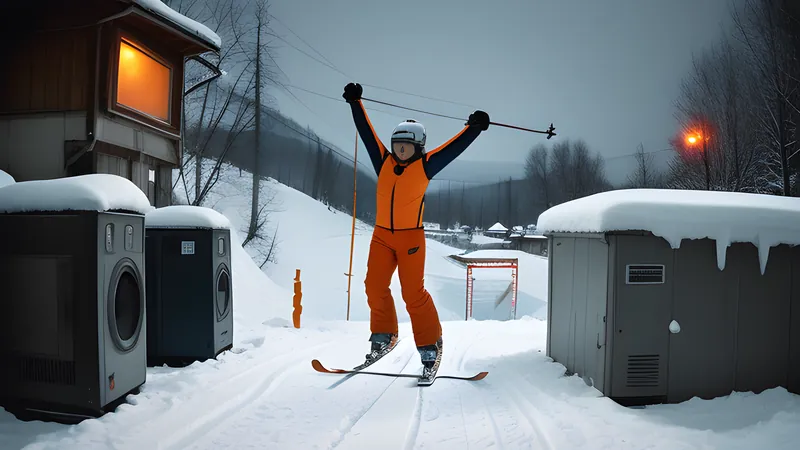
Ski jump is the event Winter Games is best remembered for, and it earns that reputation by being the purest distillation of what the whole game is actually testing: a timed release, followed by a held pose, followed by a landing that depends entirely on how well the first two decisions were made. Building speed down the ramp requires nothing skillful. The skill is in the takeoff timing and the mid-air stunt attempts a player chooses to risk before committing to a landing stance — score is built from a combination of distance and the stunts performed in flight, and a jump ruined by a badly timed landing after an ambitious stunt attempt costs more than a cautious, stunt-free jump that lands cleanly. That’s a genuine risk-reward decision made in the space of a few seconds of flight, and it rewards a player who’s learned the rhythm of the event rather than one who’s simply reacting fastest. No joystick dies making that decision. The event’s whole appeal is the held breath between committing to a stunt and finding out whether the landing punishes you for trying it.
A different studio’s hand on the same formula
Winter Games carries a development credit distinct from the first Summer Games — Action Graphics, working under Epyx’s design direction and released in Europe through US Gold — which is worth noting because it means the shift away from wiggle-heavy events wasn’t necessarily a single design team having a change of heart. It reads more like Epyx treating the “Games” format as a publishing umbrella with a consistent brief — multi-event, turn-based, carnival-framed, playable by up to several people trading a joystick — that different teams could execute against with their own judgement about which mechanics suited which sport. That structure explains why Winter Games feels like a considered response to winter sport specifically rather than a reskin: whoever built it had the freedom to decide that a bobsled run wants route-planning and a held lean rather than a repeated button mash, because nothing about the format’s brief forced every event toward the same input shape the earlier game had used.
Free skating’s quieter test
Figure skating and free skating both ask the player to execute a sequence of moves in a chosen order, timed against music, with points awarded for difficulty and execution rather than pure speed — a scoring philosophy lifted fairly directly from how the real sport is judged, and one that sits oddly close to what a rhythm game would later formalise more explicitly. The skill being tested is planning a routine that plays to a chosen difficulty level and then executing the timing cleanly enough that the difficulty actually pays off, which means a cautious routine well executed can outscore an ambitious one botched partway through — the same risk calculus the ski jump event runs, transplanted from a single mid-air decision into a longer sequence of them. It’s a quieter event than ski jump because the tension is spread across a whole routine rather than concentrated in one held moment, but it’s built from the same underlying idea: that a good winter-sports game rewards foresight and clean timing over raw reactive speed.
Why timing beat wiggling, and why it took a second try to prove it
Epyx’s summer format worked as a party game partly because raw physical effort is legible to a room — you can see someone struggling with the joystick and laugh about it before the round even ends. Timing-based events are legible in a quieter way: the tension is in the wait, not the motion, which asks an audience to actually watch the screen rather than watch each other’s arms. Winter Games’ seven events, taken as a set, are a bet that this quieter tension could carry a party game just as well as the summer format’s louder one, and the ski jump event in particular proves the bet correct — it’s consistently the event singled out in period reviews and player memory alike, ahead of speed skating’s more familiar effort-based design. That’s a meaningful result for Epyx’s design process: it suggests the studio wasn’t simply reskinning the same mechanic season to season, but testing whether the underlying formula — turn-based single-player attempts scored and compared across a multiplayer field — could support an entirely different texture of tension and still hold a room’s attention just as well.
Presentation doing the emotional work timing can’t
None of the timing-based design would land the way it does without the presentation carrying its share of the tension, and Winter Games was regarded at release as one of the more visually accomplished C64 titles of its year — detailed snow-covered backdrops, a genuine sense of place behind each event rather than a flat scoring screen, the ski jump’s approach ramp and valley view doing real work to make the held-breath moment feel like something rather than an abstract number ticking upward. A timing mechanic lives or dies on whether the player can feel the stakes of the wait, and Winter Games spends its presentation budget almost entirely on making that wait visible — the jumper’s silhouette against open air, the skater’s blades catching the light mid-spin — rather than on flourishes that don’t serve the moment of decision. That’s a deliberate allocation of a limited budget, and it’s the reason the ski jump in particular is remembered as a genuine highlight rather than merely a clever scoring system.
What a held breath does that a wiggle can’t
The design lesson worth taking from Winter Games’ best event is that anticipation is a legitimate substitute for effort as a source of tension, and in some contexts a better one, because it doesn’t cost the hardware anything and it scales to an audience rather than just the player holding the controller. A room watching someone attempt a risky stunt mid-jump, waiting to see if the landing holds, is invested in a way that doesn’t require understanding the input scheme at all — the suspense reads from the animation and the score ticking up, which makes the event legible to onlookers in exactly the way a joystick-destroying sprint is legible to onlookers, just through a completely different channel. Epyx had already proven the loud version worked with Summer Games. Winter Games proves the quiet version works just as well, and arguably ages better, since a held breath doesn’t wear out a peripheral the way a race to the death does.
Biathlon’s honest trade-off
Biathlon deserves a closer look than “cross-country plus shooting” suggests, because the penalty structure is the whole design. A missed rifle target doesn’t end the attempt or dock points directly — it adds time, which means the event is constantly asking a player to weigh whether slowing their aim down for one more target is worth the seconds it costs against the clock. That’s a cleaner version of the ski jump’s risk calculus, expressed as a single repeated decision — steady and slow, or fast and gambling on accuracy — made five separate times across one attempt, which gives biathlon a rhythm distinct from every other event in the set despite sharing the same underlying philosophy of trading speed for precision.
The rest of the carnival
Winter Games sits inside the same run of Epyx multi-event games that started with the two Summer Games titles. Summer Games II is the clearer contrast case, its eight events built substantially around the raw-effort wiggle mechanic Winter Games mostly steps away from, which makes the two games a useful pair for tracking how quickly Epyx was willing to rethink its own formula between releases rather than simply reskinning it. California Games, arriving two years later, goes further still, dropping the Olympic-carnival structure almost entirely in favour of looser, attitude-driven events that don’t fit an Olympic mould at all. World Games takes the opposite route from Winter Games’ timing-forward design, leaning into events so unusual — log rolling, caber toss — that they needed entirely new control schemes invented from scratch rather than adapted from the biathlon-and-bobsled playbook Winter Games had just finished refining.
Spoilers below
There’s no narrative twist in a Winter Olympics carnival, but the scoring detail worth flagging for anyone playing ski jump cold is that stunts attempted mid-air only add to the final score if the landing that follows is clean — a spectacular series of mid-flight rotations followed by a stumbled landing scores worse than a plain, stunt-free jump landed perfectly, which runs directly against the instinct most first-time players bring to the event. The bobsled and free skating events carry a similar quiet trap: both reward a player who plans the full run or routine in advance over one who reacts input by input, since a strong opening in either event is easy to undo with one badly timed correction near the end.
Related Content