The One-Room Game Canon
Thirteen games that never let you leave, and got bigger for it
Contents
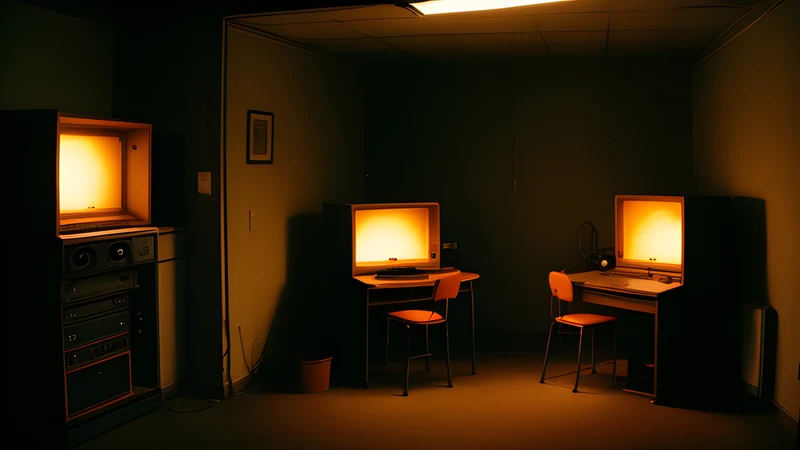
Here is a design constraint with an unreasonably good hit rate: give the player one room and refuse to open the door. No traversal, no map screen, no fast travel, no biome. Everything the game has to say must be said with the objects on the table.
It works because the money that would have gone into square footage goes into depth instead. A studio that would have built forty rooms at a shallow level of interaction builds one at an absurd one. And it works because a single space becomes legible in about ninety seconds, which means the designer can start playing games with your assumptions almost immediately — you know where everything is, so the only thing left to surprise you is what the things do.
Thirteen of them, grouped by what the room contains.
The terminal
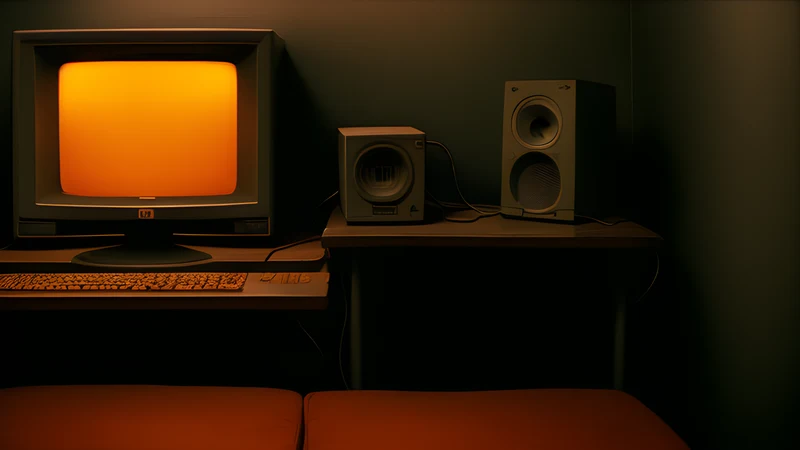
Hacker (Activision, 1985). It boots to a black screen and the words LOGON PLEASE. That is the entire tutorial. The manual, famously, contained nothing useful, because Activision’s marketing decided the absence was the product. You are sitting at a modem connection you have stumbled into, and the game’s first act is finding out what game it is. Steve Cartwright built a puzzle whose opening move is admitting you have no idea what the interface wants, and forty years of terminal games have been a footnote to it. What I remember from the C64 version is the specific quality of being fourteen and typing words at a machine that answered in a tone suggesting I ought to already know. Nothing since has replicated that, because nothing since has been allowed to ship without a tutorial.
Uplink (Introversion Software, 2001). A fictional OS, a bank of servers you have never physically seen, and a trace bar that fills while you work. Chris Delay’s design puts every tool behind a purchase and every job behind a rating, so progression is a shopping list, and the tension is a timer you can watch. Introversion made it in a bedroom and it launched a studio. The reason it still holds is that the fiction and the interface are the same object: you are looking at exactly what your character is looking at, and there is no camera.
Duskers (Misfits Attic, 2016). You command salvage drones through derelict ships by typing
commands — navigate r2, sensors, motion — while looking at grainy monochrome feeds. You
never see the ships. You infer them from a schematic and a noise, and when a drone stops
responding you have to work out from the map alone what is in the room with it. The command
line here is a horror device, and the roguelike attrition underneath means every drone you
lose was a limb. Misfits Attic understood that typing is slow, and made slowness the horror:
you cannot panic-mash a command line, so the four seconds it takes to spell out a retreat are
four seconds the thing on the ship also gets to use.
Hypnospace Outlaw (Tendershoot, 2019). A fake 1999 desktop, and the operating system is the level design. You never leave the chair. The world is a search box, and the design’s craft is that the fake web is dense enough that a stray phrase on one page is a real lead on another, so exploration happens entirely in your notes.
The desk
Papers, Please (Lucas Pope, 2013). One booth on the Arstotzkan border, one rulebook that gains a page every morning, one clock. The room never changes and the job becomes unrecognisable inside a fortnight, which is the cleanest demonstration on this list that a one-room game grows by accretion rather than by geography. The pinboard above the desk is the whole design in miniature — every bulletin you pin to it is a rule you now own, and by the second week the wall is doing your remembering because your head has run out.
Her Story (Sam Barlow, 2015). A police database, seven interview tapes cut into clips, and a search field that returns the first five matches for any word you type. Barlow’s design is a one-room game where the room is a full-text index: you are limited to five results, so the whole of the play is choosing a better word. It won the BAFTA for Game Innovation and it deserved it for the retrieval limit alone, which turns a database into a maze. Viva Seifert plays every clip, and the performance has to survive being watched in an order nobody scripted, which is a demand almost no screen actor has ever been handed. Barlow’s real discovery is that a player given a search box will interrogate a fictional woman with more diligence than any detective character ever written, because the questions are theirs.
Immortality (Sam Barlow, 2022). Barlow’s follow-up puts you at an editing bench with the footage of three unfinished films by an actress who vanished. The scrubbing is the whole verb: you match-cut out of one clip by clicking an object and land in another clip containing a similar object, so navigation is visual rhyme. It is a fourteen-hour game whose only room is a frame, and the thing hiding inside the frames is the best trick in FMV.
Do Not Feed the Monkeys (Fictiorama Studios, 2018). A bedsit, a computer, and a set of purchased webcam feeds of strangers. You watch, you take notes, you sell information — and the rent arrives regardless, so voyeurism becomes piecework. The room is the point: you are physically stuck in a horrible flat, and the horrible flat is why you keep watching.
Home Safety Hotline (Night Signal Entertainment, 2024). A 1996 call-centre desk, a database of household pests, and callers who describe something in the loft. You look it up, you send the right specialist, and the taxonomy quietly stops being about wasps. Three hours, one desk, and a superb use of the oldest one-room mechanic there is: a reference document you have to actually read.
The table
Cultist Simulator (Weather Factory, 2018). Alexis Kennedy put a desk in front of you covered in cards and timers, and refused to explain any of it. Health, reason, passion — you drag them into slots and watch what happens, and what happens is usually that you starve or go mad while learning the grammar. The room is a tabletop, the tutorial is failure, and the game’s honesty about that is bracing.
Inscryption (Daniel Mullins Games, 2021). Act I is a cabin, a table, and a man across it dealing cards. The frame keeps breaking on purpose, and it only breaks because the cabin was so completely established first. You have to stand up from the table and look at the room — checking the drawers, examining the clock — and the moment you realise the room is interactive is the moment the game has you. Mullins had already run the trick on an arcade cabinet in Pony Island (2016), which is a one-room game where the room is a machine that wants something.
Balatro (LocalThunk, 2024). A table, a deck, some jokers, and a scoring formula. It ate a year of a lot of people’s lives on a single screen with no environment art of any kind. The design’s depth comes entirely from multiplicative interactions between joker cards, which is a system you could print on paper. One person made it. There is no room.
The flat
Twelve Minutes (Luis Antonio, 2021). A top-down one-bedroom flat, a time loop, and a cast of James McAvoy, Daisy Ridley and Willem Dafoe. The loop structure means the room accumulates knowledge instead of objects, and every replay is faster because you know more. It divides people sharply, mostly on the writing rather than the box — the box is exactly right, and the argument it makes about repetition as a mechanic is sound whatever you think of the ending.
The adjacent shelf
Two houses that behave like rooms. Blue Prince is a mansion that redeals its own floor plan every morning, which makes it a one-room game where the room is drafted. Lorelei and the Laser Eyes is a hotel that functions as a single puzzle box with a memory, and the real containment is that every number you find belongs somewhere else.
And going backwards, Little Computer People (Activision, 1985) put a man in a cutaway house on one screen and let him live there, which is the ancestor of every game that decided a fixed frame was enough world.
Where to start
Her Story if you have an evening and want to see the form at its most elegant. Inscryption if you want to feel a room turn on you. Balatro if you have anything else planned this month, in which case do not.
The common thread is a designer who has worked out that a room is an argument about attention. Give a player a continent and they skim it. Give them a desk with nine things on it and they will pick up all nine, twice, and start theorising about the eighth. The one-room game is the only format that can rely on being read closely, and everything on this list is built to reward the second look. That is a rare deal in a medium that mostly sells acreage.
Related Content