The Last Ninja: The Isometric Game Before It Learned Restraint
System 3's 1987 original built the isometric action-adventure template it would take a sequel to actually perfect
Contents
The Last Ninja arrived on the Commodore 64 in 1987 looking like nothing else on the format — a lush, layered isometric world of gardens, forests and temple interiors rendered with a depth of colour and detail that made most of its contemporaries look like they were drawn with a ruler. System 3 built something genuinely new with it. They also built something genuinely punishing, and the distinction between the two is most of what makes it worth revisiting.
An isometric world that finally looked like a place
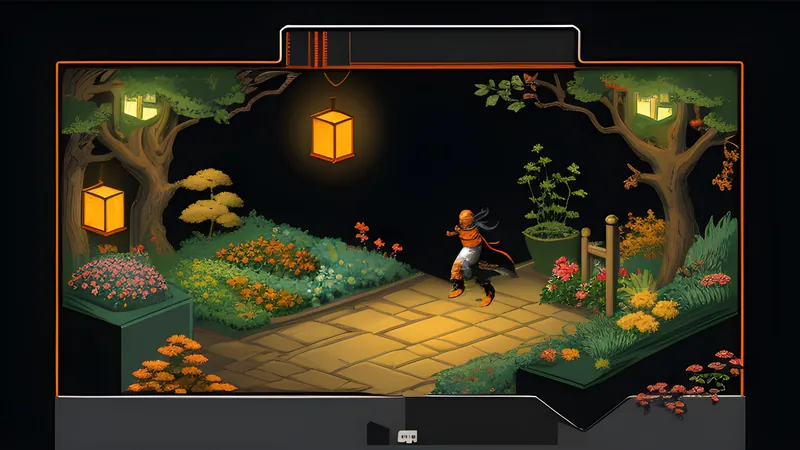
Isometric action games existed before The Last Ninja — the format had already produced sturdy, clever puzzle-platformers built on the same projection. What The Last Ninja changed was scale and atmosphere. Its opening garden, with reflective water, layered foliage and a sense of real depth between foreground and background elements, looked like a considered environment rather than a puzzle box built from cubes. That art direction — credited to Hugh Riley, whose backgrounds carry most of the game’s sense of place — is the reason The Last Ninja is still remembered as a visual landmark on the C64 independent of how the combat underneath it plays.
The scrolling, multi-screen structure matters here too. Rather than the single static isometric puzzle rooms of earlier genre entries, The Last Ninja lets you walk continuously through connected outdoor and indoor spaces, which sells the idea of a real journey — garden to forest to riverbank to temple — in a way the room-by-room format didn’t. It’s a meaningfully different pitch to the player: not “solve this box,” but “move through this world,” and that shift in ambition is what the isometric genre was reaching for even when the mechanics underneath hadn’t caught up yet.
The combat the sequel had to fix
Here’s the part that dates the original hardest. Combat in The Last Ninja is governed by an isometric movement scheme where your character’s facing and attack direction don’t always read cleanly against the perspective — a kick or punch aimed at a diagonal approach can miss an enemy standing at what looks, visually, like point-blank range, because the underlying collision logic is working off a grid the isometric art doesn’t make fully legible. Against a single easy enemy that’s a minor annoyance. Against the game’s tougher encounters, where several enemies close from different angles at once, it becomes the single biggest source of unfair-feeling deaths in the game, and it’s the exact problem Last Ninja 2 was built to solve — the sequel refined hit detection and clarified character orientation specifically because players had spent a full game fighting the perspective as much as the enemies in it.
That’s why “before it learned restraint” is the right way to describe the original rather than a knock against it. The Last Ninja isn’t badly designed so much as unfinished in its combat legibility — a first attempt at translating a genuinely new visual idea into a fair action game, with the fairness part still a draft. The sequel’s restraint — tighter hit windows, clearer facing, fewer moments where the camera angle actively works against you — only exists because the original found every place where isometric perspective and combat friction collide.
Puzzles that respect the world more than the fight does
Where The Last Ninja is more assured is in its object-based puzzles: keys, throwing weapons, environmental interactions like fires that need dousing or gaps that need a specific tool to cross, all integrated into the walk-through-the-world structure rather than gated behind separate puzzle screens. Finding a bo staff in the garden that becomes the only way to strike an early enemy at range, or realising a locked temple door needs an item picked up two screens back, gives the world a sense of continuity that the fighting doesn’t quite match. The adventuring skeleton of the game — explore, find, carry, use — is confident even where the combat is rough, and it’s the half of the design the sequel didn’t need to overhaul because it was already sound.
The inventory as a second puzzle layer
The Last Ninja carries an inventory system alongside its combat and its environmental puzzles, and the way it’s used sets it apart: rather than a simple key-for-lock exchange, several items serve double duty as both puzzle solutions and combat tools — a weapon picked up to solve an environmental gate is often also the only effective option against a specific enemy type later in the same zone. That overlap forces a kind of resource discipline uncommon in the genre at the time; a player who uses an item purely for its puzzle function without realising its combat value can find themselves under-equipped for the fight immediately afterward. It’s a smart piece of integration between the game’s two halves even where the combat mechanics themselves are shakiest, and it’s part of why exploration in The Last Ninja rewards genuine attention rather than reflexive item-hoarding.
Why the perspective problem was so hard to avoid
It’s worth being fair to System 3’s engineers here, because the combat legibility issue isn’t a case of sloppy work — it’s a genuinely difficult problem that isometric projection creates by its nature. A top-down or side-on game can map an attack’s reach directly onto the screen space the player is reading; an isometric view asks the player to judge distance and alignment along two diagonal axes simultaneously, while the underlying game logic is very likely still tracking position on an orthogonal grid underneath the diamond-tiled art. Getting those two representations to feel like the same space to a player, in real time, during a fast-moving fight, was an unsolved problem across the genre in 1987, not a mistake unique to this game. The Last Ninja is simply the most visible early example of the gap, precisely because its world was ambitious enough to put real combat pressure on a projection trick that earlier, calmer isometric puzzle games had never stress-tested in the same way.
The soundtrack that outlasted the frame rate
Ben Daglish and Anthony Lees’ score for The Last Ninja is one of the most celebrated pieces of C64 SID chip composition of its era, and it’s worth separating from the gameplay discussion because it’s doing real work: the garden theme in particular sets a tone of melancholy and scale that the visuals support but the combat, on its own, doesn’t earn. A game with rougher mechanics than its reputation suggests can still land as a landmark if the audio and art are carrying the atmosphere convincingly enough, and The Last Ninja is a clean example of that — ask anyone who played it in 1987 what they remember first and the garden music usually comes up before any specific fight does.
A loading break that became part of the pacing
Like most C64 games of its scale, The Last Ninja loads its major zones from tape or disk between sections rather than streaming everything continuously, and those breaks fall at exactly the points where the game shifts tone — garden to forest, forest to riverside, riverside to temple. Rather than reading as pure technical overhead, the pauses end up functioning as scene breaks, giving each zone room to feel like a distinct chapter rather than one continuous, undifferentiated map. It’s not a deliberate structural choice in the way a modern game’s loading screen might be designed as a pacing beat, but it has the same practical effect: a moment to reset your expectations before the game changes the palette, the enemy set and the architecture around you completely.
Why the rough draft still matters
It would be easy to file The Last Ninja under “the game the sequel fixed” and leave it there, but that undersells what the original actually accomplished: proving an isometric world could carry genuine atmosphere and a sense of place, rather than functioning purely as a projection trick for puzzle logic. Later isometric and pseudo-3D action-adventures — on the C64, the Amiga, and well beyond — inherited that ambition more than they inherited any specific mechanic from the game, and the sequel that gets called the peak of the format only got there because System 3 spent the first game finding out, expensively, what didn’t work yet. Last Ninja 3 went on to test how far the formula could stretch once both halves — the world and the combat — were finally in balance.
What “restraint” actually means as a design word
It’s a word worth defining rather than leaving as a vague compliment. Restraint, in the sequel’s context, means fewer simultaneous enemies per encounter, clearer facing indicators on the player character, and hit windows tuned generously enough that a correctly-timed attack lands even when the isometric perspective makes the geometry ambiguous to the eye. None of that makes Last Ninja 2 an easier game overall — its puzzles and later areas are at least as demanding — but it does mean deaths there tend to feel earned rather than arbitrary. The original Last Ninja hadn’t yet learned which fights needed thinning out and which ambiguities needed resolving, and that’s a genuinely different failure mode from being poorly made. It’s the failure mode of being first.
Where to play it
The Last Ninja runs well in any Commodore 64 emulator, and it’s worth playing before Last Ninja 2 rather than after, specifically to feel the gap the sequel closes. Go in expecting to lose fights to the perspective more than to the enemies themselves, and the game reads less as a flawed classic and more as the honest first draft of an idea that took two attempts to get completely right.
Spoilers below
The game’s structure sends you through four escalating areas — garden, forest, riverside village and temple interior — each gated by a specific item or ability picked up in the previous zone, meaning a mistake early (missing the throwing weapon in the garden, for instance) can leave a later area effectively unsolvable without backtracking. The final confrontation takes place inside the temple against the strongest enemy in the game, and it’s the encounter where the isometric hit-detection problems described above are least forgiving — arriving with full health and every item collected along the way matters more here than in any earlier fight.
Related Content