Stunt Car Racer: The 3D Racer That Made You Feel the Drop
Geoff Crammond built a racing game around suspension physics on tracks with no safety rail at all
Contents
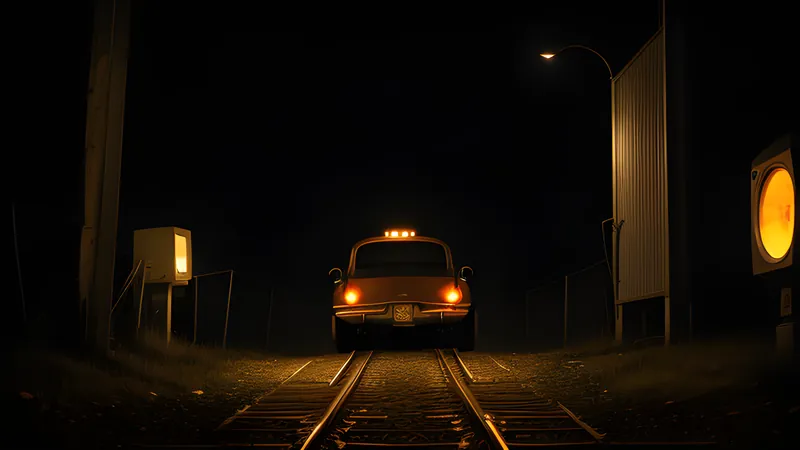
MicroStyle released Stunt Car Racer in 1989, on Amiga, Atari ST and a handful of 8-bit systems, and the premise is stripped down to almost nothing: two cars race head-to-head on elevated wooden tracks, built on stilts high above an unseen ground, with no barriers at the edges and no recovery from a fall except restarting the entire race from the pit. Geoff Crammond, the designer behind it, had already built a reputation for physics-first racing simulation, and Stunt Car Racer is where that reputation gets applied to a track design so aggressively vertical — ramps, jumps, banked curves stacked at genuinely alarming angles — that the game’s real subject turns out to be suspension physics rather than lap times.
The suspension model as the whole game
Every jump in Stunt Car Racer lands or fails based on a genuinely simulated suspension system rather than a scripted animation, and that distinction is the reason the game still feels distinct from almost everything else in the racing genre from its period. Land a jump squarely and the suspension compresses and rebounds the way a real vehicle’s would, keeping the car planted and under control; land it nose-down, or at an angle that puts uneven weight on one side, and the physics model punishes that imprecision immediately, sending the car into a spin or pitching it clean off the track’s unguarded edge. There’s no arcade racer’s forgiving auto-correct nudging a landing back onto the road — Crammond built a genuine simulation and let its consequences play out honestly, which means mastering Stunt Car Racer is really mastering a physical understanding of weight transfer and landing angle rather than memorising a fixed set of jump inputs.
That honesty about consequence is what makes the absence of guard rails such a load-bearing design decision rather than a cosmetic touch of extremity. A racing game with safety barriers can afford a more forgiving physics model, because the barrier itself absorbs a mistake that would otherwise be catastrophic. Stunt Car Racer removes that safety net entirely, which means the suspension simulation has to be taken completely seriously by the player at every single jump — there’s no barrier to bounce off, just open air and a long fall back to the pit lane if the landing angle was wrong. Every jump on every track is a genuine risk assessment rather than a scripted setpiece, and that constant, honest risk is the reason the game generates real tension lap after lap in a way a guard-railed racer simply can’t replicate.
Head-to-head, not against the clock
Stunt Car Racer’s structure pits exactly two cars against each other per race, climbing a league table stacked with progressively tougher AI opponents and progressively more vicious track designs, rather than the multi-car grid a conventional racing game would default to. That two-car format matters because it lets the game’s individual jumps carry genuine tactical weight beyond pure lap-time optimisation — a slightly slower, more controlled landing that keeps the car stable can be the correct choice against a specific opponent’s known tendencies, even if a faster but riskier line exists on paper, because a single crash costs the whole race rather than just a few places on a longer grid. The head-to-head format turns every jump into a real decision about risk tolerance relative to a specific rival, not just a technical challenge to be solved once and repeated identically every lap.
The track editor bundled with the game extended that tactical thinking into genuinely open-ended territory: players could design their own elevated courses, stacking jumps and banked curves as extreme as the suspension physics could handle, and the resulting community of home-built tracks pushed the same physics engine into scenarios Crammond’s own official courses hadn’t necessarily anticipated. That’s a rare feature for a game of this vintage to include at all, and it gave Stunt Car Racer a much longer functional lifespan than its modest, two-cars-and-a-ramp premise would suggest on paper.
Beyond racing, the league structure ties a car-upgrade economy to a player’s winnings, letting improved suspension, tyres and engine components carry forward against tougher opposition — a genuinely simple system compared to a modern racing game’s sprawling customisation menus, but one that gives the physics model itself a second axis to interact with. A softer suspension setting bought with early winnings behaves differently on a steep landing than the default car does, which means the tuning choices a player makes between races feed directly back into the same physical honesty the jump mechanics are already built around, rather than sitting off to the side as a separate progression system.
Filled polygons and the sense of falling
The visual rendering matters as much to the game’s feel as the physics underneath it. Stunt Car Racer draws its tracks in solid, filled 3D polygons rather than the wireframe outlines a lot of contemporary home-computer racing and flight games were still relying on to hit an acceptable frame rate, and that solidity is what makes the height genuinely legible rather than abstract. A wireframe track can imply a drop; a filled, shaded one makes the distance between an elevated ramp and the ground below read as an actual physical gap a player’s eye can measure, which matters enormously for a game whose entire tension depends on a player correctly judging how dangerous a given jump’s landing angle is going to be before committing to it. Crammond’s rendering choice wasn’t just a technical flex for the Amiga and ST’s graphics hardware — it was a legibility requirement the whole design depended on, because a suspension physics model this honest is wasted if the player can’t actually see the geometry clearly enough to plan around it.
That solid-polygon rendering came at a real performance cost, and the game’s frame rate is noticeably choppier than a same-era wireframe racer would manage on equivalent hardware. Crammond and the team judged, correctly, that a slightly rougher frame rate was worth the trade for genuinely readable elevation and landing geometry, a bet that later 3D racing games on more powerful hardware would eventually get to make without the compromise, but one that Stunt Car Racer had to make explicitly in 1989.
Where the physics-first lineage actually goes
Crammond’s other major work, the Formula One simulations he built across the following decade, shares Stunt Car Racer’s core conviction that a racing game’s real substance is an honestly modelled physical system rather than a curated sequence of scripted challenges — but Stunt Car Racer arrived first, and its stripped-down, two-car, no-barriers format makes the underlying design philosophy easier to see clearly than a fuller simulation’s greater surface complexity would allow. It’s the leaner, more legible statement of the same idea Crammond spent the rest of his career refining.
The Amiga’s own reputation as a machine that could support genuinely ambitious 3D owes something real to Stunt Car Racer’s presence in that catalogue — filled polygon track sections rendered fast enough to keep a suspension simulation feeling responsive were a genuine technical showcase for the hardware in 1989, and the game earned its place in conversations about what the machine was actually for rather than just what it was capable of on a spec sheet.
The split platform releases underline how demanding the underlying simulation actually was. The Amiga and Atari ST versions kept the full suspension model and solid-polygon rendering intact, while the 8-bit conversions had to simplify both the physics and the track geometry considerably to hit a playable frame rate on far less capable processors — a direct illustration of how much of Stunt Car Racer’s identity depended on horsepower most home computers of the era simply didn’t have to spare.
Spoilers below
The league’s later divisions escalate track design into territory the earlier stages never hint at — jumps stacked in immediate sequence with no flat recovery ground between them, banked curves steep enough that a poorly weighted approach sends a car off the track’s edge before the driver has even registered the mistake. The final division’s opponents are tuned to exploit exactly the impatience a player picks up from steadily beating easier AI earlier in the league, punishing any driver who’s started taking landings for granted rather than reassessing each new track’s specific geometry on its own terms.
The verdict on Stunt Car Racer, considered decades on, is that its reputation as a cult curiosity undersells a genuinely rigorous piece of physics design — removing the guard rail wasn’t shock value, it was the mechanism that forced total honesty about a suspension model most contemporary racers were content to fake. If you want a racing game that solved the multi-car screen problem through pit management and split-screen realism rather than physical risk, Pitstop II took the opposite approach to the same era’s racing-genre puzzle; if you want to see what the same hardware generation did with racing tension built on scale and elimination instead of physics, Micro Machines is the next stop.
Related Content