Spy vs Spy: The Split-Screen Game About Cruelty
First Star's Simulvision put two players in one house and removed the turn
Contents
Antonio Prohías drew his first Spy vs Spy strip for Mad magazine in 1961, and the joke never needed a word of dialogue to land. Two spies, identical but for the colour of their coats, forever building traps for each other in a Cold War with no stated cause and no possible end. Neither side is right. Neither side wins for good. The strip’s entire moral position is that the schemer and the schemed-against are the same person wearing a different coat, and the reader is invited to enjoy the cruelty without picking a side.
Prohías was a Cuban exile who’d fled Havana in 1960 after being accused by Castro’s government of working for the CIA. He arrived in New York speaking no English, sold his first strips to Mad through his daughter acting as interpreter, and the format’s silence wasn’t just a stylistic choice — it was a working cartoonist finding a way to build a forty-year career in a language he didn’t yet speak. That the strip’s two identical, wordless antagonists became one of the defining Cold War satires of American print says something about how little dialogue a good adversarial system actually needs.
First Star Software’s 1984 adaptation is one of the rare licensed games that understood exactly what it had been handed, and built a system that delivers the joke mechanically rather than just illustrating it.
No turn to hide behind
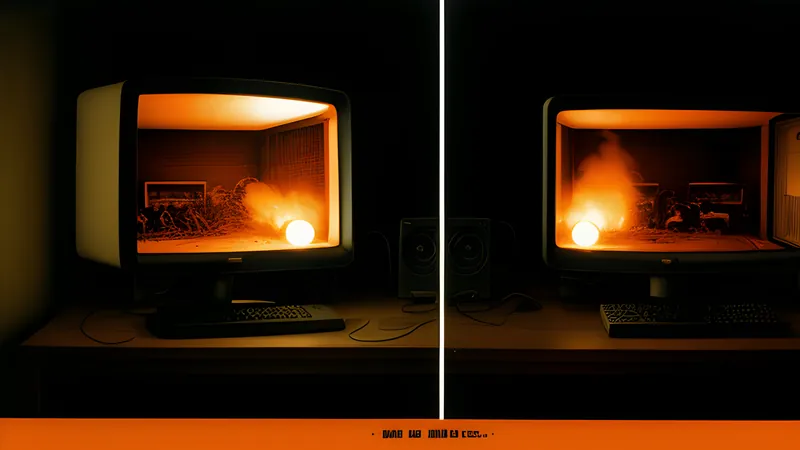
Mike Riedel wrote Spy vs Spy for the Commodore 64, and the thing that made it a technical event was a feature First Star branded Simulvision: a split screen, one player’s view on top and the other’s beneath, both live at once. That sounds modest now, when every co-op game on a shelf runs split-screen as a default. In 1984 it was close to unheard of for a competitive two-player game to run this way. The standard solution to head-to-head play on a home computer was hotseat — one player moves, hands the joystick over, the other player moves — because giving two people simultaneous, independent control over the same shared space was an engineering problem most studios didn’t attempt.
Spy vs Spy attempts it, and the design consequence is the whole game. Both spies explore the same embassy map at the same time, each confined to their own half of the screen, each able to act without waiting for the other to finish. There’s no turn to hide behind, no polite pause in which nothing bad can happen to you. Whatever the other player is doing, they’re doing it right now, off in some room you can’t see, and the not-knowing is the engine the whole design runs on.
Traps, items, an exit
The embassy holds a fixed set of secret items you need to gather into a briefcase — documents, cash, a passport among them — before making for the correct door and the airport transport waiting to carry you away before the clock runs out. You search drawers and cabinets for them. So does your opponent. Whoever fills the briefcase and reaches the exit first wins, which sounds like a scavenger hunt until you add the traps.
Beside each player’s half of the split screen sits the Trapulator, a panel of the gadgets and weapons available to plant — the game dresses its inventory screen as a piece of spy hardware rather than a menu, which is a small touch that does a surprising amount of work. It frames every choice you make as an operative selecting equipment rather than a player picking from a list, and it keeps the fiction present in a screen that would otherwise just be bookkeeping.
Every room offers hiding places for something lethal — dynamite in a drawer, a gun rigged behind a door, a bucket over a doorway, a mine under a rug — and you can plant them as you go, then get on with your own search while a trap sits waiting for whoever opens that drawer next. The genius is that both spies are doing this constantly and neither one can watch the other do it. You don’t see your rival building an ambush. You find out about it by walking into it, or you find their ambush by getting lucky and disarming it first, and the game is honest about the fact that a good part of the outcome is nerve rather than information.
That’s the paranoia the split screen produces without ever showing you the other half’s contents. You know a trap is out there somewhere in a room you haven’t reached yet, set by someone whose current location you can’t see and whose plans you can only infer from which drawers are already open. Every cabinet becomes a small bet. The tell is rarely visual — you learn to read a room’s furniture for whether it’s been disturbed, which is exactly the kind of paranoid attentiveness the source strip built its comedy on, transplanted into a system where you’re now supplying the paranoia yourself.
Meeting in the corridor
Traps are the indirect violence, set and left for later. The game also has a direct version: when the two spies end up in the same room, you can fight, hammering the joystick left and right or up and down to land blows, and the encounter resolves fast and physically rather than through any menu. It’s a small system, almost an afterthought next to the trap-and-search loop, but it matters for pacing — it gives the design an escape valve for the moments when stealth breaks down and both players find themselves face to face with no ambush prepared. Without it, an accidental collision would just be dead air. With it, the worst-case encounter becomes its own small game, resolved in seconds, and you’re straight back to searching drawers with whatever time you have left.
Why the slapstick survives the translation
The comic’s violence is cartoon violence — spies get blown up, dunked, clubbed, and are back for the next panel with nothing worse than soot on their coat and a fresh grudge. Riedel’s game keeps that tone rather than trying to dramatise it. A trap connecting doesn’t produce a cutscene or a death screen with weight to it; it costs you time, sets you back, occasionally strips an item you were carrying, and play resumes. The stakes are real inside the match — you can lose outright — but the texture stays slapstick rather than grim, which matters more than it sounds like it should. A game this competitive, this willing to have you actively sabotage a specific other human being sitting next to you, needs the violence kept cartoonish or the whole thing curdles into something meaner than the joke intends. First Star got that balance right, and a large share of the game’s four-decade shelf life is down to keeping the tone light while keeping the competition genuinely sharp.
The house as the real opponent
It’s worth being precise about what kind of game this actually is underneath the espionage dressing, because the genre it belongs to is bigger than “spy game” suggests. Spy vs Spy is a fixed-location item hunt on a timer, played inside a multi-room building you have to learn by walking it — the same basic shape as Skool Daze’s school you had to map by hand and Impossible Mission’s tower of guarded rooms, both from the same C64-era moment when “explore a building, collect the things, beat the clock” was doing a huge amount of design work across genres that don’t otherwise resemble each other. What Spy vs Spy adds to that shared template is a second human occupying the same building with contrary intentions, and that addition changes everything about how you move through a space you’d otherwise explore at your own pace. You’re not just mapping the embassy. You’re mapping it while assuming someone else is doing the same thing one step ahead of or behind you, and that assumption changes which rooms feel safe to linger in.
A design that got harder to build on than it looks
The obvious question forty years on is why more games didn’t simply take this shape and run further with it — simultaneous split-screen sabotage in a shared space is, on paper, a template with enormous range. Part of the answer is technical: real-time independent split-screen rendering was expensive on 8-bit hardware, and plenty of studios that wanted competitive multiplayer settled for hotseat or a shared single view precisely because Simulvision-style rendering cost cycles that could otherwise go into graphics or speed. Part of the answer is that the format demands a very specific kind of content — a space worth exploring, actions worth hiding, information worth denying the other player — and building that well is harder than it looks from the outside. Spy vs Spy makes the embassy, the trap inventory and the item list feel inevitable, which is the tell of a design that took real iteration to land.
Its DNA shows up later mostly by convergent evolution rather than direct lineage — any game where two or more players share a small space, race against a hidden opponent’s plans, and can sabotage without seeing the sabotage happen is doing a version of what Riedel built in 1984, whether or not the designers ever played it. That’s a wider compliment than a direct sequel would be. The idea turned out to be sound enough that it kept getting rediscovered.
Where to play it now
The Commodore 64 version is the one to seek out, though the Atari 8-bit release from the same year is essentially the same game and the later ports hold up reasonably well if C64 hardware or an accurate emulator isn’t to hand. It wants two people on one keyboard or two joysticks plugged into the same machine — there’s no meaningful way to experience the design solo, because the entire point is a second consciousness in the room making decisions you can’t see. Find that second person, split the screen, and the forty-year-old joke about two identical men who can’t stop building traps for each other still plays exactly as sharp as it did the week Mad first ran the strip.
Related Content