Silent Hill: The Fog That Was a Hardware Limit
Team Silent turned a PlayStation draw-distance problem into the defining image of horror
Contents
The PlayStation could not draw the town. That’s the origin of the most famous image in horror games, and it’s worth sitting with, because the industry has spent twenty-four years imitating a solution to a problem that no longer exists.
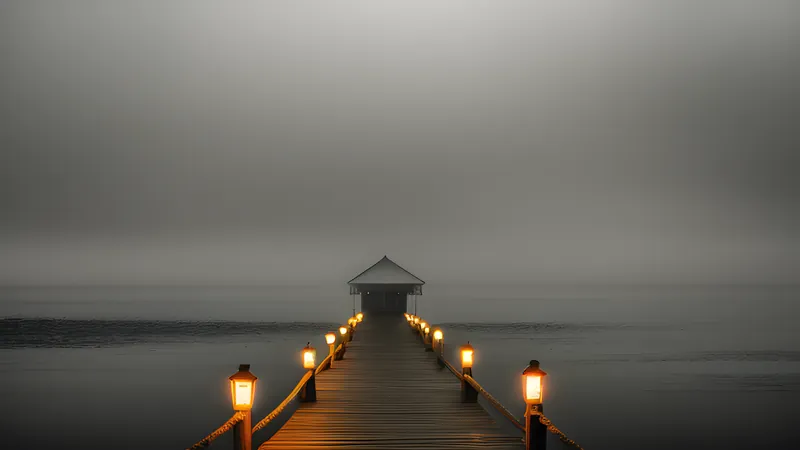
Silent Hill shipped on PlayStation in 1999, from Konami’s internal team — the group retroactively known as Team Silent, with Keiichiro Toyama directing. Its hero is a novelist looking for his daughter. Its setting is a foggy American town. And the fog is there because a 1994 console with a few megabytes of RAM cannot hold a street of geometry at draw distance.
The constraint, and what they did with it
Every 3D game of the era had this problem, and almost all of them solved it the same way: corridors. Put the player indoors, cap the sightline at a wall, and the hardware never has to render more than one room. Resident Evil went further and pre-rendered its backgrounds outright, which is why the mansion looks so much better and why you can never turn the camera.
Team Silent wanted an open town — free camera, walkable streets, no loading between blocks. That’s structurally impossible on the hardware unless the geometry vanishes at range. So they made the geometry vanish at range and put weather on top of it.
The clever part is the second decision. Fog alone would read as a technical apology; you’d see the pop-in and know. So they added the flashlight, which is a cone of visibility in a dark space, and the radio, which emits static when a monster is near.
Look at what that combination produces. Your sight is capped at a few metres. Your hearing has been converted into a proximity alarm with no directionality. You know something is close. You do not know where. You have to walk towards the static to find out.
That’s a fear machine built out of a draw-distance budget, and it is a better one than any amount of rendering power would have bought. The hardware limit forced them to think about perception instead of display, which is the more interesting problem.
The radio is the best idea in the game
I want to isolate the radio because it’s the single most efficient piece of design here.
It’s diegetic — a physical object Harry picks up early. It’s always on. It hisses when a creature is within a radius. It gives you no direction, no count, no distance readout.
The information content is one bit: something is here, or nothing is. And that one bit does more work than a full radar would, because a radar answers the question and the static only poses it. The player’s imagination fills the gap, and the player’s imagination is free and renders at any resolution the PlayStation cannot.
This is the inverse of what Kojima did the same year with the soliton radar in Metal Gear Solid — complete perceptual information, converting stealth into a legible puzzle. Team Silent went the other way: deliberate blindness with an alarm attached. Konami published both in the space of a year, which is a hell of a run for one company.
The cruellest detail is that the static persists in rooms where the monster is behind a wall, or on the other side of a fence, or unreachable. The radio doesn’t know about geometry. It just knows about distance. So you get warned about threats you cannot address, and you learn to walk through a hissing world doing nothing about it, which is a trained helplessness the game absolutely intends.
Sound design, and Akira Yamaoka
Yamaoka’s score is the other half and it’s the thing that dates least. He came onto the project late, replaced the previous composer’s direction, and produced a soundtrack built from industrial noise, prepared metal, tape hiss and detuned strings — with occasional passages of genuinely pretty guitar that arrive without warning.
The reason it works is that the noise and the ambience are the same material. In most horror games there’s an environmental bed and a music layer, and the music tells you how to feel. In Silent Hill, the boundary is deliberately unmarked. A grinding drone may be the score, or a machine, or a monster in the next room. You cannot tell which without going to look.
Combine that with a radio giving you undirected proximity alarms and you have an audio design where no sound can be dismissed. That’s an extraordinarily hostile place to spend eight hours, and it’s the reason the town gets into people.
Where it creaks
The combat is bad. Harry is a writer — he handles a pistol and a lead pipe like a man who has never held either, which is fine as characterisation and miserable as play. Aiming is auto-lock and unreliable, melee has a wind-up that whiffs on anything moving, and the correct answer to most encounters is to run.
To the game’s credit, running is usually allowed. The design mostly declines to lock doors behind you and force a fight. But there are enough forced encounters to expose the weakness, and the boss fights are uniformly poor — arena battles against a game that has no arena battle mechanics.
The Otherworld transitions can also become routine. The first flip from foggy town to rusted, grated, blood-lit nightmare is one of the great moments in the medium. The sixth is a level transition.
And the puzzles include the famous Shakespeare riddle on Hard, which is a genuinely fine piece of design, alongside a lot of key-in-the-hole busywork.
Where to play it
The PS1 original, on PS1 hardware or via emulation, is the version, and it’s the version that matters — the fog is a rendering artefact and it reads differently at higher resolutions with the mist over-sharpened. Play it on a CRT if you have one. The dithering was authored for a display that blurs it, and the game looks like a completely different, much softer object on the tube it was made for.
Silent Hill 2 is the better-written game and the one everyone cites; I’ve made that case in Silent Hill 2: the fog and the guilt. The first game is the better machine.
The verdict, argued
Silent Hill is the strongest argument in the medium for constraint as a creative engine. The fog, the flashlight, the radio and the fixed-camera-free town are all downstream of one hardware fact, and each is a better idea than the unconstrained version would have been.
That principle transfers. The C64’s SID chip produced a generation of composers who thought harder about melody because they had three voices. The Amiga’s blitter produced a parallax obsession that outlived the machine. Limits do this reliably, and the modern industry’s real problem is that nothing stops it any more.
The descendants took the fog as a look. Signalis is the recent one that took it as a method — building perception limits on purpose, on hardware that could render anything. That’s the correct lesson, and it took twenty years for anyone to draw it.
Spoilers below
The town’s logic resolves as a child’s, and that’s the piece most people miss on the first run.
Alessa Gillespie was burned in a ritual by her mother Dahlia, survived, and has spent seven years in agony in a hospital bed with enough psychic capacity to dream the town into a second shape. The Otherworld isn’t hell. It’s the room she’s lying in, extrapolated — the rust, the grating, the chain-link, the hospital fixtures, the surgical light. You’ve been walking through a burn ward the whole game and the game never says so.
The monsters follow from the same rule. They’re a sick child’s bestiary: the pterodactyl-things and the grey children and the dogs are what a bedridden kid with a school textbook and a picture book produces. The game is scrupulous about this — there’s nothing in the town that Alessa couldn’t have seen.
Which makes Dahlia the actual antagonist, and Kaufmann the most interesting person in the story. He’s the town’s drug dealer and the hospital’s director, complicit in the whole business, and he spends the game furious at Dahlia for losing control of a scheme he had a financial stake in. A cult story where one of the cultists is mainly annoyed about the operational failure is a much better idea than the god it’s building towards.
Cheryl is Alessa’s other half — the soul split at the ritual, given to Harry as a foundling, which means Harry’s daughter has been half of the thing tormenting the town for the whole search. The reunion is the game’s real ending and it’s over in about a minute.
The UFO ending, unlocked with a hidden item, is Konami declining to take any of this seriously, and it started a series tradition. It’s also the correct instinct: a game this committed to dread needs a pressure valve, and the valve being a joke about aliens is more graceful than a difficulty slider.
Related Content