Silent Hill 2: The Fog and the Guilt
Team Silent inherited a hardware workaround and turned it into a confession
Contents
There’s a version of this piece that’s mostly about the story, and it’s the version almost everyone writes. James Sunderland gets a letter from his wife Mary, who has been dead three years, telling him to meet her in the town where they were happy. He goes. The town obliges.
I want to write the other version, because Silent Hill 2 is remembered as a triumph of writing and it’s actually a triumph of systems — a game where the fog, the combat, the monster roster and the ending logic are all doing the thematic work, and the script is mostly getting out of their way. Team Silent’s 2001 game is the strongest argument in the medium that a theme is something you build out of mechanics rather than something you say out loud.
The fog was a lie that became a method
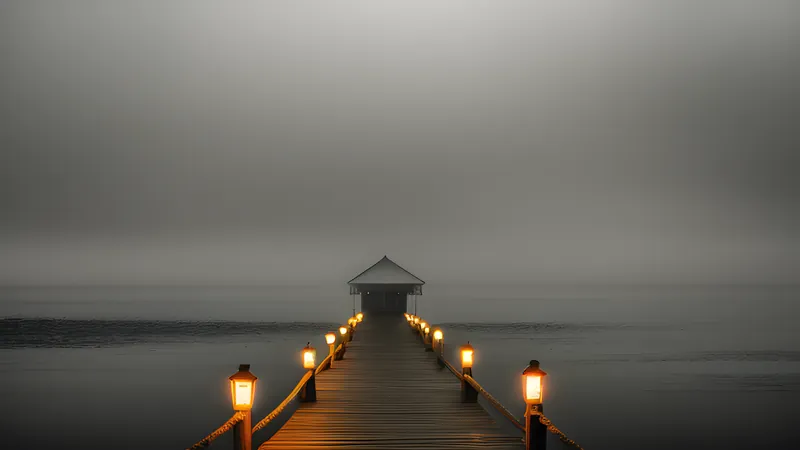
Start with the famous part. The original Silent Hill shipped on PlayStation in 1999, and the fog in it was an engineering answer to an engineering problem: the hardware could not draw a town, so Konami drew fifteen metres of town and filled the rest with weather. That story is well told — it’s the whole subject of the fog that was a hardware limit — and it’s usually where the anecdote stops, as a nice bit of constraint-breeds-creativity trivia.
The genuinely interesting move is what happened next. On PS2, Team Silent didn’t need the fog. The machine could have drawn a street. They kept it anyway, and once you keep a limitation you no longer have, it stops being a limitation and becomes a claim.
Here’s the claim, mechanically. Fog caps your information at walking pace. You cannot survey. You cannot plan a route, because a route requires seeing where it goes. Every intersection in Silent Hill is discovered at the moment you’re standing in it, which means the town has no shape in your head — you never build the mental map that makes a game world feel conquered. Eight hours in, you still don’t know where you are. That’s not atmosphere. That’s a designed condition, and it maps precisely onto a man who has no idea what he’s actually doing there.
The radio does the complementary job. Static rises when something’s near, so you always know a monster is coming and never where from. Information about threat, no information about geometry. Dread is exactly that gap, and Team Silent engineered it rather than scored it.
James can’t fight, and that’s the point
Combat in Silent Hill 2 is bad. It’s meant to be, though I’ve read enough defences of it to think the distinction gets lost, so let me be precise about what’s good-bad and what’s just bad.
The good-bad: James swings a plank like a man who has never hit anything. He’s slow to turn. The pistol is inaccurate and the ammo is thin. He has no combat idiom whatsoever, and the animation sells it — there’s a stiffness that reads as a middle-aged man doing something appalling in the dark rather than a protagonist executing a combo. Compare that to Resident Evil’s tank controls, where the awkwardness is a deliberate tax that makes each zombie a puzzle. Capcom’s clumsiness is tactical. Konami’s clumsiness is characterological. Both are choices; they buy different things.
The just-bad: the lock-on is inconsistent, and enemies in tight rooms can trap you in a corner where the camera has nothing useful to show. That isn’t thematic. That’s 2001.
But the reason the good-bad matters is what it does to the monster design. Masahiro Ito’s roster is not a bestiary of things that want to eat you. The nurses are shaped like a hospital and move like they’re in pain. The lying figures are bound. Almost everything in the town is restrained, bagged, or mutilated in a way that recalls a body rather than a predator, and you beat them to death with a piece of wood while breathing hard. The combat isn’t a challenge system with horror paint. It’s a repeated act of ugly violence against things that look like suffering people, performed by a man who is bad at it. Do that forty times and the game has told you something about James that no cutscene could.
Yamaoka scores the absence
Akira Yamaoka’s soundtrack gets praised as music and under-praised as design. The trick isn’t the compositions, good as they are. It’s the distribution.
Most of Silent Hill 2 has no score at all. What you get instead is industrial noise — grinding, distant metal, a hum with no source — laid at a volume low enough that you’re never sure whether you’re hearing the town or the machine you’re playing it on. Then, at intervals, a guitar figure with actual melody arrives and the effect is close to relief, which is a dangerous thing to feel in a horror game because it makes the next stretch of noise worse. Yamaoka is running the same dosing logic the fog runs: withhold, withhold, deliver, withhold.
The other half is that the noise layer doubles as a threat signal you can’t quite trust. The radio tells you something’s near. The ambience tells you nothing and sounds exactly the same either way. Two audio channels, one honest and one useless, and after an hour you’re listening hard to both.
The endings are a behaviour audit
This is the part I’d put in a design textbook. Silent Hill 2 has multiple endings, and it doesn’t ask you to pick one. There’s no dialogue wheel, no final door with two options. The game watches how you play and decides.
The record on this is well established: the ending logic reads hidden counters fed by ordinary behaviour. How often you open Mary’s letter and look at her photograph. How you manage your health — whether James runs at low health without healing, or hoards. How closely you stay to Maria, whether you keep her safe or leave her behind. Whether you listen to Angela’s conversations or walk out of them. None of it is flagged. All of it is habitual.
Think about what that achieves. Every other narrative game of the era asked you to perform a characterisation at a decision point, which produces the familiar problem of the player optimising a menu. Team Silent instead measured the things you do when you think nobody’s counting, and the result is an ending that reflects your actual play temperament. A player who neglects James’s health and dwells on the dead wife gets one ending. A player who plays protectively and attaches to the woman in front of him gets another. Neither player chose. Both revealed.
It’s an idea the medium has barely picked up in twenty-plus years, and it’s a cousin of the argument in save systems are ideology: the plumbing you don’t think about is making claims about you.
The real ancestor, and the descendants
The lineage everyone reaches for is cinema — Lynch, Kubrick, the Japanese horror wave. Fine, and Team Silent invited it. The mechanical ancestor is Resident Evil, straightforwardly: fixed cameras, item box, scarce ammo, locked doors and keys shaped like nonsense. Silent Hill 1 was Konami’s answer to Capcom, and 2 is that architecture with the survival economy loosened and the psychology tightened.
The descendants are easier to spot. Signalis inherits the mood and the refusal to explain; a whole generation of games in the horror canon beyond Resident Evil inherits the idea that the monsters should mean something. What almost nobody inherited is the behaviour-audit ending, which remains the most radical thing in the game and the least copied.
Where to play it
The PS2 disc is the reference version and the Xbox release adds the Maria side-scenario, which is a genuine addition rather than a bonus. The PC port has always been fiddly and the community has kept it alive with more devotion than Konami ever managed. The 2024 remake exists and is a different argument about the same material; if you’ve never played any version, I’d still start with an original, because the fog does something on that hardware that a modern renderer has to consciously reconstruct.
Play it alone, at night, and don’t look up the endings.
Spoilers below
Mary didn’t die three years ago. She died recently, and James killed her — she’d been ill for a long time, ill enough to be cruel about it, and he smothered her with a pillow and then built himself an amnesia to live inside. The letter is blank paper. The town has been running the confession the whole time.
Now go back through the systems. Pyramid Head is not a villain; he’s an executioner James imported from the town’s history because he wants punishing, and the two of them fight when James is finally prepared to stop being punished. Maria is Mary with the illness removed and the affection restored, which is to say she is the wife James wanted, and the game kills her repeatedly in front of him. Angela and Eddie are the two other roads out of the same guilt — one turns it inward, one turns it outward — and neither of them is offered as a warning so much as a possibility James is walking past.
And the endings, read back with the twist in hand, are devastating in a way they can’t be on a first pass. The player who let James run at low health, hoarding no medicine, staring at his dead wife’s photograph, gets the ending where he drives into the lake. That player was playing him suicidal for hours and had no idea the game was writing it down. The player who kept him healthy and stayed close to Maria gets the ending where he leaves the town with a replacement wife and the same lie intact.
That’s the achievement. Not the twist — the twist is fine, and you can see it coming if you’re paying attention. The achievement is that the game gathers evidence for eight hours and then hands you a verdict on the person you actually were while playing. Team Silent found the one thing that only a game can do to you, and they did it in 2001, and it still hasn’t been bettered.
Related Content