Shadow of the Beast: The Parallax That Sold Amigas
Thirteen layers of scrolling forest, a David Whittaker score, and almost nothing underneath
Contents
There was a specific noise an Amiga shop made in 1989, and Shadow of the Beast was the source of it.
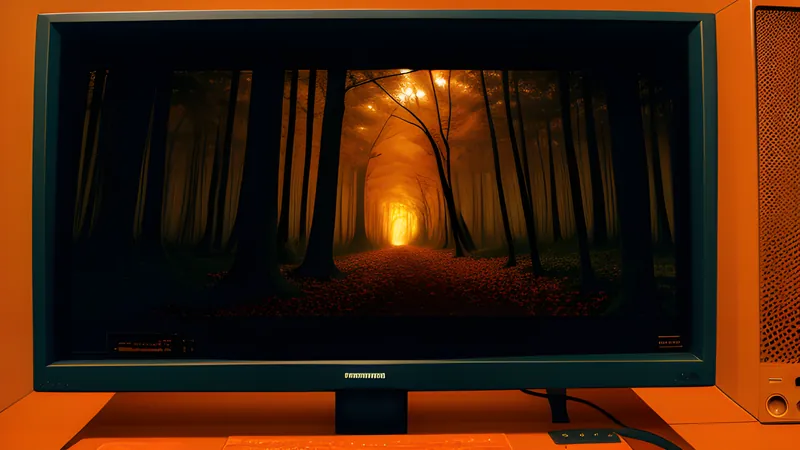
You would walk into a Dixons or a local computer place and there would be an A500 running the first level on loop, and a small crowd around it. Aarbron walks right. Behind him, a forest of trees slides past at one speed. Behind that, another rank at a slower speed. Behind that, another. Behind that, hills. Behind that, a horizon. Whittaker’s synth line loops over the top. Nobody was playing it. Everybody was watching it. That is the most honest possible description of what this game is.
Reflections — essentially Martin Edmondson and Paul Howarth, later of Driver — built it, and Psygnosis put it in a box with Roger Dean cover art and a T-shirt and charged £34.99 for it, which was outrageous money and which people paid. It shifted machines. If you want a single artefact that explains why the Amiga won its corner of the market, this is it, and the game inside it is barely worth twenty minutes of your life.
What thirteen layers actually cost
The headline is thirteen parallax layers. That number gets thrown around loosely, so: the Amiga’s display hardware could do a certain amount of this natively via playfields and hardware sprites, and Shadow of the Beast went well past what the hardware gave you for free. The technique is copper-driven — reprogramming the display on a per-scanline basis so that horizontal bands of the screen scroll at independent rates, with sprites pressed into service as additional scrolling furniture rather than as characters.
That is a real achievement and I want to be precise about why. Scrolling one background is cheap. Scrolling several at different rates means the machine is doing distinct work on effectively every raster line of the frame, at fifty frames a second, while also running a game. Reflections spent essentially the entire machine on the illusion of depth, and the illusion is good — it still reads. Put the first level on a CRT today and the forest still has volume, because parallax is not a trick your eye gets tired of. It is the actual mechanism by which you perceive distance.
But the budget went somewhere, and what it came out of is instructive. The screen has almost nothing on it. Aarbron, a couple of enemies at a time, a few platforms. Sixteen colours in most bands because the palette is being juggled per-scanline. The world is enormous and empty because the hardware could either draw depth or draw activity and Edmondson picked depth.
Then you press fire and discover the second cost. Aarbron punches. That’s it. He punches, he crouches, he jumps, and later there are a couple of weapons. Combat resolves to walking into a thing and punching it before it touches you. Enemies fly at you on fixed patterns from off-screen edges and the correct response to almost all of them is to have memorised that they were coming.
The difficulty is not design
Shadow of the Beast is famously brutal, and its brutality is the least interesting kind: it is a game that is hard because it is short.
You get one energy bar, drained by contact, replenished rarely. Enemies spawn from the screen edge with no telegraph, at speeds that make a first-sight reaction physically impossible. There is nothing to read, nothing to parry, no rule to learn beyond the specific sequence of this specific screen. When you die you go back a long way.
Compare it to how Another World uses death, two years later on the same machine. Chahi kills you constantly too, but every death teaches a discrete rule, the checkpoint is metres away, and each new threat is introduced once and then retired. Death there is punctuation. Death here is a wall. The difference is not one of severity — Chahi’s game kills you far more often — it is that one of them is teaching and the other is stalling.
The honest engineering read is that Reflections had a game roughly forty minutes long and needed it to occupy a £34.99 purchase, so the difficulty is the padding. Every generation has a version of this. This one is just unusually naked about it.
I will grant the one thing it earns: the transitions between environments are genuinely well-directed. The forest gives way to a cave gives way to a strange organic interior, and each shift is composed rather than merely occurring. Somebody with an eye laid this out. That eye had nothing to work with mechanically.
Whittaker’s score is the other half of the con
David Whittaker’s soundtrack does an unreasonable amount of the lifting, and it deserves to be discussed as the reason the demo worked rather than as accompaniment.
The Amiga’s Paula chip gave you four channels of sampled audio, and Whittaker used them for something almost nobody was doing in 1989: mood over melody. The main theme is slow, minor, sustained, with a long reverbed decay. It does not sound like game music. It sounds like a film about a forest. Set against a screen where thirteen ranks of trees are drifting past a lone figure, it produces an emotional response that the game underneath has done absolutely nothing to earn, and your brain — being a brain — assigns the feeling to the game.
This is the whole mechanism of Shadow of the Beast. Audio and visuals writing cheques that the mechanics never even attempt to cash. It is a mood generator with a fire button attached.
Whittaker knew exactly what he was doing, and the score outlived the game by decades — you can hear its DNA in an entire lineage of Amiga music that decided atmosphere beat catchiness. Turrican II went the other way, with Chris Huelsbeck writing an actual anthem for an actual game, and the difference in what those two scores are for is worth sitting with.
What it proves
Here is the part that keeps Shadow of the Beast interesting despite everything I have just said about it.
It moved hardware. It is a demo that got into a box and became a product, and it demonstrated that a sufficiently overwhelming technical showcase could sell a machine to people who would then go and buy Speedball 2 and Lemmings and Cannon Fodder on that machine. The Amiga’s software library exists partly because of a game with one punch in it. Every serious Amiga game of the following five years is standing on ground that this thing bought.
The demoscene understood it immediately and correctly: Shadow of the Beast was a demo. Reflections were doing in a retail box what the scene groups were doing on floppies passed around at school, which is to say wringing the copper for effects the hardware designers had not sanctioned. The scene’s judgment of it was never “good game” — the scene’s judgment was “how”.
It is also the exact template for a species of product that has never gone away. The technical showcase that sells the platform is a recurring role. Defender of the Crown had done the still-image version of this on the Amiga’s launch, and it too was gorgeous and hollow. The lineage runs directly to every launch title whose job is to demonstrate a new console’s fill rate. The showcase and the good game are separate professions and always have been.
The verdict, argued rather than asserted: this is one of the most important Amiga releases and one of the least worthwhile Amiga games, and both of those things are true because the same decision produced them. Reflections spent every cycle on the impression of a world and had nothing left over for a world. It worked. It sold machines. It is a landmark. It is also, once you have watched the forest go past three times, over.
Where to play it: the Amiga original is the only version that means anything — the ports to lesser hardware are a study in what happens when you remove the single thing a game consists of. Heavy Spectrum’s 2016 PS4 remake tried to build an actual combat system underneath the aesthetic, and it is a more honest game and a considerably less magical one, which is its own small argument.
Spoilers below
The story, such as it is: Aarbron is a human child stolen and transformed into a beast servant by the mage Maletoth. Partway through, he witnesses his own father being sacrificed, which breaks the conditioning and turns the whole thing into a revenge run. This is delivered almost entirely by the manual and one cutscene, and it lands with nothing because Aarbron has no interiority, no animation vocabulary beyond punch, and no relationship with anything on screen.
Shadow of the Beast II took the note and built a more conventional adventure with items and NPCs, which made it a better-structured game and killed the thing people had actually bought the first one for. Nobody remembers the second one’s forest.
Related Content