Resident Evil (1996): The Tank Controls Were the Point
The most mocked control scheme of the PS1 era was doing precise mechanical work
Contents
The received wisdom on Resident Evil is that it’s a great game hampered by clumsy controls, and that the 2002 GameCube remake and then Resident Evil 4 progressively fixed the mistake. This is wrong in an instructive way. The tank controls are the design. Remove them and you have a different genre, which is exactly what happened.
Capcom shipped Resident Evil on PlayStation in Japan on 22 March 1996, directed by Shinji Mikami, and the thing it invented was a horror game where the player’s own body is one of the hazards.
What tank controls actually do
Here’s the scheme: up moves Jill forward relative to herself, left and right rotate her on the spot. The camera is fixed, pre-rendered, and changes angle as you cross a threshold. Your input frame is the character; the camera’s frame is the room.
The standard complaint is that this is unintuitive. The standard complaint is correct and irrelevant. What the scheme buys is three things, and each one is load-bearing.
It makes the camera free. Because your controls are body-relative, the director can cut to any angle he likes — a high corner, a floor-level shot under a table, a long hall from behind a bannister — and your input still works. A camera-relative scheme breaks the instant the shot changes; you push left, the cut fires, and now left means something else and you’ve walked into a wall. Mikami wanted the shots. The shots require tank controls. Everything else follows.
It makes turning cost time. Rotating on the spot takes real seconds. So does the 180-degree quick-turn once you learn it. A zombie in a corridor is a geometry problem with a clock on it, because getting facing is half the fight. This is why the corridors are narrow. This is why zombies grab. Your inability to instantly reorient is the enemy’s whole threat model.
It converts the room into a commitment. You enter a hall, the door-load animation plays, the camera picks a shot, and you have to decide where you’re going before you can see what’s there. That door animation everyone jokes about is a load mask and a deliberate blindfold. You’re always entering a space with a plan you formed outside it.
Take those three away and give the player a free camera and an over-the-shoulder aim, and you get Resident Evil 4 — a magnificent game, and an action game. The genre shift is a direct consequence of the control shift. The tank was never a limitation Capcom was working around.
The mansion is a Metroid map with a keycard problem
The Spencer Mansion is the second great structural achievement, and it’s the one that’s been most thoroughly copied.
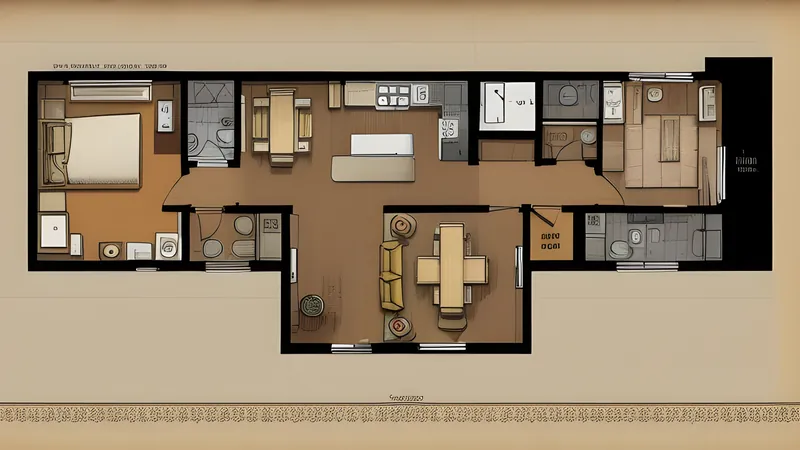
It’s a single interconnected building with locked doors, and the keys are shaped: an armour key, a sword key, a shield key, a helmet key. You go out, you find a key, you come back and open the door you saw an hour ago. Shortcuts unlock and stay unlocked. The map fills in.
That’s a metroidvania, and it’s why the mansion feels so much larger than its actual square footage. You are constantly rehearsing a space you already know, which means you are constantly rehearsing a space you already know is dangerous. The zombie you left alive in the dining room is a permanent tax on that route, and it will still be there in three hours. It’s the same locked-door dopamine described in the metroidvania map and the dopamine of the locked door, aimed at dread instead of delight.
Ink ribbons, and the honest economy
Saving requires a typewriter and an ink ribbon. Ribbons are finite. There are enough to finish the game and not many more.
This is the most argued-about system in survival horror and I’ll defend it on narrow grounds: it prices the route, not the fight. The question a ribbon asks is “have I made enough progress since the last save that losing it would hurt?” That question forces you to plan a loop — clear this wing, grab that key, get back to the save room — and a planned loop is the unit of play the mansion was designed around. Without ribbons, you save at the door of every room and the mansion collapses into a series of unconnected encounters.
The item box is the other half. Six inventory slots for Jill, eight for Chris, and a magic shared box that teleports between save rooms. It’s transparently unrealistic and it’s the correct call, because it makes inventory a routing problem instead of a hoarding problem. You cannot carry the shotgun and the key and the herbs. Something stays home. That’s a decision, made under uncertainty, about a building you half-remember — which is the whole game in miniature. I’ve said elsewhere why inventory management refuses to die; this is the exhibit for the defence.
The real ancestor
Alone in the Dark (1992) had fixed cameras, pre-rendered backgrounds, polygonal characters and a haunted house, four years earlier. Infogrames got there first and Resident Evil is downstream of it, which Mikami has never been coy about.
The other parent is Capcom’s own Sweet Home (1989, Famicom) — a horror RPG built around a mansion, permanent character death, item-based puzzle locks and scattered diary notes. The mansion structure, the notes-as-story, the inventory pressure: it’s all there in an 8-bit JRPG most people outside Japan never played. Resident Evil began development as a remake of it.
Knowing that changes how the mansion reads. The place is an RPG dungeon with a camera crew attached.
The zombie is a resource problem
One more thing the design gets right, and it’s the reason ammunition scarcity works here where it fails elsewhere. A downed zombie in the original is ambiguous — bodies stay on the floor, and a body you shot twice may stand up again when you next enter the room. There’s no kill confirmation and no corpse cleanup.
So the question at every encounter is how much you’re willing to spend on certainty. Two rounds probably drops it. Four rounds probably keeps it down. Neither is guaranteed, and the room is on your route for the next three hours. That’s a genuine gamble against an economy you can’t see the bottom of, and the 2002 remake’s Crimson Heads exist to make the ambiguity explicit — burn the body or meet something faster later.
Where it creaks
The voice acting is as bad as its reputation and the live-action FMV intro is worse. The B-movie defence gets deployed a lot and I don’t fully buy it — the badness is uncontrolled, and Resident Evil 4 would later show what deliberate schlock sounds like.
The puzzles are mostly of the “put the crest in the crest-shaped hole” school. They’re pacing furniture rather than thought.
And the mansion’s back half — the guardhouse, the labs — trades the tight interlocking geometry for corridors and set pieces. The best hours are the first six, in one building, with four keys.
Where to play it
The 1996 original is awkward to get hold of legitimately; the Director’s Cut is the commonly available PS1 version and rebalances some enemy placement. If you want the mansion as an experience rather than an artefact, the 2002 GameCube remake is the better game outright — it keeps every principle above, adds Crimson Heads to make “leave the body” a real decision, and looks extraordinary. Play the remake, then play the original for twenty minutes to understand what a 1996 PlayStation was doing.
The verdict, argued
Resident Evil is the moment horror stopped being about what’s in the room and started being about whether you can turn around fast enough. Its descendants split into two lines: the ones that kept the fixed camera and the friction — Silent Hill, and the modern throwbacks like Crow Country — and the ones that took the mansion and gave you a gun that works.
Both lines are healthy. Only one of them is still frightening, and it’s the one that understood the controls were an argument.
Spoilers below
Barry Burton is the most interesting thing in the game and the writing is too poor to know it. He’s a S.T.A.R.S. member being blackmailed by Wesker — his family is threatened — and across Jill’s campaign he keeps appearing at convenient moments, handing you a weapon, saving your life, and then vanishing on flimsy pretexts. He is betraying you, badly, and hating it.
The mechanical expression of this is genuinely good: Barry gives you the lockpick, which is Jill’s entire toolkit. Chris doesn’t get one and has to find every key manually, which is why Chris’s campaign is the harder one with fewer inventory slots. The character who is selling you out is also the reason your run is easier, and that trade is never remarked upon.
Wesker’s reveal — that S.T.A.R.S.’s own captain set the team up, that Umbrella owns the mansion, that the whole deployment was a field test with your friends as the sample — is the beat the series has been re-litigating for nearly thirty years. It works because of the mansion’s structure. You’ve spent six hours reading the researchers’ notes and finding their bodies. The lab under the house is the explanation for a building whose floor plan never made sense.
The Tyrant is the weakest ending in the game — a boss fight with a rocket launcher, which is the concession to spectacle every Capcom project of the era eventually made. The scarier ending is the self-destruct timer, because a countdown is the one mechanic that punishes exactly the thing the mansion taught you to do: think carefully about the route.
Related Content