Renegade: The Beat-'Em-Up Before the Genre Knew Itself
Technos Japan's subway brawler wrote the template a year before Double Dragon named it
Contents
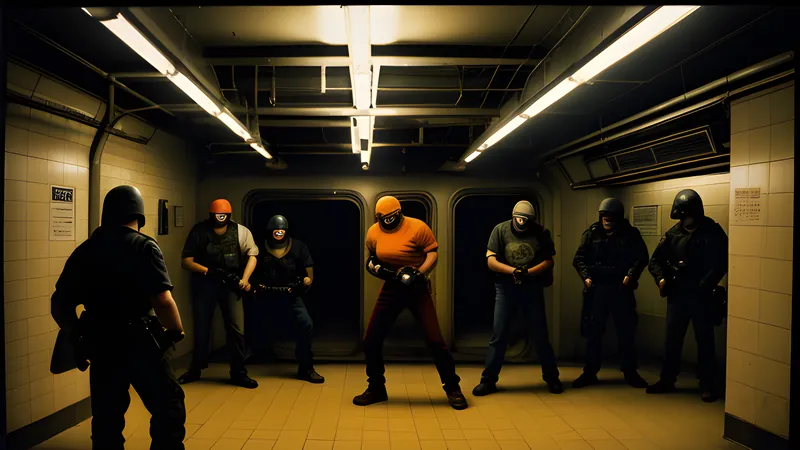
Technos Japan released Renegade into arcades in 1986 under the name Nekketsu Kōha Kunio-kun, and the game it produced doesn’t look, on paper, like it invented anything. A lone fighter walks rightward through a handful of urban settings — a subway platform first, then a street, a dockside, further scenes beyond — punching and kicking a procession of thugs who approach from both sides of the screen at once. There’s no jump button doing anything interesting, no combo system, no special moves beyond a basic punch and kick and a knee that catches anyone standing directly in front. What Renegade actually contributed to games wasn’t a move set. It was a spatial problem: enemies who can grab you from behind while you’re occupied fighting someone in front, forcing constant attention to a full 360 degrees around your character rather than the single forward-facing threat every earlier brawler and platformer had trained players to expect.
That problem is the entire reason the beat-’em-up exists as a distinct genre rather than as a subcategory of the platformer or the shooting gallery. Before Renegade, games that involved punching enemies — from Kung-Fu Master’s vertical corridor to countless one-on-one fighters — generally kept threats confined to a single axis, approaching from one direction a player could reliably anticipate. Renegade’s thugs surround. They close in from ahead and behind simultaneously, sometimes grabbing an arm to hold a player still while a second enemy lands free hits, and the correct response — pivot to face whichever attacker is more dangerous right now, accept damage from the other, and never assume the screen has a safe side — is a genuinely different cognitive task from anything a 1985 arcade cabinet had asked players to solve. That’s the template every beat-’em-up after it inherited: crowd management as the central skill, ahead of anything resembling enemy pattern memorisation.
The studio that immediately doubled down
Technos didn’t sit on that discovery. The following year, the same studio released Double Dragon, refining Renegade’s crowd-management problem with a genuinely expanded move set — a proper jump kick, a headbutt, weapons that could be picked up from downed enemies and used against the next wave — and, crucially, a second player fighting alongside the first rather than a single character managing the crowd alone. Double Dragon is the game that got the genre named and franchised, and it’s tempting, looking backward, to treat Renegade as merely a rough draft for the game that actually mattered. That undersells what Renegade got right on its own terms: the core tension of watching both sides of the screen simultaneously was already fully formed a year earlier, with a single move set stripped down to punch, kick, and knee, and no co-op partner to share the load. Double Dragon added texture to a problem Renegade had already correctly identified and correctly made central.
It’s worth being precise about why the sequel needed the extra players and the extra moves at all, rather than just reading it as more content for its own sake. A single-player crowd-management game has a ceiling on how interesting its central tension can get, because there’s only one character’s positioning to manage. Add a second player and the tension compounds — now you’re managing your own exposure while also reading a partner’s, deciding whether to peel off and cover their flank or hold your own ground — and that compounding is what let Double Dragon sustain a longer, more varied campaign than Renegade’s five scenes could support. Renegade proved the mechanic worked in its simplest possible form. Double Dragon proved it scaled.
Imagine’s second life
Imagine Software’s own history adds an odd layer of resonance to the C64 conversion. The original Imagine collapsed spectacularly in 1984, notorious for pouring money into two vapourware megagames, Bandersnatch and Psyclapse, that never shipped before the company folded live on television as part of a documentary crew’s cameras. Ocean rescued the Imagine name as a budget-adjacent label afterward, and by 1987 it was putting out arcade conversions like Renegade under a brand that had already lived through one very public failure. There’s no evidence the studio treated Renegade as some kind of redemption project specifically, but it’s a useful reminder that “Imagine Software” on a C64 cassette inlay in 1987 refers to a genuinely different operation, working under different management and different constraints, than the one that made headlines three years earlier for the opposite reason.
What the C64 conversion had to keep
Imagine Software, reconstituted under Ocean’s umbrella after its mid-80s financial collapse, published the C64 conversion of Renegade in 1987, and the port is remembered as one of the more faithful arcade-to-8-bit translations of its generation for a specific reason: the crowd-management problem that makes Renegade worth playing didn’t need arcade-grade hardware to function. Unlike a scaling road or a four-player cabinet, “an enemy sprite approaching from behind while you’re occupied in front” is a positional and collision question a 1MHz processor handles without strain — it’s the same category of cheap arithmetic that let Chase H.Q.’s ramming mechanic survive its own C64 conversion largely intact, just applied to melee range rather than vehicle contact.
Renegade’s C64 conversion earned its place in the C64 canon largely on the strength of that fidelity. What the C64 version compromised on was scale and animation fluidity rather than the mechanic itself — fewer simultaneous enemies on screen at once than the arcade board could throw at a player, choppier movement between animation frames, a smaller sprite budget overall. But the essential test — can you keep track of threats converging from two directions while your attack animation locks you in place for a beat too long — survived the conversion intact, because that test was never about how many pixels made up each thug or how smoothly they walked. It was about whether the player’s attention was correctly divided, and dividing attention costs nothing in processing power. It costs the player concentration, which is exactly the resource the arcade original was designed to tax.
The genre’s other ancestors
Renegade wasn’t operating in a total vacuum — Kung-Fu Master had already proven a side-scrolling brawler could hold an arcade audience a year earlier, and Irem’s Kung-Fu Master is routinely cited alongside it as co-founding material. But Kung-Fu Master’s threats arrive from one direction along a vertical scrolling corridor, one floor at a time, which keeps the positional question simple even as the pace increases. Renegade’s contribution was specifically the omnidirectional crowd, threats from both sides of a horizontally scrolling street simultaneously, and that’s the piece Double Dragon, and everything descended from Double Dragon, actually inherited. Genre histories that credit Kung-Fu Master alone for founding the beat-’em-up are crediting the right studio lineage but the wrong mechanic; the corridor brawler and the crowd brawler are close cousins with genuinely different central problems, whatever their shared ancestry in the arcade of the mid-1980s.
Before the genre had a name
Calling Renegade “the beat-’em-up before the genre knew itself” isn’t just a description of its release date relative to Double Dragon. It’s a description of the design’s own incompleteness in ways that are genuinely interesting rather than merely primitive. There’s no dedicated jump button doing traversal work the way later entries in the genre would demand; there’s no weapon pickup system letting a player turn an enemy’s own bat or knife against the crowd; there’s no co-op partner splitting the crowd-management burden the way Double Dragon and everything downstream of it would assume as a baseline feature. Renegade is the genre’s central idea isolated from every elaboration that would later make it feel complete, and playing it now is closer to reading a first draft of an argument that later writers refined rather than reading a lesser version of the same argument.
That’s a useful lens for Chase H.Q. too, released two years later from a different Japanese studio working through its own version of “a mechanic simple enough to be the whole game” — both titles found a single verb (surround-and-strike for Renegade, catch-and-ram for Chase H.Q.) and built an entire structure around proving that one verb, repeated with escalating fictional stakes, didn’t need embellishment to hold a player’s attention across multiple stages. Neither studio needed a second mechanic to make the first one worth building a cabinet around. What they needed was confidence that the one mechanic they’d found was actually load-bearing, and both were right.
Why a knee button was enough
It’s tempting to assume a genre needs a rich move set to feel complete, but Renegade’s restraint is instructive rather than embarrassing. The move set is exactly three actions — a punch, a kick, and a knee that only connects when an enemy is standing directly in front — and the entire skill expression of the game lives in when and against whom you use each one, a question of judgment rather than of memorising a longer list of inputs. The knee, specifically, is a commitment: it hits harder than the punch but locks the player’s character in place for a longer recovery window, which means using it while a second enemy is closing from behind is a real gamble rather than a free upgrade. That’s the same design principle Chase H.Q. would apply to its turbo boost a couple of years later — a single powerful option, deliberately expensive to use, doing more to create tension than a whole roster of lightly-differentiated moves would have.
A longer move list would have diluted that tension rather than deepening it, because the actual test Renegade poses is never “which move is correct here” in the way a fighting game asks. It’s “where should you be standing, and who deserves your attention first” — a positional question that a bigger combo system doesn’t actually help answer. Double Dragon’s later expansion worked because it added a second player to split that positional question across two people, a structural change rather than an admission that three moves had ever been an insufficient toolkit for one. The lesson generalises: a genre’s founding game doesn’t need every feature a later entry adds to be recognisably complete, provided the one mechanic it does have is the mechanic the rest of the genre will keep returning to.
Spoilers below
Renegade’s five scenes escalate location rather than mechanical complexity — subway platform, street, waterfront dock, an amusement pier, and a final confrontation — with each stage’s final opponent distinguished mainly by a slightly larger hitbox and faster recovery rather than any genuinely new attack pattern, which is consistent with a game built around one core problem rather than a boss-design showcase. The C64 port keeps all five scenes and their enemy placement largely intact, though the final scene’s crowd density is thinned compared to the arcade original, softening what was the coin-op’s hardest test of simultaneous-threat awareness into something a patient player can clear through careful positioning rather than reflexes alone. There’s no twist in the closing scene beyond the expected defeat of the last boss; the game’s ending is a single still screen rather than any kind of narrative payoff, which underlines how little Renegade’s design ever depended on story to justify the crowd-management test at its centre.
Related Content