Pacific Drive: The Car as the Character
Ironwood's survival driver builds a relationship out of panel damage and a broken wiper motor
Contents
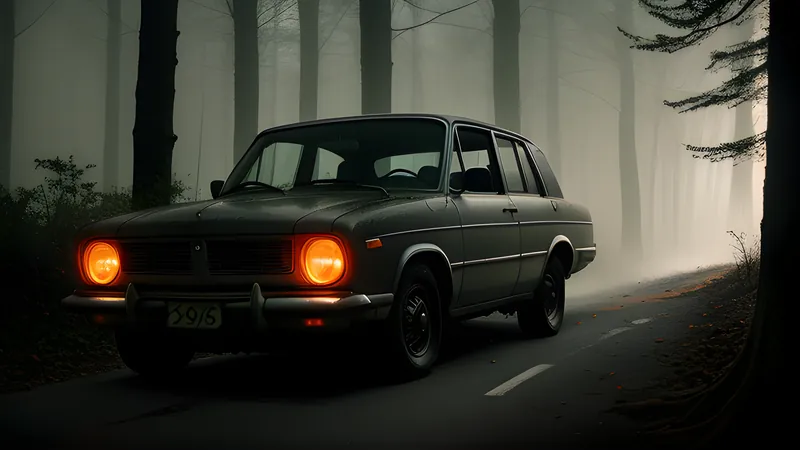
My car developed a habit. Every time I opened the boot, the headlights came on. Not a problem, exactly — a tic, the kind of thing you’d mention to a mechanic and he’d shrug at. Then, deep in a zone with a storm closing, I opened the boot to stow salvage in the dark and lit myself up like a fairground for everything in a hundred metres.
That’s Pacific Drive. That’s the entire pitch, and I’ve never played anything else that does it.
What it is
Ironwood Studios released Pacific Drive on 22 February 2024 for PS5 and PC. It’s a first-person survival driving game set in the Olympic Exclusion Zone: a cordoned-off stretch of the Pacific Northwest where the science went wrong in the mid-1950s and the resulting weather has spent decades not obeying anything.
You are a driver who ends up inside the wall with a battered station wagon and a garage. The loop is a run. You pick a destination, you drive out, you scavenge resources from abandoned buildings and dead vehicles, you find and gather the anchors that power the gateway home, the storm notices you’ve done it and comes for you, and you drive very fast at a portal while everything you own falls off the car. Then you’re back in the garage, and you spend what you took to repair what you broke.
Three voices come to you over the radio — Oppy, Tobias and Francis — and they have the good manners to be characters while doing a quest log’s job. The writing is dry and specific and knows exactly how much to withhold.
The quirks system is the reason to care
Survival games have a companion problem. If you want the player to be attached to something, the standard tools are a dog, a child, or a talking device with a voice actor, and all three work by telling you to be attached. Ironwood gave you a car and made the attachment emerge from a bug tracker.
Here’s the mechanic. As you drive through the zone and take damage, your car develops quirks: persistent, irrational faults that link an input to an unrelated output. Opening a door pops the boot. Turning left switches on the radio. Braking kills the electrics. The game tells you a quirk exists; it does not tell you what it is.
To fix it, you diagnose it. There’s a board in the garage where you record what you did and what happened, and you narrow the cause down by hypothesis and test — open the door, watch what moves, log it, do it again. When you’re confident, you name the fault and the car forgets it.
Look at what that does. In every other survival game, damage is a number you top up with a resource. Here damage is a behaviour, and diagnosing it is a genuine act of attention paid to a specific object. You cannot fix your car without learning your car. And because quirks are generated per-vehicle and per-playthrough, your wagon’s list of tics is unique to you and unshareable. It is not the car in the trailer. It’s the one you broke.
That is a character. Built entirely out of unreliable state transitions, with no dialogue, no face and no arc. It’s the smartest thing anyone did with a survival loop last year.
The design detail that makes it sing is that quirks are rarely fatal. A headlight that fires when you open the boot is an inconvenience nine times out of ten, so you don’t fix it immediately; you file it, you work around it, you build a private mental model of your vehicle’s nonsense and you drive accordingly. The game is counting on that laziness. It wants you carrying a list of small forgivable faults into a place where one of them will eventually matter, and the moment it does, the consequence is legible all the way back to a decision you made hours ago in a warm garage. Neglect with a delay fuse. Very few games trust the player to be the author of their own ambush that patiently.
The damage model does the emotional work
The other half is granular. The car is panels, doors, tyres, windows, battery, engine, and each is tracked separately with its own condition. A door doesn’t have hit points that lower a global health bar; a door gets bent, then it doesn’t close, then it comes off, and now you’re driving through acid rain with a hole in your side.
The result is a language of decline you can read at a glance. You come back into the garage and the state of the vehicle is the story of the run — one wing crumpled where you clipped a pylon, rear window gone from the hail, a tyre you limped home on. Nobody narrates it. You look at it.
This is where the game earns its comparison to Dredge, which runs a structurally identical bargain: go out, get greedy, the dark is coming, and every extra minute is a bet. Dredge tightens the screw with a grid-inventory Tetris and a sanity meter. Pacific Drive tightens it with the weather and the thing you know your rear axle can’t take. Both are pure risk-return engines dressed as a job.
The real ancestor is Jalopy (2018) — the Trabant road-trip game where the entire drama was a car that could not be trusted and a boot full of spare parts. Jalopy had the mechanical intimacy and no jeopardy. Ironwood added the storm.
Where it fights itself
The mid-game sags, and it sags for a reason worth naming. The tension curve depends on scarcity — on wanting a resource badly enough to take a stupid risk — and about fifteen hours in, the crafting economy tips. Once your wagon has decent panels and you’ve unlocked the better fabricator tiers, runs stop being desperate and start being errands. You go out with a shopping list. The storm becomes a schedule rather than a threat.
The game’s counter is to send you deeper, where the anomalies are nastier and the resources rarer, and it half works. But the fundamental problem is that survival crafting trees resolve, and a design whose whole engine is precarity has to keep the player poor. Citizen Sleeper understood this cleanly enough to make it the theme — the dice degrade, the clock runs, and stability is always a lie. Pacific Drive lets you actually get comfortable, and comfort is the death of it.
The anomalies are the other soft spot. They’re a wonderful bestiary in concept — the abductor, the bunnies, the things that follow — and in practice most of them resolve to “an object that damages the car if you’re near it” without a distinct answer. They behave like weather. The game would be better with fewer of them and a real verb for each.
And the driving, which had to carry everything, is merely good. The wagon has weight and the roads have surface, and it never quite reaches the tactile authority that would let the traversal itself be the reward on a bad-loot run. Compare what the handling model does for a game like Euro Truck Simulator, where the act of steering is sufficient payment for the hour: Pacific Drive needs the zone to be interesting because the road, on its own, isn’t. Every stretch of empty tarmac between anomalies is time the design has to fill with something, and the somethings run out.
The verdict
Pacific Drive is a great idea executed with real conviction and a loop that can’t quite sustain itself to the end. The quirks system alone justifies it — it is a genuine invention, the first mechanic I’ve seen that manufactures affection out of debugging, and I expect to see it stolen within two years by somebody with a bigger budget and less nerve.
Play it on PC if you have the option; the PS5 version is solid and the DualSense work is a nice touch. Play it in long sessions in the dark, and stop when the runs start feeling like a commute, because the first fifteen hours are as distinctive as anything released this year and there is no shame in leaving a game while you still like it.
Then go and take Dredge out for the same bargain in a boat, and Still Wakes the Deep when you want the same weather with none of the control.
Spoilers below
The Remnant material is where the fiction and the systems finally converge. The zone isn’t a disaster site; it’s an experiment that never stopped running, and the deeper you go the clearer it becomes that ARDA’s people didn’t lose control so much as decline to regain it.
What I keep turning over is the ending’s implication about the wagon. The whole game has been quietly suggesting that the car is a participant — the quirks that feel like preferences, the way the vehicle keeps turning up where you left it — and the late-game revelations make that literal enough to reframe every hour you spent with the diagnosis board. You weren’t debugging a machine. You were negotiating.
Which means the quirks system was never a repair mechanic. It was a conversation in the only language available, and the game had you fluent in it before it told you anybody was listening. Reveals rarely earn themselves that thoroughly, because most of them arrive as information. This one arrives as a re-reading of every hour you already spent at the diagnosis board, squinting at a wiper motor, being answered.
Related Content