Last Ninja 3: The Sequel That Ran Out of Road
System 3's 1991 finale had a bigger world than either predecessor and less to fill it with

Contents
By 1991, System 3 had already made the isometric action-adventure once roughly and once close to perfectly. Last Ninja 3 had the harder job of the three games: follow up a formula that Last Ninja 2 had already resolved into something close to definitive, on hardware that hadn’t meaningfully changed, without simply repeating what worked. It tried to solve that by getting bigger. Bigger, in this case, wasn’t the same thing as better.
A modern setting that traded atmosphere for square footage
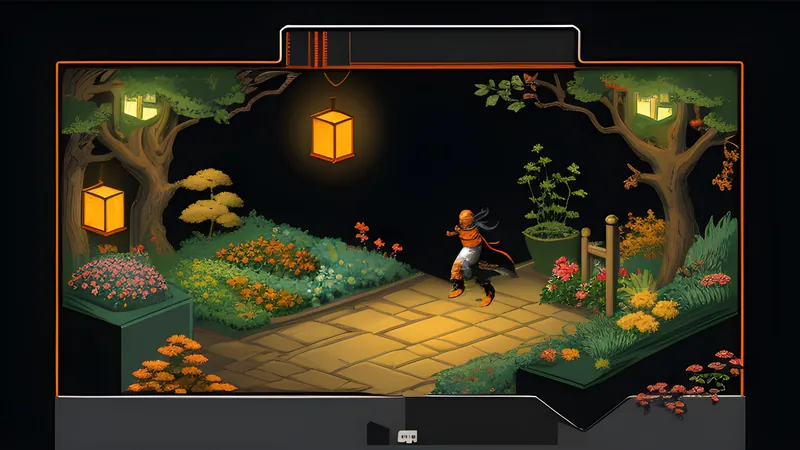
Where the first two games built their world from ancient gardens, temples and stylised historical architecture, Last Ninja 3 shifts its opening acts into a contemporary urban setting — city streets, industrial environments, office-like interiors — before eventually returning to more traditional temple territory in its closing stretch. That’s a genuinely interesting premise on paper: a ninja narrative colliding with a modern skyline. In practice, the urban zones trade away exactly the atmosphere that made the earlier games distinctive. A city street rendered in the same isometric tile style that made a moonlit garden feel mysterious mostly just looks like a city street — competent, recognisable, and far less evocative than the same engine pointed at a koi pond or a torch-lit corridor. The series' signature mood was built on a specific aesthetic vocabulary, and stepping outside it cost more atmosphere than the novelty of the new setting bought back.
More rooms, not more density
The core problem with Last Ninja 3’s scale is that the extra space is mostly extra traversal rather than extra design. Last Ninja 2 packed its zones with overlapping puzzle logic — an item found early paying off two areas later, a shortcut only visible once you knew what you were looking for — dense enough that revisiting a screen usually meant noticing something new. Last Ninja 3’s larger map spreads a comparable amount of actual puzzle content across considerably more ground, which means long stretches of walking between points of interest that don’t reward the walk with much beyond arrival. It’s the classic trap of a sequel mistaking bigger for richer, and it’s the same trap covered more generally in the piece on the map screen as an admission of failure — when a game’s world needs a map to manage precisely because there’s too much low-content space between the parts that matter, the size itself has become a design cost rather than a design win.
The combat that finally got fixed, arriving a little late
To its credit, Last Ninja 3 carries forward the combat refinements Last Ninja 2 introduced rather than regressing — hit detection and facing are clear, encounters are legible, and the isometric perspective problems that defined the original game are largely absent here. The irony is that this is the entry where combat matters least to the overall impression, because the surrounding world doesn’t generate the same tension the first two games built into their smaller, denser spaces. A fair, well-tuned fighting system is still worth having, but it can’t compensate for stretches of map that exist mainly to be crossed.
Loading, and what a bigger map does to it
The earlier games used their tape or disk loading breaks between zones as something close to a pacing device, a natural pause between distinct chapters. A larger map with more sprawling connective tissue between its points of interest strains that same structure: more time spent traversing means the loading breaks read less like scene transitions and more like interruptions to a walk that was already dragging before the pause arrived. It’s a small thing, but it’s indicative of how a decision made at the top level of the design — make the world bigger — quietly undermines choices that worked well in the previous two entries without anyone needing to touch them directly. The loading structure didn’t get worse. The pacing context around it did.
The parts that still land
It would be unfair to write Last Ninja 3 off entirely. Its puzzle logic, where it’s present, is as considered as anything in the earlier games — a sequence involving remotely triggering mechanisms to open a path elsewhere in the level, or combining a modern-setting object with a traditional weapon in a way the game clearly intends as a small joke about its own premise, shows the same design hand that built the first two entries. The closing act, once the game returns to the more classical temple aesthetic the series is known for, recovers a good deal of the earlier atmosphere, suggesting the team knew where the strength of the formula actually lived even as the middle of the game wandered from it.
An ambitious swing that deserved a better landing spot
It’s worth giving the modern-setting idea its due, because on paper it’s a more interesting choice than simply building a third traditional temple. Taking a character and a combat system built for ancient, stylised environments and dropping them into a contemporary industrial setting is a genuine tonal risk, the kind of swing a franchise usually only takes once it has enough goodwill banked to survive stumbling. System 3 had exactly that goodwill after two well-regarded predecessors, and the attempt to evolve the series’ aesthetic rather than simply repeat it is more admirable in intent than the finished product’s pacing problems make it look. The failure here isn’t a failure of ambition — it’s a failure to back the new setting with the same density of interlocking puzzle design that made the older settings work, which is a narrower and more fixable problem than a bad idea would have been.
What a third entry usually gets wrong
Last Ninja 3’s specific shape of disappointment — a bigger world with thinner content per square of map — is a pattern that shows up across a lot of trilogies once the first two entries have already solved a formula’s central problems. There’s a real temptation, once a design has been refined about as far as its current mechanics allow, to reach for scale as the only remaining axis of “more.” Scale is legible on the back of a box in a way that a genuinely new interlocking puzzle idea isn’t, and it’s cheaper to build ten sparse rooms than three dense ones. Last Ninja 3 isn’t a disaster by that measure — it’s a competent, occasionally clever isometric adventure with a fixed combat system and a strong closing act — but it’s a clear example of a team reaching for the wrong lever once the right ones had already been pulled twice before.
Why a franchise runs out of road
Last Ninja 3’s real lesson isn’t really about ninjas or isometric projection — it’s a case study in what happens to a successful formula’s third instalment when scale becomes the headline feature rather than an incidental consequence of a genuinely bigger idea. The first game established atmosphere and world-as-place over a rough combat system; the second balanced world and combat into something close to ideal; the third had nowhere obvious to go once both halves were already working, and expanding the map was the visible lever left to pull. Plenty of long-running series have made the identical mistake in the decades since — mistaking a bigger version of the same idea for a genuinely new one — and Last Ninja 3 is a clean, early example precisely because the previous two entries left so little room to actually improve on the core loop itself.
The trilogy’s actual legacy
Taken as a whole, the three Last Ninja games trace a genuinely useful arc for anyone studying how a design idea matures across a series: a rough, atmospheric first attempt that proves the concept and exposes its weakest mechanic; a second entry that fixes exactly that weakness while keeping everything that already worked; and a third that shows what happens once the obvious improvements have already been made and a team reaches for scale instead of a new idea. That arc is worth more, as a piece of design history, than any single entry judged in isolation — Last Ninja 3 is a weaker game than its predecessor, but it’s an instructive one, and the trilogy’s overall contribution to the isometric action-adventure format, discussed more broadly in the piece on the isometric canon from Knight Lore to Head Over Heels, rests as much on the mistake the third game makes as on the two triumphs that came before it.
Where to play it
Last Ninja 3 runs fine in any Commodore 64 emulator, and it’s worth playing as the conclusion to the trilogy rather than in isolation — the closing temple sequence lands considerably better with the earlier two games’ sense of place fresh in memory, as a return to what the series was always actually good at, rather than as a fresh introduction to an unfamiliar isometric world.
What to expect walking in cold
A player coming to Last Ninja 3 fresh, without the earlier two games as context, should expect a game that plays better than its reputation suggests moment to moment — the combat is genuinely fair, the puzzle logic that is present is genuinely clever — while still feeling longer than its content justifies. That’s a different experience from a badly made game, and it’s worth going in calibrated for pacing fatigue in the middle stretch rather than expecting a disaster, because the disappointment here is specifically about proportion, not about competence.
Spoilers below
The plot resolves the trilogy’s antagonist thread carried across the earlier two games, staging its final confrontation back in the traditional temple architecture the modern-city middle act largely abandons. The pacing issue described above is most visible in the middle third: the urban zones sit between a strong opening and a strong closing sequence, and a player who finds the pacing dragging in that stretch isn’t misreading the game — it’s the section System 3’s own design instincts seem least confident in, bracketed on both sides by stronger material.
Related Content