Firewatch: The Walking Sim with a Voice in Your Ear
Campo Santo built a mystery around two people who never meet, and let the disappointment be the point

Contents
Firewatch opens with roughly ten minutes of text-based backstory delivered as a choose-your-own-adventure-style prologue — Henry’s marriage, his wife’s early-onset dementia, the reasons he’s taken a summer job as a fire lookout in the Wyoming wilderness to get away from a life that’s stopped being liveable. Then the game proper begins, and for the rest of its runtime, Henry is alone in a forest, talking to his supervisor Delilah entirely over a handheld radio. Campo Santo, founded by former Telltale writer Sean Vanaman and designer Jake Rodkin alongside former Double Fine art director Olly Moss, built an entire game around a conversation between two people who spend the whole story in different watchtowers and never once share a scene in person.
That’s the whole mechanical premise, and it’s a genuinely bold one for a debut studio to bet a first release on: no combat, no traditional puzzles, no inventory beyond the odds and ends the walkie-talkie system tracks as Henry moves through the Shoshone National Forest. The player’s actual verbs are walking, looking, and talking — Henry keys his radio, Delilah answers, and the entire emotional architecture of the game is built on the chemistry of that back-and-forth, voiced by Rich Sommer and Cissy Jones respectively with a naturalism that carries most of the game’s dramatic weight.
Tension built entirely on absence
Removing physical proximity between the two leads is a structural decision with real consequences for how tension gets generated. Most narrative games rely on body language, shared space, physical stakes — someone standing between you and a door, a face registering fear in a cutscene. Firewatch has none of that available. Every beat of trust, suspicion, flirtation or unease between Henry and Delilah has to be carried by voice performance and word choice alone, which puts enormous pressure on the writing to do work that visual staging usually handles for free.
The game largely succeeds at this because it treats the radio conversations as genuinely reactive rather than as a linear script with branching flavour text. Player-chosen dialogue options shape what Henry says in the moment and how Delilah relates to him across the rest of the summer — warmer, more guarded, more teasing — building a relationship that feels earned through accumulated small talk rather than scripted toward a single inevitable outcome. That’s a difficult trick to pull off with only two voices and no visual reinforcement, and it’s the single biggest reason the game’s central relationship became the thing most players remember years later, ahead of any plot mechanics.
A conspiracy plot that isn’t really about the conspiracy
The surface plot escalates the way a thriller should: Henry starts finding evidence of surveillance in the forest, a cut phone line, a ransacked supply cache, the unmistakable sense that someone or something is watching the two lookouts specifically. Campo Santo lets that tension build across most of the game’s length with genuine craft — environmental storytelling doing the work of planting clues that make a player reasonably suspect a government cover-up, a secret research operation, something with real institutional stakes behind it.
The design choice that made Firewatch both admired and, for some players, disappointing is that this build-up resolves into something much smaller and much sadder than a conspiracy thriller’s payoff usually demands. That’s a deliberate subversion of expectations the genre had spent decades training players to have, and Campo Santo knew exactly how divisive it would be — the mystery plot exists specifically to be revealed as smaller than the fear it generated, which is a much harder thing to write convincingly than an actual conspiracy would have been. Writing a fake-out that still lands as satisfying rather than as a cheat requires the emotional material underneath it to be strong enough to carry the letdown, and the Henry-Delilah relationship is exactly that load-bearing structure.
The prologue as a design commitment
The text-based opening deserves more credit than it usually gets for how much load-bearing work it does. Rather than opening on gameplay and dribbling out Henry’s backstory through environmental notes or overheard flashbacks — the more conventional approach for narrative games of this scale — Campo Santo asks the player to read through Henry’s entire marriage in a stripped-down, choice-driven prologue before the game proper even begins. Every choice in that sequence is small and largely cosmetic in outcome, but the cumulative effect is that the player arrives at the fire lookout already invested in exactly the right things: a marriage collapsing under illness neither party chose, and a man running from grief he hasn’t figured out how to carry.
That investment is what makes the radio relationship with Delilah land as fast as it does once the game proper starts. A different structure — reveal Henry’s backstory gradually, mid-conversation, spread across the whole runtime — would have asked players to feel two relationships develop simultaneously with no established emotional foundation for either. Front-loading Henry’s marriage into ten uninterrupted minutes before any radio contact happens means the player already understands exactly what kind of man is picking up that handset, which is why the earliest exchanges with Delilah carry more weight than their content alone would suggest.
The look of a game about being alone in a beautiful place
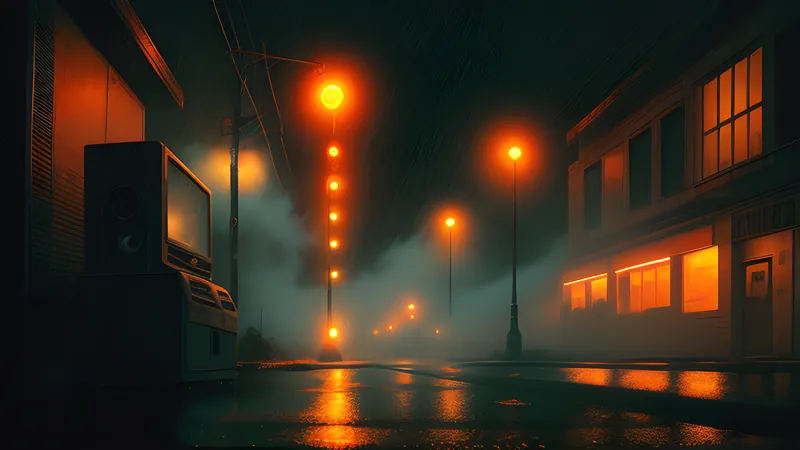
Olly Moss’s art direction gives the Shoshone forest a stylised, poster-flat colour palette — warm oranges and deep teals rendered with enough abstraction that the wilderness reads as beautiful rather than merely realistic, closer to a national park travel poster than a photogrammetry-scanned forest. That choice matters for tone: a hyper-realistic wilderness would push the game toward survival-horror atmosphere, all shadow and threat, where Firewatch’s actual emotional register is loneliness shot through with genuine beauty, a summer that’s simultaneously an escape and an exile. The visual approach and the radio-only relationship reinforce each other; both are about a landscape too large and too empty for two people to be anything but intensely present to each other across an impossible distance.
A dialogue system built for improvisation, not branching trees
Mechanically, the radio conversations run on a system that feels closer to overheard real speech than to a conventional dialogue tree. Rather than presenting Henry with obviously weighted options — a kind line, a cruel line, a joking line laid out for the player to weigh against each other — Campo Santo’s writers frequently gave him choices that read as tonally similar on the surface, forcing a player to actually think about what Henry would say rather than pattern-match toward whichever option looks like the “good” outcome. Sommer and Jones recorded enormous volumes of dialogue to support this, including numerous small variations and callbacks that only surface if a player made a particular earlier choice, which is an expensive way to build a script and a large part of why the relationship reads as genuinely responsive rather than illusioned into feeling that way.
That density of recorded variation is easy to miss on a single playthrough, which is itself evidence of good design: the game never draws attention to how much unseen content exists behind any given conversation, because doing so would undercut the naturalism the whole radio relationship depends on. A player who replays the game and picks different responses discovers an entirely different flavour of the same relationship, warmer or more guarded depending on choices made hours earlier, without the underlying plot ever needing to branch structurally to support it.
Where it sits in the walking-sim argument
Firewatch arrived in the middle of an ongoing critical argument about whether games built around walking, looking and talking — without traditional combat or puzzle mechanics — deserved to be called games at all, a debate covered at length in the walking simulator was always a bad name. Campo Santo’s answer, made through design rather than argument, was to build a game whose central mechanic — a two-way radio conversation shaping a relationship in real time — genuinely couldn’t exist in any other medium. A novel can render internal monologue; a film can show two actors’ faces. Only a game can let a player’s specific word choices, made under time pressure with a radio key held down, actually shift how a supporting character relates to them for the rest of the story. That’s interactive in a way passive media structurally cannot be, whatever the genre gets called.
The studio’s subsequent path underlines how much of a genuine achievement the original was: Campo Santo was acquired by Valve in 2018, and Firewatch remains the clearest single argument for treating walking-and-talking as its own legitimate design space rather than as adventure games with the puzzles quietly removed.
Spoilers below
The surveillance Henry uncovers turns out to be the work of Ned Goodwin, the father of a previous season’s fire lookout, Brian, who died in an accident in the forest years earlier. Ned has been living off-grid in the wilderness ever since, monitoring the area obsessively and interfering with Henry and Delilah’s summer out of a mixture of grief, guilt and paranoia rather than any institutional conspiracy — no government agency, no research cover-up, just one broken man who never left the woods his son died in.
That reveal recontextualises everything the game spent hours building toward genuine dread: the cut phone line, the ransacked cache, the sense of being watched, all of it traceable back to a grieving father rather than a sinister organisation. It’s a purposefully anticlimactic answer, and the game earns it by giving Ned’s grief real weight rather than treating him as a mere plot device — his son’s death, and his own slow unravelling in isolation, mirror Henry’s own reasons for running from his marriage into this same wilderness. The final scene, Henry evacuated by helicopter ahead of a wildfire with Delilah’s fate left deliberately ambiguous, closes the radio relationship without ever letting the two characters occupy the same physical space, which is exactly the note the whole design has been building toward from the opening keyed transmission.
If the two-hander, voice-only relationship structure is what stayed with you, The Walking Dead is worth returning to for how it built comparable emotional stakes through remembered choices instead, proof that this specific kind of intimacy can be engineered through more than one mechanical approach.
Related Content