Dying Light 2: The Parkour Held Up, the Rest Sagged
Techland built the best moving body in the genre and then asked it to carry a city that wasn't ready
Contents
Techland released Dying Light 2 Stay Human in February 2022, seven years after the original Dying Light and after a development stretch long enough that the studio had to publicly reset expectations more than once before launch. What arrived was a game whose central promise — that you’d move through a city better than in any other open world on the market — was almost entirely kept, wrapped around a story and a choice system that couldn’t match it. Revisiting it now, well past the patches that quietly fixed most of its early problems, the parkour still holds up as one of the best traversal systems anyone has built. Everything Techland hung on top of it needed another year.
The vault, the grab, the read
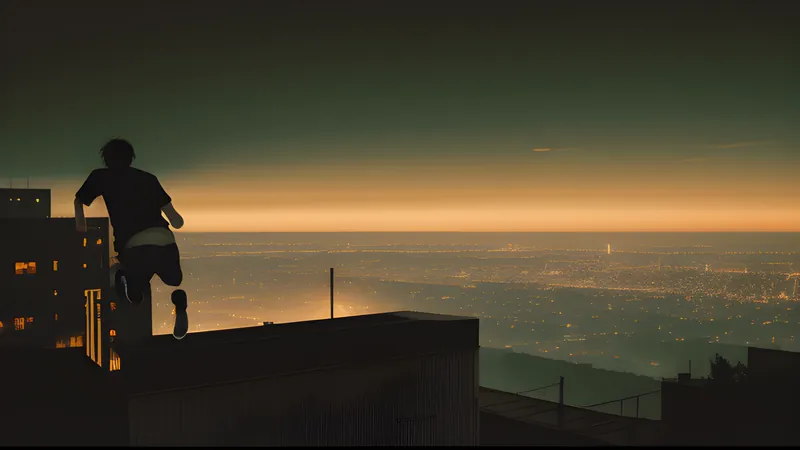
Villedor, the game’s fictional city, is built explicitly as a parkour playground: rooftops with deliberate sightlines between ledges, pipes that exist to be climbed, gaps sized to reward a running jump rather than punish it. The traversal itself is a small vocabulary — vault, mantle, slide, wall-run, grapple hook once you unlock it — but the vocabulary is deep enough that reading a rooftop becomes its own kind of puzzle-solving, done at speed, under pressure, usually with infected chasing you. That’s the trick Mirror’s Edge never quite pulled off at scale: it had the vocabulary but not the open canvas to use it on. Techland gave the same grammar an entire city to write sentences in.
The stamina bar is the mechanic doing the quiet work here. Every vault and climb costs stamina, and running dry mid-leap means falling, so a route across three rooftops is also a stamina budget you have to plan before you commit to it. That single resource turns movement from a button-press into a decision with real stakes, and it’s the reason Villedor’s rooftops feel like a system rather than scenery. Compare it to a game like Assassin’s Creed’s free-running, which never runs out and therefore never asks you to plan — as Jay covered revisiting Assassin’s Creed Valhalla’s raid loop — and the difference in what “climbing a building” actually means as a piece of design becomes obvious immediately.
Night is the real game
The day/night cycle is where Dying Light 2 earns its horror-adjacent reputation. By day, Villedor’s infected are slow and sun-averse, mostly avoidable; by night, the city fills with faster, aggressive variants and a handful of the terrifying Volatiles, and your UV flashlight becomes a countdown timer rather than a tool. Choosing to go out after dark is choosing to trade safety for GRE Anomaly loot caches that only spawn at night, and the tension of that choice — do I need this enough to risk it — is the game’s best sustained idea, built directly on the first Dying Light’s day/night structure and sharpened by giving night-time traversal an actual mechanical cost rather than just more monsters to dodge.
Chases at night work because the parkour system and the horror system are the same system. You don’t fight your way out of a Volatile encounter; you climb, because climbing is what you’ve spent the whole game getting good at, and the chase becomes a rooftop-reading test under the worst possible conditions. It’s one of the only times in recent open-world design where the central traversal mechanic and the central threat mechanic were clearly built by people talking to each other.
Combat as the weaker twin
Melee combat carries over the original game’s blueprint of degrading weapons and blueprint crafting, but it never reaches the same standard as the traversal it sits alongside. Swinging a pipe wrench at a Biter is functional rather than expressive, and the skill trees split between Parkour and Combat make the split legible on a menu screen without making combat feel like it was designed with the same care. Weapons degrade and break, forcing regular trips back to a crafting bench, and the loop settles into the kind of busywork a crafting menu too often becomes once you’ve found a build that works. It’s a rare case where a sequel visibly improved one half of its inherited formula and left the other half almost untouched, and the contrast is sharper for it: every fight is a reminder of how good the game is at the thing it’s not currently asking you to do.
The paraglider and the grapple hook
Two traversal unlocks arrive later in the campaign — a paraglider and a grapple hook — and both are the kind of mid-game system change that either breaks a game’s spatial logic or deepens it. Villedor deepens. The paraglider turns rooftop-to-rooftop planning into something closer to three-dimensional route-finding, letting you launch off a tower and choose a landing spot blocks away, while the grapple hook lets you close short gaps you’d otherwise have needed a running start for. Neither replaces the core vault-and-climb vocabulary; both extend it, adding options to an already legible system rather than layering in a new one that competes for the same attention. It’s the traversal design equivalent of a good expansion pack — more verbs, same grammar — and it’s the clearest evidence in the whole game that the parkour team understood exactly what they’d built and how carefully it could be pushed without breaking.
The faction choices that don’t hold weight
Dying Light 2 pitches its story around a choice between two factions — the authoritarian Peacekeepers and the scrappier Survivors — with the promise that your decisions reshape which utilities (water, power) different districts get and how the city’s politics play out. In practice, the visible consequences are narrower than the marketing suggested: districts change hands and cosmetic details shift, but the underlying quest structure and the map’s core shape stay largely fixed regardless of which side you back. It’s a choice system that performs consequence more convincingly than it delivers it, and the gap between the pitch and the result was one of the most consistent criticisms at launch.
The protagonist, Aiden Caldwell, and his search for his missing sister carries the main plot, and it’s serviceable rather than memorable — competent voice work in service of a story that never quite earns the emotional beats it reaches for. None of that would matter much in a shorter game built purely around movement and night-time tension. Stretched across the twenty-plus hours Dying Light 2 asks for, the thinness of the writing becomes harder to ignore precisely because the parkour keeps proving how good the studio’s craft can be when it’s focused.
Villedor against Harran
The original Dying Light’s city, Harran, was smaller and messier, built more like a sun-baked Middle Eastern sprawl than an architectural showcase, and its parkour worked because the geography was dense and improvisational rather than purpose-built. Villedor swings the other way: a post-collapse European city rebuilt in tiers by survivor factions, with rooftop gardens, scaffolding bridges and windmill towers deliberately placed to give the parkour system clean lines to read. It’s a more legible city and a less lived-in one, and the trade-off is honest — Techland chose readability over texture, and the choice paid for itself in how much better the traversal reads at speed compared to the first game’s rougher edges.
The GRE Anomaly loot caches, appearing only after dark and guarded by the toughest infected variants in the game, are the closest thing Dying Light 2 has to an endgame loop once the main story wraps: high-risk night runs for the best late-game gear, functionally similar to the original game’s Bozak Horde challenge arenas but woven into the open world instead of walled off in a separate mode. It’s a smarter piece of design than it gets credit for, because it uses the existing night-time tension system as its own reward structure rather than bolting on a separate horde-mode minigame, and it’s one more example of a game that consistently finds its best ideas at the intersection of movement and dread.
What five years of patches fixed
Techland committed publicly to five years of post-launch support, and the updates since launch — new story content, difficulty and traversal tweaks, community-requested quality-of-life changes — have addressed a lot of the early complaints about pacing and combat feel without touching the faction system’s fundamental shallowness. That’s the right order of priorities for a live game to fix things in, but it also means the deepest criticism of Dying Light 2 was never really fixable with a patch: the choice architecture was thin by design, not by bug, and no update was going to retrofit branching consequence into a city that was built around one.
What to play now
Play it for the parkour and the night runs, and treat the faction plot as flavour rather than the point. The traversal alone justifies the time, and Villedor at night — flashlight dying, a Volatile two rooftops back, a ledge just out of stamina range — is still one of the tensest regular moments open-world action design has produced this decade. Turn the difficulty up before you start; the extra pressure on stamina and infected aggression makes the traversal decisions matter in a way the default settings soften. Co-op, which lets up to four players run the same city together, sharpens the tension further — a shared chase is a shared stamina budget, and watching a friend miscalculate a jump two rooftops over is its own kind of spectator sport.
Techland’s next open-world project inherits a genuinely hard act to follow on movement alone. Very few studios have built a traversal system this legible at this scale, and it’s worth remembering that fact independently of how the story around it landed — the parkour is the argument for the game, and it’s an argument that still holds up years after the patches stopped mattering.
Spoilers below
Aiden’s search for his sister Mia eventually reveals she’s alive and has been experimented on by the GRE, the pre-outbreak organisation responsible for the original virus research, tying Villedor’s present-day politics to the same biotech conspiracy that underpinned the first game’s backstory. The endgame lets you choose whether to destroy or preserve a central tower’s water supply infrastructure, one of the few choices in the game that visibly locks off a late area depending on which way you go, and the ending state of the city — thriving under whichever faction you backed, or sliding back toward collapse — is reflected in an epilogue slideshow rather than in any meaningfully different final mission.
Related Content