Bruce Lee: The Platformer That Fits in One Room
Datasoft's 1984 licence game turned a temple into twenty single-screen puzzles and a fistfight for two
Contents
Datasoft’s Bruce Lee shipped in 1984 for the Atari 8-bit line, then the Commodore 64 and Apple II, riding a licence that had almost nothing to do with what the game actually asks of you. Ron J. Fortier and Kelly Day built a platformer that never leaves a single screen for longer than it takes to solve it, and that discipline is the reason it’s still worth booting up forty years later.
The temple is twenty rooms, not one world
There’s no scrolling in Bruce Lee. The game is a sequence of static chambers — roughly twenty of them — each one a self-contained arrangement of platforms, ropes, trampolines and lanterns. Touch every lantern in a room and a door opens to the next; miss one, or trip a rigged lantern that detonates into a spark ball, and you’re rebuilding your position from scratch. There’s no map, no inventory, no dialogue. The whole design vocabulary is jump arcs, timing windows and the shape of a room you have to read at a glance.
That constraint reads as a limitation of 1984 hardware — no smooth scrolling on an 8-bit micro without serious engineering — but Fortier and Day made it a virtue. Every room is a discrete puzzle you can hold entirely in your head, which means the difficulty curve comes from composition rather than sprawl. A late-game chamber isn’t bigger than an early one; it’s built from the same handful of elements — a trampoline chained to a sliding block chained to a lantern you can only reach mid-bounce — recombined into something that demands you’ve actually learned the physics rather than memorised a layout.
The sliding blocks are the game’s cruellest idea. They crawl back and forth across a platform on a fixed cycle, and they will crush you against a wall if you misjudge the gap. Bruce Lee never explains this. You learn it by dying against one, which is a design ethic Datasoft shared with a lot of early-80s platform games and which Jumpman, discussed in the piece on the platformer as a showcase for its own level editor, also leaned on: the room teaches you by killing you exactly once in a way you won’t forget.
Reading a room before you enter it
Because nothing scrolls, every hazard in a Bruce Lee chamber is visible from the doorway. That sounds like a small mercy, but it changes how you approach each screen: instead of feeling out a level by walking into the unknown, the game hands you the whole puzzle up front and dares you to solve the choreography before committing to it. A rope hangs beside a gap you can’t clear by running jump alone; a trampoline sits under a ledge with a lantern bolted to its underside, so the only way to reach it is a bounce timed off the trampoline’s own rebound rather than your jump button. The skill the game is actually testing isn’t reflexes in isolation — it’s the ability to read a static arrangement of objects and correctly sequence a route through it, which is closer to a spatial logic puzzle wearing a platformer’s clothes.
This is also why the game ages so well next to flashier contemporaries. A Bruce Lee room has no filler geography — no corridor you walk down purely to arrive somewhere, no decorative platform that exists for scenery rather than function. Every object on screen is either a route, a hazard, or a lantern, and the room is exactly as big as it needs to be to pose its one idea. That economy is closer to a puzzle designer’s instinct than a platformer’s, and it’s part of why the format still reads as clean rather than dated.
The trampolines carry most of that logic. They don’t just launch you upward — the height and arc of the bounce depend on where you land on the mat and how much momentum you’re carrying into it, which means the game is quietly teaching physics rather than a fixed animation cycle. Later rooms chain two or three trampolines together, so a route that looks impossible from the doorway turns out to be a single continuous bounce if you enter it at the right speed. Once you notice that the trampoline responds to your approach rather than just your button press, whole categories of room stop looking like memorisation exercises and start looking like physics problems with a correct, repeatable answer — which is a more durable kind of difficulty than a hazard that simply has to be dodged on reflex.
Two players, one of them is the villain
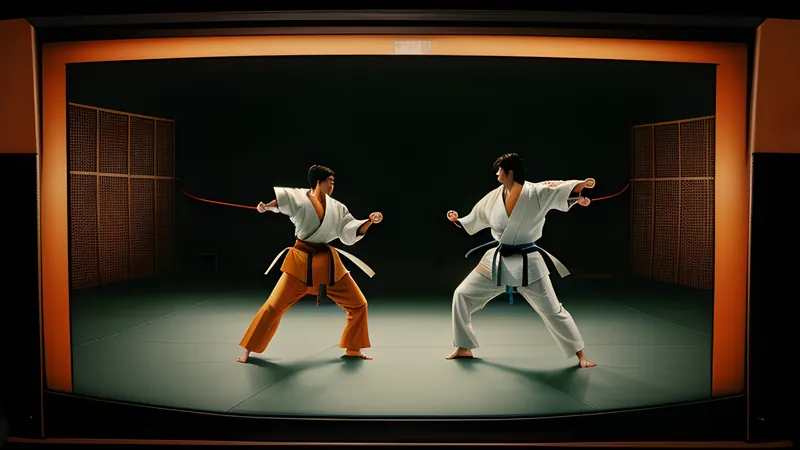
The feature that made Bruce Lee stick in playground memory wasn’t the solo game — it was the two-player mode, where the second controller doesn’t give you a co-operative partner. It gives you the antagonist. One player runs Bruce Lee toward the lanterns; the other plays as the game’s ninja enemy, whose job in single-player is an AI routine that patrols and lunges, and who becomes a second human trying to physically block, chase and knock the other player off platforms in real time.
This is a strange and slightly ahead-of-its-time idea: an asymmetric versus mode bolted onto what looks, from the box, like a straightforward solo action game. It works because the level geometry that makes the single-player puzzles legible — clean sightlines, readable platform shapes, no scrolling to lose track of where anyone is — does double duty as an arena. You can see the whole fight. There’s no camera to argue with, no off-screen threat. The one-room discipline that shapes the puzzle design turns out to be exactly what a two-player brawl needs too.
It’s worth setting this against International Karate, released the following year and a much more deliberate fighting game. Bruce Lee’s versus mode wasn’t trying to be a fighting game — the moveset is a platformer’s jump-and-kick, not a combat system with range and timing tiers — but it landed on the same insight from a different direction: put two humans in a legible space with a small verb set and the tension takes care of itself. IK refined that into a genre. Bruce Lee stumbled into it as a bonus mode and never followed up, and the asymmetry — one player solving a puzzle, the other actively trying to break the solution — is closer to what modern asymmetric multiplayer games are still chasing than anything else released on 8-bit hardware in 1984.
The enemy that isn’t a gun
Bruce Lee’s default enemies — a green ninja figure and a squat brawler wielding a stick — can’t be killed. You can’t punch through the game’s threats the way the Bruce Lee licence might suggest; the closest thing to combat is a kick that staggers an enemy for a moment, buying you room to run past rather than a kill. The entire survival strategy is spatial: know where the trampoline throws you, know the sliding block’s rhythm, know which lantern is trapped, and outmanoeuvre rather than fight.
That’s a more interesting design decision than the box art lets on, and it puts Bruce Lee in a small, good-humoured tradition of 8-bit games that license a punch-em-up premise and then quietly refuse to build a punch-em-up underneath it. The tension the game generates comes from precision platforming under a ticking threat, not from a health bar grinding down. Impossible Mission, released the same year, made the identical move even more explicitly — Dennis Caswell removed the attack button entirely and built a puzzle game out of the absence. Bruce Lee keeps a token kick, but the actual solution to every room is always movement, never violence, and both games arrived at that answer independently in the same twelve months, which suggests it wasn’t a coincidence so much as a shared realisation about what an 8-bit machine’s collision detection could actually support with any fairness.
A licence game that didn’t cash the licence in
It’s worth remembering how routine it was, in 1984, for a film or celebrity tie-in to be a cynical, rushed cash-in — a sprite wearing the right colour scheme bolted onto a generic engine and shipped before the licence expired. Bruce Lee the film star had been dead for over a decade by the time the game appeared, and Datasoft’s design owes nothing to any specific Bruce Lee film; there’s no plot beat borrowed from Enter the Dragon, no digitised likeness, just a yellow tracksuit that gestures at Game of Death and a temple setting that could be any pulp adventure serial. What the team spent their effort on instead was the platforming grammar — which is exactly backwards from how most licensed games of the era allocated their budget, and exactly why this one outlived its licence.
Why the one-room shape still teaches something
Modern platformers mostly solved the scrolling problem decades ago, so the constraint that shaped Bruce Lee’s design no longer exists as a technical limit. But the underlying lesson — that a single, fully-visible space with a small number of interacting elements can generate more genuine difficulty than a sprawling one — hasn’t gone anywhere. It’s the same principle behind every good boss arena, every escape-room game, every roguelike floor that works because you can see the whole threat at once rather than half of it scrolling in from off-screen.
Bruce Lee never asks you to remember a map. It asks you to read a room, once, correctly, and then execute. Twenty rooms later, that’s the entire game — and it’s a tighter, more legible design than plenty of licence tie-ins from the same year managed with far more colour or, in 1984’s case, far more sprite flicker. The Bruce Lee name got the game onto shelves. The one-room structure is why people still talk about it.
Where to play it
Bruce Lee runs cleanly today on any Commodore 64 emulator, and the Atari 8-bit original is just as playable if you’d rather see where the design started. Either version, it’s a short commitment that still teaches its lesson cold, and the two-player mode is worth firing up with someone else in the room precisely because there’s no netcode, no input lag excuse, and nowhere on the single screen for either of you to hide.
Related Content