Assassin's Creed IV: Black Flag — the pirate game hiding inside the assassin game
Ubisoft built the best pirate simulator of its decade and had to call it something else
Contents
Assassin’s Creed IV: Black Flag arrived on 29 October 2013 for the outgoing PS3 and Xbox 360, then again a few weeks later as a launch-window title for PS4 and Xbox One, with a PC release the same November — the rare cross-generation game that actually ran well on both ends of that split. It sends the series to the Caribbean during the golden age of piracy, roughly 1715 to 1722, and hands you Edward Kenway, a Welsh privateer-turned-pirate who stumbles into the Assassin-Templar conflict almost by accident, mostly interested in plunder and only reluctantly in the ancient-artefact plot the series usually treats as its main event.
The ship is the actual protagonist
Say what you like about the Assassin’s plot Kenway keeps getting dragged into — the game everyone actually remembers is about the Jackdaw, Edward’s brig, and sailing her is easily the best thing Ubisoft Montreal built into the franchise up to this point. Naval combat runs on broadside cannon volleys, mortar arcs, chain shot to strip enemy sails and swivel guns for close-range harassment, tuned so that outmanoeuvring a faster ship or timing a broadside against a target’s exposed flank matters as much as raw firepower. Boarding an enemy vessel mid-fight, once its hull and crew morale are low enough, drops you into a scripted melee sequence that ties the ship combat directly back into Ezio-lineage sword-and-counter fighting, so the two systems never feel like separate games stapled together.
The open sea itself does something the series’ city maps hadn’t managed before: it makes exploration feel genuinely optional and genuinely rewarding at the same time. Sailing between islands, you’ll spot a distant ship silhouette worth chasing down for cargo, a floating wreck worth diving, a fort worth reducing to rubble before you can dock — none of it marked with a mandatory waypoint, all of it visible from the crow’s nest if you bother to look. That’s a meaningfully different open-world texture to the courier-quest-dense cities of Assassin’s Creed II, trading dense urban parkour for a wide, legible ocean where the player’s own curiosity is doing more of the navigational work than a minimap ever did.
The Jackdaw itself is a genuine progression system, not just a vehicle. Plunder gold and timber upgrade her hull strength, broadside power, ram reinforcement and cannon range, so a ship that gets outgunned by a man-of-war in the opening hours is, by the campaign’s back half, capable of hunting the largest legendary ships in the Caribbean on your own terms. Ubisoft tied that upgrade path to the same exploration loop driving everything else — the money funding it comes from the same shipwrecks and cargo runs you’d be doing anyway — so improving your ship never feels like a grind bolted on beside the fun, it feels like the fun compounding on itself.
Underwater diving is a smaller system doing similar work in a different register. Sunken wrecks scattered across the map hold treasure chests and Animus fragments, guarded by shark patrols and a finite air supply that turns each dive into a short, tense resource-management puzzle rather than a straightforward collectible grab. It’s a minor addition against the scale of the naval combat, but it’s another example of the game finding a fresh verb for a setting most open-world games would have used purely as scenery.
When the plot admits it’s the side content
Here’s the honest structural joke at the centre of Black Flag: Edward isn’t an Assassin for most of the game. He steals an Assassin’s robes and Hidden Blade off a corpse near the start purely to pass himself off as one and profit from the reputation, and spends a solid two-thirds of the story caring far more about building a pirate fortune at Nassau than about the Sage-hunting, Observatory-seeking Templar conspiracy the plot keeps trying to hand him. That’s unusual honesty from a Ubisoft open-world game — the mainline story missions are frequently the least interesting hour you’ll spend in any given session, competing against treasure maps, Mayan stelae collectibles, fort sieges and the simple pleasure of hunting whales for crafting materials along a coastline the game clearly enjoys building more than it enjoys writing dialogue for.
Nassau itself is where that structural joke becomes text. Edward arrives to find a genuine pirate republic — a fictionalised but historically grounded take on the real Republic of Pirates that operated out of the Bahamas between roughly 1706 and 1718, with Edward Thatch (Blackbeard), Charles Vane and Benjamin Hornigold all appearing as characters rather than footnotes. The game’s clear affection for that period of loosely governed, self-declared piracy — men who’d walked away from the Royal Navy and East India Company to run their own economy on their own terms — gives Edward’s early arc a genuine political texture the Templar plot, by comparison, treats as a checklist of ancient-artefact locations to visit in sequence.
The honest case against it
That imbalance is also the biggest weakness once you notice it. The assassin-versus-Templar plot, still nominally the A-story, has to keep interrupting a pirate captain who has no real stake in it, and Edward’s arc — greed curdling slowly into a conscience once he sees the human cost of the slave-trade economy the Caribbean runs on — deserves more room than the Sage subplot leaves for it. The modern-day frame story fares even worse here than in earlier entries: you play an unnamed Abstergo Entertainment employee mining Kenway’s memories for a video game, a meta joke about the series itself that’s clever once and thin by the fourth or fifth time it interrupts a naval chase to remind you.
Fort assaults, one of the game’s signature repeatable activities, also wear out their welcome faster than the open sea does. Reduce a fort’s garrison and cannon strength with your ship, then storm it on foot to raise your flag, and the loop is satisfying the first handful of times and mechanically identical the twentieth — there’s no meaningful escalation in how a fort fights back, just more health and more soldiers standing in the same positions.
The on-foot city sections — Havana, Kingston, Nassau’s streets — also feel like the series treading water rather than advancing. The parkour, the counter-heavy melee, the tailing-and-eavesdropping side missions are close to unchanged from the Ezio games four years earlier, and standing next to the naval combat’s genuine innovation, that stagnation is far more visible here than it was when the whole game was on foot. The ship’s leap forward simply makes the unchanged ground game look like it stopped evolving somewhere back in 2010.
Where it sits
Black Flag’s real place in the series’ history is as proof that the Assassin’s Creed engine could support an entirely different genre wearing the same hood, a lesson Ubisoft would return to more explicitly with the RPG-scale reinventions in Valhalla and Shadows a decade later. It’s also the clearest sign the series had drifted a long way from Assassin’s Creed II’s tight, character-first Renaissance revenge story — Ezio’s plot needed you invested in Ezio; Black Flag’s plot survives entirely on the strength of a ship most players would happily sail forever, with or without an assassination at the other end of the voyage.
The commercial verdict backs that reading up. Black Flag sold better than the Ezio trilogy’s individual entries and became, for years, the highest-selling game in the franchise’s history, a result Ubisoft itself has attributed largely to word of mouth about the naval combat rather than to marketing around the Kenway family plot. That success is exactly why the studio kept the ship system alive across the following two entries, Rogue and Origins’ more limited version of it, before eventually retiring full naval combat as later games shifted toward the RPG structure Valhalla and Shadows now represent. A pirate side system outselling and outlasting the assassin plot built around it is as clear a verdict as a franchise can hand down on its own priorities.
It’s also worth naming what Black Flag proved about licensed open-world design more broadly: that a studio willing to admit its franchise’s core promise — stalk, infiltrate, assassinate — wasn’t the most interesting thing on offer that year could still ship the game people wanted, provided it built something genuinely excellent to replace the attention it was borrowing from. Few franchise entries are this candid about which of their two halves the team actually wanted to make.
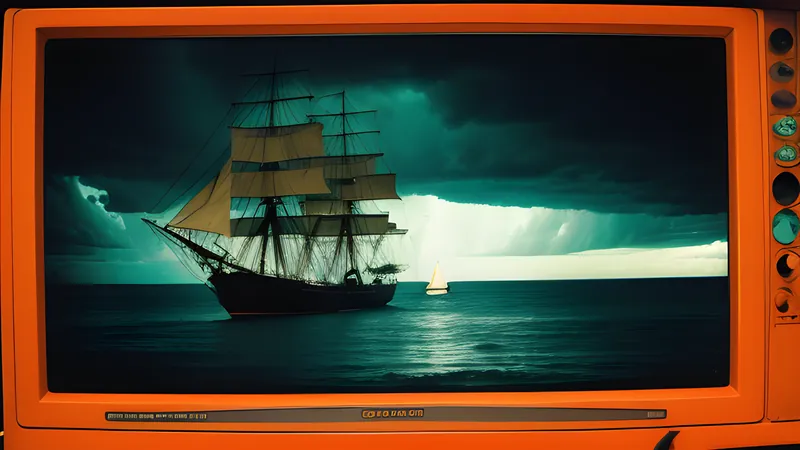
Weather is doing more design work here than in most naval games of the period, too. Storms roll in with genuine visual drama — towering waves that can swamp a smaller ship, lightning that occasionally strikes a mast — and Ubisoft Montreal tuned the physics so a storm meaningfully complicates an active fight rather than just dressing the skybox, forcing you to manage a listing ship and a fight at the same time. It’s the kind of environmental system that could easily have been decorative, and instead it’s load-bearing.
Spoilers below
The Sage Edward has been pursuing across the Caribbean, Roberts, turns out to be a Templar plant using Kenway’s own greed against him, and Edward’s late discovery of the Observatory — a Precursor device capable of watching anyone alive through their bloodline — comes paired with the deaths of two of his closest crew, Adéwalé’s near-loss and, more permanently, the execution of his old friend and fellow pirate captain by the British Navy, which finally tips Edward from mercenary opportunism into genuine Brotherhood loyalty. The epilogue’s flash-forward to an adult Haytham Kenway, Edward’s son and the antagonist of Assassin’s Creed III, recontextualises the entire game retroactively as a tragedy about how a father’s compromises get inherited by a son who never knew him well enough to learn from them.
Related Content