Another World: The Cinematic Game With No Words
How one man on an Amiga 500 built a story that never explains itself
Contents
The first thing Another World does is kill you with a slug.
You arrive on the alien world flat on your back in a pool of water, having been dragged there by a lightning strike through a particle accelerator you were, seconds earlier, calmly operating. You stand up. Tentacles are already reaching for your ankles from below the surface. You swim up, you climb out, and a small black creature ambles over and eats you. No warning. No tutorial box. No health bar to watch drain. Just the death animation and a return to the water, slightly wiser.
Eric Chahi released this in 1991 through Delphine Software, having spent roughly two years building almost all of it himself on an Amiga 500. It went out as Out of This World in North America, a title change I have never forgiven, because the French original is the whole thesis in two words. North America is another world. So is the room you are sitting in. The game’s argument is that arriving somewhere and understanding it are separate problems, and it refuses to solve the second one for you.
The engine is the aesthetic
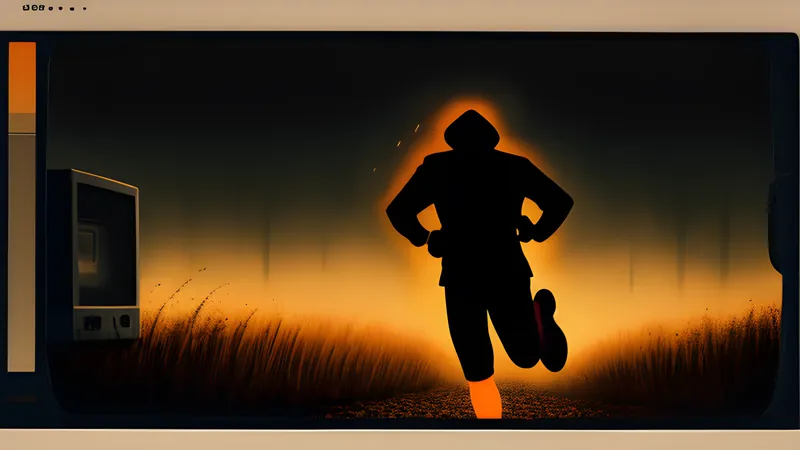
Chahi did something structurally strange for 1991. Rather than draw pixel art, he wrote a polygon renderer and drew the entire game as filled vector shapes — characters, backgrounds, cutscenes, all of it. The protagonist is a handful of flat polygons. The alien horizon is a few large ones. There is no texture anywhere.
This was a compromise that became a style. Vector shapes are cheap to store and cheap to redraw, which is how a game with this much animation fitted onto Amiga floppies at all, and how it later ported to machines with wildly different graphics hardware. Chahi built the game on top of a bytecode interpreter — a small virtual machine of his own design — so the game logic lived in portable instructions and only the renderer had to be rewritten per platform. That decision is why the thing exists on the SNES, the Mega Drive, the 3DO and every subsequent format that has ever wanted it. The engineering choice and the artistic choice are the same choice.
And the flatness pays off in a way I do not think Chahi could have fully predicted. Because nothing has texture, nothing has scale cues, and everything reads as silhouette. When you step out of the cave onto that first vast red plateau, the reason it lands is that your eye has no detail to hold onto and must take the composition whole. A more capable machine, a more literal artist, would have filled that horizon with rock formations and lost the shot.
The animation is the other half. Chahi rotoscoped the protagonist — filmed reference and traced the movement, the same technique Jordan Mechner had used for Prince of Persia two years earlier. Lester runs like a person, weight forward, arms wrong in the way real running arms are wrong. When he gets shot he crumples with actual joints. Against a world of abstract shapes, one accurately-observed human body is enormously persuasive.
Nobody says anything and you understand everything
There is no dialogue in Another World. The aliens speak, and what they speak is invented phonetic gibberish with no subtitles, no translation, no codex entry. There is no HUD. There is no inventory. There is no text on screen during play at all.
What replaces all of it is staging. Within about ninety seconds of arriving you are captured, hung in a cage next to a large alien prisoner, and the two of you break out together. That alien — the fan name is Buddy, the game never names him — becomes the most legible character in the whole thing without a single translated line. He hauls you up ledges you cannot reach. He waits. He goes on ahead when you are slow. At one point he holds a door.
You understand him because the game only ever shows you behaviour, and behaviour is what we actually use to read people. A dialogue tree would have made him worse. Every RPG companion who has ever explained his motivation to me in a barked line during combat is a step down from an alien who has never said a word I can parse and whose loyalty I would nonetheless bet money on.
The world does the same thing. There is a city here, a prison, a power system, a species with a hierarchy and guards and something like a leisure class. None of it is explained. All of it is drawn. You infer a civilisation from architecture and from who gets to walk where, which is roughly how you would infer one if you actually fell into it.
Death as punctuation
You will die constantly, and the game is engineered around that fact rather than apologetic about it.
Deaths are instant, spectacular and specific. The slug. The guard’s gun. The falling rock. The eel. Checkpointing is generous and immediate — you restart metres away, seconds ago, with no loading screen worth the name and no penalty other than having watched yourself die. The loop is: encounter a novel threat, die to it, learn its one rule, execute. It is a memory game dressed as an action game, and it is entirely honest about that from the slug onwards.
What makes it work rather than infuriate is the pacing of the reveal. Almost every screen introduces exactly one new idea and then retires it. The shield-and-shoot gunfight system arrives about a third of the way in — hold to charge a shot, tap for a quick blast, or plant an energy shield — and the game then spends the rest of its runtime asking increasingly interesting questions with those three verbs and never adding a fourth. That is a discipline almost nobody has. Modern games would have given me a skill tree by the second gunfight.
The whole game runs somewhere around a couple of hours if you know it. It is short in the way a film is short, and Chahi’s ambition was explicitly cinematic — camera cuts, held establishing shots, a title sequence that is genuinely a title sequence. The Jean-Francois Freitas score barely plays; it arrives for punctuation and then gets out, which is why the moments it does arrive land like a hand on your shoulder.
Why it still matters
The genre it sits in got named after it and Prince of Persia: the cinematic platformer. Heavy animation, deliberate movement, storytelling through staging, death as a teaching tool. Its most direct descendant is Flashback, which came out of the same studio a year later and gets mistaken for a sequel to this day, despite being a different game by a different lead with a different set of interests entirely. Limbo and Inside are working from this playbook. So is Playdead’s entire career.
But the deeper inheritance is the wordlessness. Every game that has since trusted an audience to read an environment without a lore dump owes something here. Return of the Obra Dinn restricts its palette to two colours and lets you do the deducing. Tunic hands you a manual in a language you cannot read and makes the reading the game. Chants of Sennaar builds its entire mechanical structure out of the problem Another World solved by refusing to have it. All of them are downstream of a 1991 Amiga game deciding that a comprehension gap is a feature.
Compare it to what the Amiga was mostly doing with “cinematic” at the time. Defender of the Crown was gorgeous stills and a hollow game. Shadow of the Beast was thirteen parallax layers with nothing behind them. Another World is the one that spent its cinematic ambition on structure rather than surface, which is exactly why it is the one that reads properly today while the others read as demos.
The verdict is easy and I will argue it anyway: this is the most confident piece of game direction of its decade, and the confidence is legible in what Chahi left out. No words. No HUD. No explanation. One man decided that an audience would meet him if he set the bar high enough, and he was right, and the industry has spent thirty-four years slowly catching up to a two-hour game about a physicist who falls in a puddle.
Where to play it: the 20th Anniversary Edition is on effectively everything with a screen — PC, current consoles, phones — and it lets you toggle between Chahi’s original polygons and the redrawn HD art. Play it on the originals. The flatness is the point.
Spoilers below
The ending is the argument. Lester, badly wounded and unable to walk, is carried out on the back of the alien he broke out of a cage with — a flying beast lifts them both away over the ruined city, and the last thing you see is his arm hanging limp. He does not go home. The game never explains what the accelerator did, what the aliens want, or what the tank was for. You get an image of two prisoners, one carrying the other, and a fade.
Compare the closing beat of Flashback, which resolves its conspiracy, names its aliens, and sets up a sequel. That is the entire distance between the two games in one shot.
Related Content