Zuurvlees: Limburg's Sweet-Sour Beef Stew With Gingerbread
Beef marinated in vinegar for three days, thickened with spiced cake
Contents
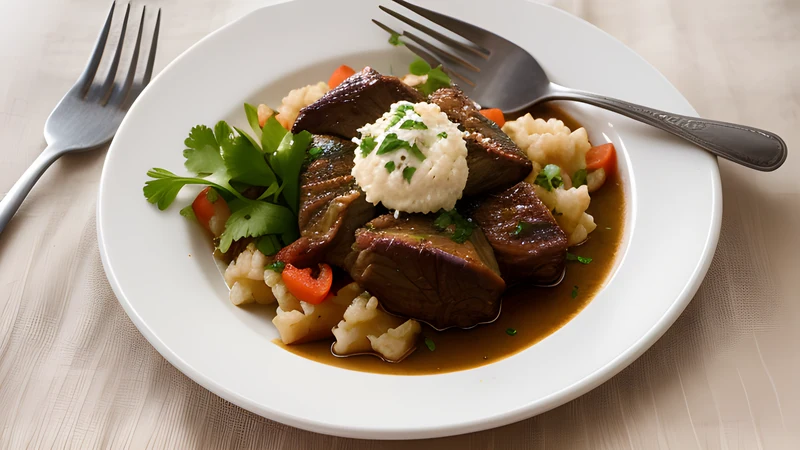
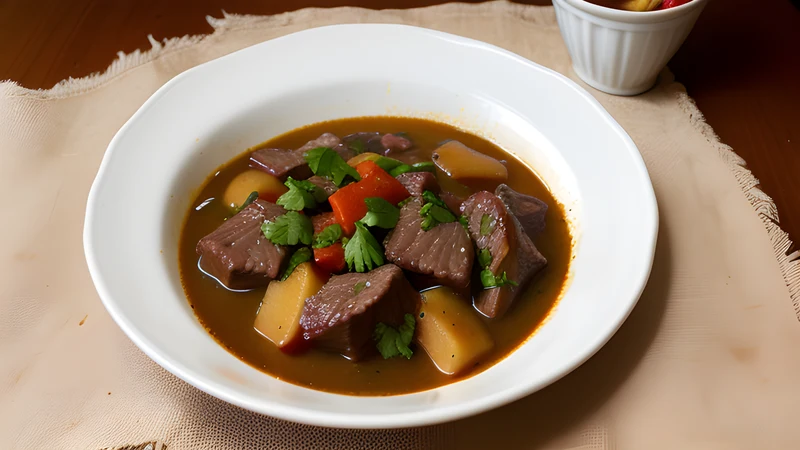
↓ Jump to recipeZuurvlees means sour meat, which undersells it by half. Beef sits in vinegar for three days, then braises for three and a half hours, and at the end you crumble a slice of spiced cake into the pot and stir until it disappears. The sauce that results is almost black, glossy enough to hold a spoon mark, and swings between sharp and sweet with every mouthful. Limburg eats it with chips. It is the best stew in the Netherlands and nobody outside the province seems to know it exists.
The dish belongs to Dutch Limburg, the long thin province that dangles south between Belgium and Germany, and it carries the accent of all three. Across the German border the same idea is Sauerbraten. In Belgium it is a first cousin of stoofvlees, which uses beer where this uses vinegar and mustard-smeared bread where this uses gingerbread. The family resemblance is obvious once you have made two of them.
Zuurvlees: Limburg's Sweet-Sour Beef Stew With Gingerbread
Ingredients
- 1.2 kg beef shin or chuck, cut into 5 cm cubes
- 250 ml red wine vinegar
- 250 ml water
- 3 bay leaves
- 6 whole cloves
- 10 juniper berries, lightly crushed
- 1 tsp black peppercorns
- 2 large onions, halved and sliced 5 mm thick
- 40 g unsalted butter
- 2 tbsp neutral oil
- 2 tsp fine salt
- 300 ml beef stock
- 100 g ontbijtkoek or dark gingerbread, crusts removed, torn into pieces
- 3 tbsp appelstroop (Dutch apple syrup) or dark treacle
- 2 tbsp dark brown soft sugar
- 1 tbsp Dijon mustard
Method
- Three days ahead: combine the vinegar, water, bay, cloves, juniper, peppercorns and half the sliced onion in a non-reactive bowl. Submerge the beef, cover, and refrigerate for 72 hours, turning once a day.
- Lift the beef out and reserve the marinade. Pat every cube completely dry with kitchen paper — this takes longer than you expect and matters.
- Strain the marinade through a sieve, keeping the liquid and discarding the spent onion and spices.
- Heat 1 tbsp oil and 20 g butter in a heavy casserole over a high heat. Season the beef with the salt and brown it in three batches, 4 minutes per batch. Set aside.
- Lower the heat to medium, add the remaining butter and oil and the rest of the onion. Cook 20 minutes, stirring, until deep gold.
- Pour in 150 ml of the strained marinade and scrape the base of the pan clean.
- Return the beef, add the remaining marinade and the stock. The liquid should just cover the meat.
- Bring to a bare simmer, cover, and cook at 150C fan for 2 hours 30 minutes.
- Stir in the torn gingerbread, appelstroop and brown sugar. Cover and cook a further 30 minutes.
- Uncover, stir hard to break up any remaining gingerbread, and reduce for 20-30 minutes until the sauce coats a spoon.
- Stir in the mustard off the heat. Taste and balance with more sugar or a splash of vinegar. Rest 20 minutes before serving.
Where a province learned to pickle its beef
Limburg is a border province and always has been. It has been Spanish, French, Austrian and Prussian at various points, and Maastricht — its capital — is closer to Cologne, Liège and Aachen than to Amsterdam. What that produced is a kitchen with almost nothing in common with the rest of the Netherlands: sweet-sour braises, apple syrup on everything, a serious pastry tradition, and a preference for meat cooked until it gives way.
The sour part is a preservation habit that outlived its purpose. Before refrigeration, a joint of beef in a strong vinegar bath kept for a week or more in a cool cellar, because acetic acid at that concentration suppresses most spoilage bacteria. The technique travelled along the Rhine — it is the same reasoning behind German Sauerbraten, and behind the vinegar-heavy marinades of Alsace. Limburg’s particular contribution was the gingerbread and the appelstroop, both of which turned a preserving expedient into something worth eating deliberately.
Horse meat came into it in the nineteenth century, when working horses reaching the end of their lives were the cheapest red meat available to Limburg’s mining communities. Horse is lean and tough, and three days in vinegar plus three hours of braising is precisely what makes lean and tough edible. Maastricht butchers still sell paardenvlees for zuurvlees, and old Limburgers will tell you the beef version is a compromise. They have a point about the sweetness, though beef gives you more gelatine.
The dish is inseparable from the friture. Limburg’s chip shops sell zuurvlees by the tub, ladled over chips with a blob of mayonnaise, and that is where most Dutch people who have eaten it encountered it — at a counter, in the rain, out of paper. It has never been restaurant food and it does not want to be.
Why three days in vinegar
The marinade is the dish and the temptation to shorten it is the main reason people make a disappointing version. Two things happen over 72 hours, and neither happens in six.
The first is straightforward chemistry. Acid at around pH 3 denatures the muscle proteins on and just below the surface of the meat, unwinding them so they hold water differently. It also swells the collagen matrix — acid-swollen collagen hydrolyses into gelatine at a lower temperature and faster than untreated collagen does, which is why zuurvlees develops a body that a plain braise takes much longer to reach. The second is diffusion, and diffusion is slow. Acetic acid molecules migrate into a 5 cm cube of beef at a rate measured in millimetres per day. At six hours you have seasoned the outer two millimetres. At 72 hours the sourness is genuinely through the meat, and that is what you are eating.
There is a limit. Push past four days and the surface proteins denature so thoroughly that the outside of each cube turns chalky and mealy, in the way overlong ceviche does. Three days is the sweet spot Limburg settled on, and the province has had a few centuries to test it.
Use a non-reactive bowl. Glass, ceramic or food-grade plastic — a bare aluminium or cast-iron container will react with 250 ml of vinegar over three days and give the whole pot a metallic taste you cannot remove.
The gingerbread
Ontbijtkoek — literally breakfast cake — is a dense Dutch rye gingerbread, sold in loaves, spiced with cinnamon, cloves and ginger and sweetened with syrup. Crumbled into a braise it does three separate jobs. Its starch gelatinises and thickens the sauce. Its sugar balances the vinegar. Its spice supplies the warm background that makes the sourness read as complexity rather than as a mistake.
This is the same bread-as-thickener logic that runs through medieval European cookery, and Limburg’s version is the most sophisticated example still in daily use. The gingerbread carries flavour that plain bread does not, and unlike a flour roux it adds no raw starch taste, because the cake is already baked.
If you cannot find ontbijtkoek, a dense dark gingerbread works — the German Lebkuchen or a British ginger cake, provided it is the sticky kind and not a dry biscuit. Avoid anything with icing. Cut the crusts off whatever you use; they are drier, and they resist breaking down, so you end up fishing brown lumps out of a finished sauce.
Add it late. Thirty minutes before the end is right. Put it in at the start and the sugars will scorch on the base of the pot over three hours, and the starch will thicken the sauce early enough to stop convection, which means the bottom cooks harder than the top.
Appelstroop, and why it matters
Appelstroop is apple syrup — apples and sugar beet boiled down for hours to a black tar with a sour edge. It is a Limburg product specifically, made in the same orchards that supply the province’s cider, and it is the second acid in the dish alongside the vinegar. Malic acid from the apples tastes different to acetic acid from the vinegar: rounder, fruitier, slower on the tongue. Having both is why zuurvlees is more interesting than a Sauerbraten thickened with the same gingerbread.
Dark treacle is the closest substitute and it is a fair way off — treacle brings the bitterness and the colour without the fruit acid. If you use it, add a tablespoon of apple cider vinegar alongside to make up the difference.
Method notes
Dry the meat obsessively. Beef that has been in liquid for three days is soaked, and a wet surface has to boil dry before it can brown at all. Kitchen paper, both sides, every cube, until the paper comes away nearly clean. If you skip this you will not get a Maillard crust, and the finished stew will be sour and thin with nothing savoury under it.
Keep the marinade. All of it goes into the pot. The three days of diffusion works in both directions — the liquid has taken up a great deal of beef flavour, and throwing it away throws away a third of the dish.
Salt at the browning stage. Keep it out of the marinade entirely: salt draws moisture out of the meat by osmosis and works against the acid’s diffusion inward. Season the dried cubes just before they hit the pan.
Bare simmer only. 150C fan in a covered casserole holds the pot at roughly 85C, which is where collagen converts without the muscle fibres squeezing themselves dry. Visible bubbling means the oven is too hot.
What goes wrong
It is aggressively sour and nothing balances it. Add sugar in 1 tsp increments off the heat, tasting between each. Vinegars vary enormously in strength — a 5% red wine vinegar and a 7% one are a different recipe. If it is still harsh, another 30 g of gingerbread will help.
The sauce is grainy. The gingerbread did not fully break down. Stir it hard during the uncovered reduction, and if lumps persist, press them against the side of the pot with a spoon.
It tastes flat and sweet. You reduced too far and cooked off the volatile acetic acid. A tablespoon of vinegar stirred in off the heat brings it back immediately.
The meat is chalky at the edges. Marinated too long. Four days is the ceiling.
Variations and the honest case against
Some Limburg cooks add a handful of prunes in the last hour, which is very good and pushes the fruit note further. Others use a mix of beef and horse — horse meat was the traditional protein and is still sold for zuurvlees in Maastricht butchers, where it is leaner and slightly sweeter. A version around Sittard adds a spoon of apple butter at the end.
The honest objection is that zuurvlees is polarising in a way most stews are not. The sweet-sour axis is pushed hard, and people who dislike that combination will dislike this specifically and immediately — there is no gentle version. It is also a four-day commitment for a bowl of brown food, and the marinade takes up half a fridge shelf.
Serve it with chips and mayonnaise, which is how Limburg does it and which is correct: the fat and the starch are what the sharpness needs. Beer-braised carbonade flamande is the gentler entry point to this family if the vinegar sounds like too much, and Dutch hutspot makes a decent alternative to chips underneath it.
The cut
Shin over chuck, and it is a bigger margin here than in most braises. Shin is wrapped in the heaviest collagen sheets on the animal, and the vinegar has already started swelling that collagen over three days, so the conversion to gelatine runs faster and further than it would in an unmarinated pot. The result sets to a firm wobble in the fridge and coats a chip properly.
Ask for it cut across the bone in thick rounds and cube it yourself, keeping the marrow bones to drop into the braise for the first two hours. Silverside and anything sold as generic braising steak are the wrong choice: too lean to give up gelatine, and the acid makes lean meat chalky faster than it makes it tender.
Cut large. Five-centimetre cubes look excessive and are right — the marinade only needs to travel 2.5 cm to the centre over three days, and smaller cubes over-sour before the collagen has finished.
Storage
Zuurvlees is better on day two and better still on day three; the acid mellows and the spice integrates. Refrigerate up to five days. Reheat at a bare simmer for 15 minutes with a splash of water. It freezes for three months, though the gingerbread thickening breaks slightly on thawing and wants a brisk stir and five minutes of reduction to come back to gloss.
Related Content