Zürcher Geschnetzeltes: Veal in Cream and White Wine
Twelve minutes of cooking and one decision about kidneys
Contents
↓ Jump to recipeZürcher Geschnetzeltes is fifteen minutes of cooking and a lifetime of people getting it wrong. It goes wrong in three ways, all of them avoidable, all of them the result of treating a fast dish as though it were slow.
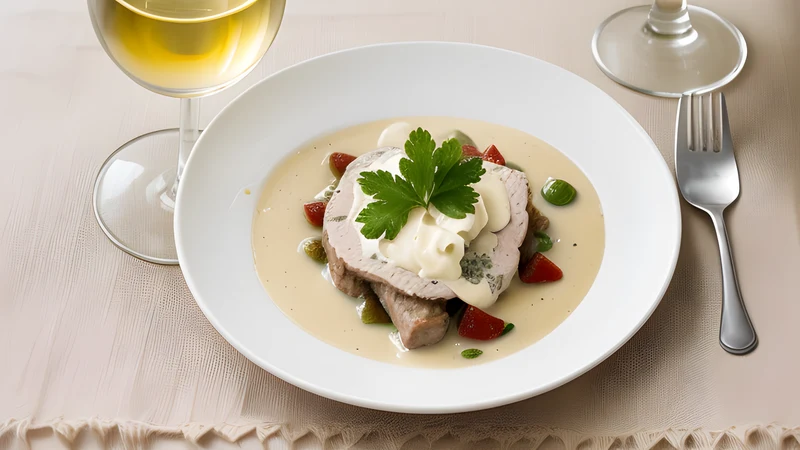
The name is literal. Geschnetzeltes means “cut into small pieces” — a Swiss-German culinary term for meat sliced into strips for quick pan-cooking. Zurich claims this particular version, and what it claims is veal, cream, white wine, mushrooms and, if you are being honest about it, kidney.
Zürcher Geschnetzeltes: Veal in Cream and White Wine
Ingredients
- 600 g veal loin or topside, in one piece
- 150 g veal kidney, trimmed of core and fat (optional)
- 1 tsp fine sea salt
- 0.5 tsp freshly ground white pepper
- 2 tbsp plain flour
- 3 tbsp neutral oil, such as rapeseed
- 50 g unsalted butter
- 1 banana shallot, finely diced
- 250 g button or chestnut mushrooms, sliced 4 mm thick
- 150 ml dry white wine, ideally a Swiss Räuschling or a dry Riesling
- 200 ml veal or chicken stock
- 250 ml double cream
- 1 tbsp Dijon mustard
- 1 tsp lemon juice
- 3 tbsp flat-leaf parsley, finely chopped
- 1 tbsp brandy or kirsch (optional)
Method
- Put the veal in the freezer for 25 minutes until firm at the edges. This makes clean slicing possible.
- Slice the veal against the grain into 5 mm slices, then stack the slices and cut them into strips 5 mm wide and 5–6 cm long. If using kidney, halve it, cut out the white core entirely with scissors, and cut the flesh into similar strips.
- Pat the strips thoroughly dry with kitchen paper — properly dry, this matters more than anything else here. Toss them with the salt, white pepper and flour in a bowl, then shake off the excess in a sieve.
- Heat a wide, heavy frying pan over a high heat with 1.5 tbsp of the oil until it just shimmers. Add half the veal in a single layer with space between the pieces and leave it undisturbed for 45 seconds, then toss for a further 45 seconds. It should be barely coloured and still pink inside. Tip it into a sieve set over a bowl.
- Repeat with the remaining oil and veal. If using kidney, fry it last, on its own, for 60 seconds total, and add it to the sieve. Discard any liquid that collects.
- Lower the heat to medium. Add 25 g of the butter to the same pan, then the shallot, and cook for 3 minutes until translucent.
- Raise the heat to high, add the mushrooms, and cook for 6–8 minutes without crowding, until all their water has boiled away and they take colour at the edges.
- Add the brandy if using and let it boil off. Pour in the wine, scrape the base of the pan clean, and reduce until only about 2 tbsp of liquid remain, roughly 3 minutes.
- Add the stock and reduce by half, about 4 minutes. Add the cream and the mustard and simmer for 3–4 minutes until the sauce coats the back of a spoon.
- Take the pan off the heat. Stir in the lemon juice and the remaining 25 g butter until glossy. Return the veal and any kidney to the pan and fold it through for 30 seconds in the residual heat only — do not let the sauce boil again.
- Taste for salt, stir in the parsley, and serve immediately with rösti.
The kidney argument
Let us deal with this first, because it is the thing most recipes quietly delete.
The original Zurich dish, as it appears in Swiss cookbooks through the middle of the twentieth century, contains veal kidney alongside the veal loin, as a co-equal component and usually around a quarter of the meat by weight. Sometimes sweetbreads too. This was a dish that used the whole animal, and the offal was the point of difference; a plate of veal in cream sauce without it is a generic thing that any European kitchen could produce.
Somewhere in the last forty years, the kidney fell out. Restaurants outside Switzerland dropped it because customers baulked, and then Swiss restaurants dropped it because tourists baulked, and now the majority of recipes online do not mention it. Zurich’s own establishments are split: the Kronenhalle still serves it with kidney, several others offer both versions, and the Zürcher Geschnetzeltes you get in a station buffet is loin only.
I would encourage the kidney, and I would encourage it for a specific reason: veal kidney is mild. It has none of the ammoniacal insistence of ox or pig kidney, and cooked for sixty seconds it is faintly mineral, faintly sweet, and gives the sauce a depth that the loin alone cannot. Trim it properly — cut out every scrap of the white core with scissors, which is where the bitterness lives — and cook it separately, briefly, and add it at the end.
If you leave it out, the dish is still good. It is also, at that point, essentially a Swiss version of blanquette de veau in a hurry, and you should know that is the trade you are making.
The three failures
Failure one: a pan that is not hot enough. Veal strips 5 mm thick have an enormous surface-to-mass ratio. In a moderate pan they release water, the temperature drops below 100°C, and they poach. Poached veal is grey, weeps liquid into the sauce and has the texture of a rubber band. You need the pan properly hot — oil just shimmering, around 200°C — so the surface moisture flashes off and browning starts within seconds.
Failure two: crowding. This is failure one wearing a disguise. Six hundred grams of veal in one pan drops the pan temperature by more than a hundred degrees the instant it lands, and no amount of preheating survives that. Two batches, minimum. Three if your pan is small. The thirty seconds you save by doing it in one go costs you the dish.
Failure three: cooking the veal twice. Almost every published recipe tells you to return the meat to the sauce and simmer for a few minutes. This is where the dish dies. Veal loin is fully cooked after ninety seconds in a hot pan; another four minutes in simmering cream takes it past 70°C, the muscle fibres contract, and it squeezes out the juices you just sealed in. Fold it through off the heat. The residual warmth of the sauce is all it needs, and it will be at temperature by the time it reaches the plate.
The sieve is a small detail with real payoff. Resting the fried veal in a sieve over a bowl lets any liquid drain away instead of pooling; if you tip that liquid into the sauce, you dilute it and reintroduce the water you worked to drive off. Discard it.
Cutting it properly
The freezer step is worth the twenty-five minutes. Veal loin at fridge temperature is soft enough that a knife pushes the fibres aside instead of severing them, and you end up with ragged strips of uneven thickness that cook at different rates. Twenty-five minutes in the freezer firms the outer centimetre to the point where the blade cuts cleanly, and the meat is nowhere near frozen through.
Cut against the grain. Look at the muscle and find the direction the fibres run — they are visible as fine parallel lines — and set your knife across them. Slicing with the grain gives you strips made of long unbroken fibres, and long unbroken fibres are what your teeth read as chewy. Cutting across shortens every fibre to 5 mm, which is the whole reason a fast-cooked strip of veal can be tender at all.
Five millimetres square and 5–6 cm long is the target dimension. Thicker and the interior is still raw when the surface is done; thinner and there is no interior left to speak of. Uniformity matters more than the exact figure — a pan holding some 3 mm strips and some 8 mm strips will overcook half of them regardless of what you do.
Why the flour, and why the drying
The light dusting of flour does two things. It absorbs the last of the surface moisture, which helps browning begin faster, and it dissolves into the sauce when the meat returns, giving a slight thickening and — more usefully — a starch that helps the emulsion hold. Shake off the excess through a sieve; a heavy coating turns pasty and clouds the sauce.
But the flour cannot save wet meat. Patting the strips genuinely dry with kitchen paper, until the paper comes away barely damp, is the single highest-leverage minute in this recipe. Water on the surface must be boiled off before the surface can exceed 100°C, and until it exceeds about 140°C the Maillard reaction that gives the veal its flavour cannot begin. Wet meat spends its whole time in the pan trying to get dry, and by the time it succeeds it is overcooked.
The mushrooms follow the same logic and get the same treatment: high heat, a wide pan, and hold your nerve through the grey wet phase until the water boils off and the sizzle changes pitch. The same argument applies in full to the mushroom sauce on a Jägerschnitzel, and it is the most transferable thing on this page.
The sauce, and the acid
Reduce the wine hard — down to a couple of tablespoons. Wine that has not been reduced tastes raw and sharp in cream, and the reduction concentrates the wine’s own glycerol and acids into something that reads as depth. A dry Swiss white is traditional; a dry Riesling, Chasselas or Muscadet all work. Avoid anything oaked, which turns the sauce woody.
Double cream at around 48% fat is required. Single cream will split at a simmer, because the fat globules are too sparse to stabilise the emulsion when the proteins coagulate. If you only have single cream, take the sauce off the heat before adding it and accept a thinner result.
The lemon juice at the end is the difference between a good version and a flat one. Cream, veal and butter are all rich and low in acid, and without something bright the sauce sits on the tongue like paint. Add it off the heat — boiling drives off the volatile aromatics that make lemon read as lemon and leaves only the sourness.
Rösti, and nothing else
The correct accompaniment is rösti, and it is genuinely correct rather than conventionally correct: you need something crisp and starchy to take the sauce, and the grated, pressed, fried potato cake is the best vehicle Switzerland has produced. Buttered noodles, Spätzle or plain boiled potatoes are all acceptable. Rice is not, whatever your Zurich hotel served you.
A green salad afterwards, dressed sharply. Nothing else on the plate.
Storage, scaling and the honest limits
This is a dish that cannot be made ahead, held, or reheated. Reheating means cooking the veal a third time, and the whole argument of the recipe is against cooking it twice. If you have leftovers, eat them cold or fold them through pasta with a splash of stock, and accept that the texture is gone.
You can prep everything, which is where the fifteen-minute claim becomes true. Slice the veal and refrigerate it, covered, for up to a day. Trim the kidney the same morning. Slice the mushrooms and dice the shallot hours ahead. Then the actual cooking is a straight run from a cold start to the table.
Scaling beyond four is where it gets hard, and it is worth being honest: the batch rule means eight portions is four separate frying rounds, and by round four the pan is full of fond that is starting to burn. Deglaze and wipe the pan between rounds two and three. For a dinner party of eight I would make something else, or accept that the first four plates will be better than the last four.
Related Content