Wienerbrød: Danish Pastry Made Properly at Home
The Austrian pastry Denmark stole, improved, and named after Vienna
Contents
↓ Jump to recipeThe Danes call it Vienna bread. The Austrians, when they think about it at all, call it Kopenhagener Plunder — Copenhagen pastry. Both are correct and the story behind the disagreement is one of the better pieces of food history, because it starts with a strike.
In 1850 Copenhagen’s bakers walked out over pay and conditions. The master bakers, needing bread on the shelves, brought in Austrian bakers, who arrived with the Viennese laminated Plundergebäck they had grown up with. When the Danish bakers came back to work they had learned the technique, and they proceeded to do what any sensible thief does with a good idea: they improved it. More butter. Egg in the dough. Cardamom. Marzipan-based fillings. Within a generation the Danish version had diverged enough that the rest of the world eventually named it after Denmark instead — everywhere except Denmark, where it is still, politely, Vienna bread.
Wienerbrød: Danish Pastry Made Properly at Home
Ingredients
- For the dough: 500 g strong white bread flour
- 60 g caster sugar
- 10 g fine sea salt
- 1 tsp ground cardamom, freshly ground
- 10 g fast-action dried yeast
- 200 ml cold whole milk
- 2 large eggs, cold
- 50 g unsalted butter, softened
- For the lamination: 250 g cold unsalted butter, at least 82% fat (a European-style block)
- For the remonce filling: 100 g unsalted butter, softened
- 100 g caster sugar
- 100 g marzipan (60% almond), coarsely grated
- For finishing: 1 egg beaten with 1 tbsp milk; 100 g icing sugar mixed with 1.5 tbsp water; 30 g flaked almonds
Method
- Mix the flour, sugar, salt, cardamom and yeast in a large bowl. Add the cold milk, cold eggs and the 50 g softened butter and mix to a rough dough.
- Knead for 6 minutes by hand or 4 in a mixer, until smooth. Do NOT prove it. Flatten into a 20 cm square, wrap, and chill for at least 1 hour or overnight.
- Make the butter block: put the 250 g cold butter between two sheets of baking paper and beat it flat with a rolling pin into an even 15 cm square, about 1 cm thick. Chill for 20 minutes. It should be cold but bend without cracking — around 13°C.
- Roll the dough into a 30 cm square on a lightly floured surface. Set the butter block in the middle at 45 degrees, like a diamond in a square, and fold the four corners of dough over it to enclose completely. Pinch the seams shut.
- Roll the parcel out to a rectangle roughly 20 cm by 60 cm, working lengthwise with firm even pressure. Brush off excess flour.
- Fold in three like a letter: bottom third up, top third down. That is one single fold. Wrap and chill for 30 minutes.
- Repeat the roll and single fold twice more, chilling 30 minutes between each. Three single folds in total gives 27 butter layers. Always turn the dough 90 degrees before each new roll.
- Make the remonce: beat the softened butter and sugar until pale, then work in the grated marzipan to a smooth paste.
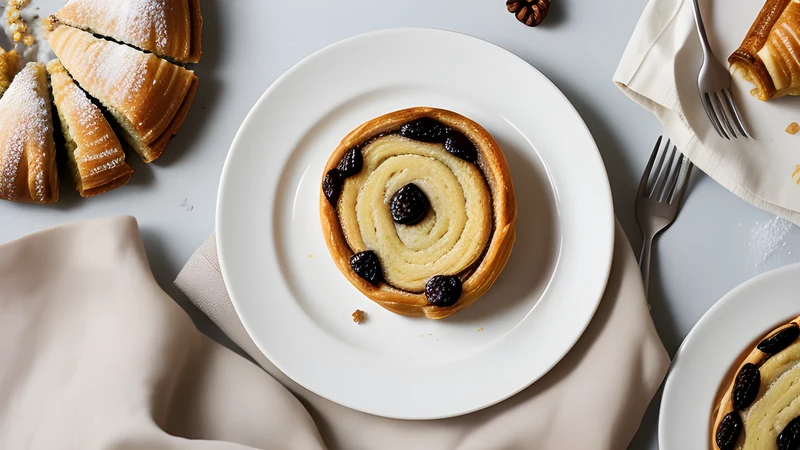
- Roll the chilled dough to a 30 cm by 40 cm rectangle, about 4 mm thick. Spread the remonce over it, leaving a 2 cm border along one long edge. Roll up tightly from the other long edge into a log.
- Cut the log into 12 slices, each about 3 cm. Lay them cut side up on two lined baking trays, well spaced, and press each lightly flat.
- Prove at room temperature (18–22°C, no warmer) for 60–90 minutes, until visibly puffed and wobbly. If butter begins to weep from the layers, the room is too warm — chill them for 15 minutes and continue.
- Heat the oven to 200°C fan / 220°C conventional. Brush each pastry with egg wash, avoiding the cut layers on the sides.
- Bake for 16–18 minutes until deep gold and the layers have separated visibly. Cool on a rack for 10 minutes.
- Drizzle with the icing and scatter with flaked almonds while still warm.
What makes it Danish rather than French
It is worth being precise about what wienerbrød actually is, because “Danish pastry” gets used loosely.
Croissant dough is yeasted and laminated with butter and contains very little sugar and no egg. Rough puff is laminated and unyeasted, lifted entirely by steam. Wienerbrød is yeasted and laminated and enriched — eggs and sugar and butter in the base dough as well as butter between the layers. That combination is what gives it a crumb that is flaky at the edges and slightly bready and custardy at the centre, and it is why a good wienerbrød tastes richer and softer than a croissant while still shattering when you press it.
The enrichment makes the lamination harder. Egg and sugar both slow the yeast and soften the dough, so you are trying to roll a slack, sticky dough around a butter block, and the dough will fight you. This is the honest reason home wienerbrød is difficult, and it is fixable with cold and with patience.
The other Danish signature is remonce: butter, sugar and marzipan beaten to a paste. Nearly every classic wienerbrød has it — the spandauer, the kanelsnegl, the frøsnapper. It stays soft where a frangipane would set and a pastry cream would firm: it melts into the layers and caramelises against them, and it is why a Danish pastry has that dense, almondy, slightly greasy sweetness at the core that no croissant has.
The butter block, which is the whole job
Everything in lamination is a single problem: keeping the butter as a continuous sheet inside the dough. If it stays a sheet, steam and yeast gas push the layers apart in the oven and you get 27 distinct leaves. If it shatters into fragments, the fragments melt and soak into the surrounding dough, and you get a rich brioche with grease in it.
So the butter has to be plastic — bendable without cracking. That is a narrow window, roughly 13 to 16°C, and it depends entirely on the butter. Use a European-style block at 82% fat or higher. British and Danish butter sit around 82%; Lurpak, Kerrygold and most French beurre de tourage work. American-style butter at 80% carries more water, and that extra water makes the block brittle when cold and greasy the moment it warms, which is why so many recipes written for one market fail in another.
Beat it flat rather than rolling it. Butter between two sheets of paper, whacked with a rolling pin, comes out as an even slab with a homogeneous texture; rolling it tends to squeeze the middle and leave thick corners. Then chill it, and then check it before it goes in: bend a corner. Cracks mean too cold — leave it five minutes. Fingerprints that stay glossy mean too warm — back in the fridge.
The dough must be at the same temperature. A cold butter block inside a room-temperature dough will crack on the first roll because the two have different resistances under the pin. Both at fridge temperature, both rolled firmly and evenly, and the layers stay intact.
Three single folds and no more
Three single folds gives 3 × 3 × 3 = 27 layers of butter and 28 of dough. That is the Danish number and it is deliberate.
The temptation is to do more, on the theory that more layers means flakier. It does not. Past about 40 layers the individual butter films become thinner than the dough can hold, they rupture, and the layers merge — you have done a great deal of work to make a homogeneous dough. Croissants use three folds. Puff pastry uses six because it has no yeast and needs the steam separation to do everything. Wienerbrød has yeast pushing the layers apart from within, so 27 is plenty and 27 gives you leaves thick enough to see.
Turn the dough 90 degrees before each roll. Gluten stretches in the direction you roll it, and rolling the same axis three times gives you a dough that snaps back and a finished pastry that shrinks into an oval. The quarter turn keeps the gluten network even.
Chill thirty minutes between folds, always. This does two things: it re-firms the butter, and it lets the gluten relax so the next roll does not require force. If the dough resists and springs back, it needs longer in the fridge — pushing through it is how butter breaks.
The prove, which is where home bakers lose it
Wienerbrød proves cool. Eighteen to twenty-two degrees, sixty to ninety minutes, and no warmer under any circumstances.
The reason is arithmetic. Butter starts melting at around 32°C. A warm proving spot — an airing cupboard, a low oven, a sunny windowsill — will get the pastry there long before the yeast has finished, and the butter runs out of the layers and pools on the tray. You will see it happening: little yellow beads weeping from the cut sides. That butter was the lift, and once it is on the tray it is gone.
A cold kitchen is an advantage here. If your kitchen runs warm, prove in two stages: forty minutes out, fifteen minutes in the fridge, forty minutes out. Slower, and it works.
The pastries are ready when they look visibly puffed and jiggle as a unit when the tray is nudged. Underproved wienerbrød is dense and greasy; overproved collapses in the oven and the layers merge.
Egg wash goes on the top and the sloped shoulders, never on the cut sides where the layers are exposed. Egg glues layers together, and glued layers cannot separate.
What goes wrong
Butter leaked all over the tray in the oven. Either the block broke during rolling, or the prove was too warm. Both leave the same evidence — a pool of clarified butter and a flat, dense pastry — and the second is far more common.
The layers merged into a bready crumb. The butter warmed during folding and soaked into the dough. Chill for thirty minutes at the first sign of the dough going soft or sticky, at any stage, including mid-roll. There is no penalty for an extra chill.
The dough tore and butter came through the surface. Uneven pressure, or the parcel was sealed badly at the corners. Patch a tear with a dusting of flour and carry on gently; the layer count survives one small breach.
The pastries shrank into ovals. Gluten was overworked in one direction. Turn 90 degrees between rolls and rest longer between folds.
They were pale and heavy. Underproved, or the oven was too cool. Wienerbrød needs a genuinely hot oven — 200°C fan — so that the butter turns to steam fast enough to blow the layers apart before it can simply melt out.
Storage, and what else to make with the dough
Wienerbrød has a shelf life of about six hours and is at its best at ninety minutes out of the oven. That is the whole truth of it, and it is why Danes buy them fresh rather than make them.
The dough freezes well, which is the workaround. After the third fold, wrap and freeze it for up to a month; thaw overnight in the fridge and shape as normal. Baked pastries also freeze, and refresh at 180°C for five minutes, which gets you about eighty per cent of the way back.
Once you have the block, the classics are all shapes of the same dough. The kanelsnegl is the log above with cinnamon in the remonce. The spandauer is a square with the corners folded to the middle and a spoon of pastry cream and jam in the centre. The frøsnapper is a strip folded, twisted and rolled in poppy seeds. If you want the fundamentals without the cardamom and marzipan, danish pastry dough is the plain base to work from. And if the whole cold-butter-and-folding business appeals, kouign-amann is the Breton version that adds sugar to the lamination and caramelises it, and kanelbullar is the Swedish answer that skips lamination entirely and is a very good Tuesday when you cannot face the folding.
Related Content