Wiener Schnitzel: Veal, Breadcrumbs and a Loose Coat
The blistered golden coat that should never touch the meat
Contents
↓ Jump to recipeThere is a test for Wiener Schnitzel that has nothing to do with taste. You lay the fried escalope on a plate, take a fork, and press the centre of the crust. If the coat depresses and springs back — if there is air under there, a pocket of steam between crumb and meat — you have made the real thing. If the crust sits welded to the veal like a bandage, you have made a breaded cutlet. It will be perfectly pleasant. It is a different dish.
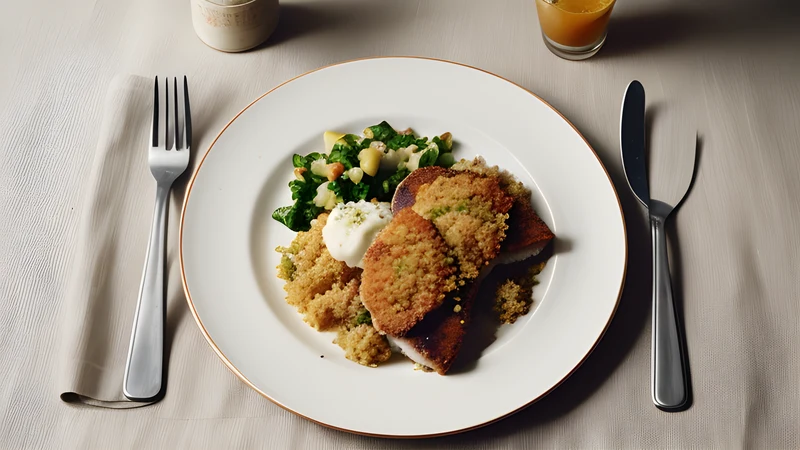
That gap is the whole point, and Austrians have a word for the surface that produces it: soufflierte Panier, the souffléd coat. The wrinkles that ripple across a proper schnitzel are a record of physics: the crust expanded away from the shrinking meat while both were still in the fat, and the ripples are where it buckled.
Wiener Schnitzel: Veal, Breadcrumbs and a Loose Coat
Ingredients
- 4 veal escalopes cut from the topside or cushion, 120–140 g each
- 1.5 tsp fine sea salt
- 0.25 tsp finely ground white pepper
- 80 g plain flour
- 3 large eggs, at room temperature
- 1 tbsp double cream
- 180 g dry white breadcrumbs, sieved through a 3 mm mesh
- 400 g clarified butter, or 300 g neutral oil plus 100 g clarified butter
- 2 unwaxed lemons, cut into wedges
- 2 tbsp flat-leaf parsley leaves, roughly torn
- 40 g cold unsalted butter, for finishing
Method
- Lay each escalope between two sheets of clingfilm and beat it out with the flat side of a heavy pan or a smooth mallet, working from the centre outwards, until it is an even 3–4 mm thick and roughly the size of a side plate. Work with pressure and drag rather than percussion, so the fibres stretch instead of tearing.
- Season both sides of each escalope with salt and white pepper and rest them for 5 minutes so the salt dissolves.
- Set out three wide shallow dishes: flour in the first; eggs beaten with the cream until completely uniform in the second; sieved breadcrumbs in the third.
- Pour the clarified butter into a wide, heavy pan to a depth of at least 1.5 cm — the schnitzel must float. Bring it to 170°C, checking with a probe thermometer.
- Coat one escalope at a time and fry it straight away. Press it into the flour, lift, and slap it against the side of the dish so only a bare film remains. Draw it through the egg, letting the excess run off for two seconds. Lay it in the crumbs, spoon crumbs over the top, and press once with your fingertips — lightly, so the crumbs adhere without being compacted.
- Slide the schnitzel away from you into the fat. Immediately take the pan handle and swirl the pan in a continuous circle for 30 seconds so hot fat washes over the top of the coat. This is what makes it puff and separate from the meat.
- Fry for 90 seconds to 2 minutes until the underside is the colour of straw with darker freckles, then turn once with tongs and fry the second side for 60–90 seconds. Do not crowd the pan; cook one or at most two at a time.
- Lift onto kitchen paper, blot for 10 seconds each side, and move immediately to a warm plate. Never stack them or cover them with foil.
- When all four are fried, tip out the frying fat, wipe the pan, and melt the 40 g of cold butter over a medium heat until it smells of hazelnuts and the milk solids turn tan. Spoon a teaspoon over each schnitzel.
- Serve at once with lemon wedges and torn parsley, with the potato salad or cucumber salad alongside rather than underneath.
Why the coat lifts
Here is the mechanism, because once you understand it the technique stops being folklore.
Egg is roughly 75% water. When you draw the escalope through beaten egg, you leave behind a thin film of protein solution, and the breadcrumbs stick to it. Drop that into 170°C fat and the water in the egg film flashes to steam almost instantly. Steam occupies about 1,700 times the volume of the water that made it. Meanwhile the egg proteins are coagulating into a flexible, semi-permeable skin, and the crumb layer above is drying and setting into a rigid shell.
If the fat only touches the underside, the steam escapes upwards through the wet, unset top crumbs and nothing happens. If hot fat is washing over the top surface at the same moment, the top crumb sets too — and the steam, now trapped between two setting layers, has to go somewhere. It pushes the crust upward and away from the meat. The veal simultaneously contracts as its own proteins tighten, pulling in the opposite direction. The coat separates. The wrinkles appear.
This is why the swirling matters more than anything else in the recipe. It is also why the schnitzel has to float. In a shallow pan with 5 mm of fat, the escalope sits on the base and the underside conducts heat while the top steams sadly. You need enough fat that you can rock the pan and send a wave over the top of the meat within the first thirty seconds.
The Milanese question
Every article about this dish repeats a story: that Field Marshal Radetzky brought the recipe back from Lombardy in 1857 after his campaigns in northern Italy, and that Wiener Schnitzel is therefore a Viennese copy of cotoletta alla milanese.
The story appears to have been invented. The food historian Heinz-Dieter Pohl traced it to a 1969 article in an Italian newspaper, and no Austrian or Italian source before the twentieth century mentions Radetzky in connection with schnitzel at all. Radetzky’s own dispatches are extensively archived; none of them contain a recipe. The tale has the shape of things people invent to make a national dish feel more cosmopolitan.
What we can actually document is duller and more interesting. Breaded, fried meat appears in Central European cookbooks well before Radetzky was born. The 1719 Viennese manuscript cookbook of Katharina Prato’s predecessors, and more securely the 1831 Allerneuestes allgemeines Kochbuch by Maria Anna Neudecker, describe meat dipped in egg and breadcrumbs and fried in fat. The name “Wiener Schnitzel” is first printed in 1831 in Neudecker’s book — decades before the alleged Radetzky moment.
The Milanese cutlet, meanwhile, is a rib chop with the bone in, fried in butter, and its crumb is meant to cling. It is a genuinely different construction. The two dishes are cousins, and the family they belong to is older than either.
The strange, and to my mind genuinely charming, wrinkle is that in Austria the name is legally protected. Under Austrian food-labelling rules, a dish sold as “Wiener Schnitzel” must be veal. Anything made with pork must be sold as Schnitzel Wiener Art — schnitzel in the Viennese style. Vienna cares enough about this to legislate it, and the average Viennese Beisl still serves ten pork ones for every veal.
Choosing and beating the veal
Ask for veal from the topside (Kaiserteil) or the cushion (Nuss). Both are lean, fine-grained and largely free of the connective tissue that tightens into a curl in the pan. Rose veal from a British or Dutch supplier gives you a slightly pinker, more flavourful meat than the pale Dutch milk-fed style, and it holds up better at 3 mm.
The beating deserves care. Most people hammer, which is wrong twice over: percussion tears the muscle fibres, so you get holes that let fat in and turn the schnitzel greasy, and it also thins the middle while leaving the edges thick. Use the flat side of a heavy saucepan, and push — press down and slide outwards, from the centre towards each edge in turn. You are stretching the meat, and you can watch it grow. Three to four millimetres is the target. Thinner than 3 mm and the escalope overcooks before the crust colours; thicker than 5 mm and the meat is still contracting long after the crust has set, which tears the coat.
Season the veal itself, and season it a few minutes before coating. Salt in the flour or the crumbs mostly ends up in the fat.
Crumbs, fat and the sequence that ruins it
The breadcrumbs must be dry, white and fine. Panko is too coarse and too spiky; it produces a beautiful crunch and a coat that will never souffle, because the open structure lets the steam out. Buy plain dried white crumbs, or dry stale white rolls in a low oven and blitz them, then push them through a sieve. Anything larger than about 3 mm goes back in the grinder.
Fat: clarified butter is the traditional and the best-tasting choice, because the milk solids have been removed and it can hold 170°C without burning. Whole butter smokes and blackens at around 150°C, which is below the temperature at which the coat sets fast enough. A blend of neutral oil with a slug of clarified butter for flavour is a reasonable compromise if 400 g of butterfat feels like an act of aggression. It costs less and tastes 90% as good.
The sequence rule is absolute: coat one, fry it, then coat the next. Breaded escalopes left standing go soggy at the interface as the egg film hydrates the crumbs from below, and a wet crust cannot separate. Breading four schnitzels in advance and frying them in sequence is the single most common reason home versions come out flat and welded. Everything else — the flour slap, the two-second egg drip, the fingertip press instead of a palm press — is in service of keeping that egg film thin and uniform.
What goes with it
In Vienna, the classic pairing is a warm potato salad slicked with beef stock and vinegar, or a cucumber salad with a whisper of sugar. The German-Swabian version of that potato salad — dressed hot with stock so the potatoes drink it — is worth knowing in its own right; I have written up Schwäbischer Kartoffelsalat with warm stock and vinegar separately, and it is the better partner. Lingonberry jam is a German import that Viennese purists sniff at and everyone eats anyway.
What must never happen is sauce. A schnitzel under sauce is a schnitzel with a wet coat, and the whole architecture collapses within a minute. If you want the mushroom cream, make Jägerschnitzel, which is built for it: the coat is thicker, the meat is pork, and the sauce is the point. Two different dishes, two different intentions.
For the rest of the Viennese repertoire, Tafelspitz is the other pillar — boiled beef, apple horseradish, and a broth you serve first — and Kaiserschmarrn is what you eat afterwards if you have any sense.
Troubleshooting
The coat is welded to the meat. Either the fat was too shallow to swirl over the top, or it was below about 160°C, or the escalope was too thick and kept contracting after the crust set.
The crust is dark brown. Too hot, above about 185°C, or your crumbs contain sugar — check the label on shop-bought crumbs, some contain malt.
The schnitzel is greasy. The fat was too cool, so the crust absorbed instead of sealing, or you tore the meat while beating and fat got in through the holes.
The coat fell off in the pan. Too much flour, or too much egg. Both leave a thick, slippery layer that never bonds. Slap the flour off. Let the egg drip.
It was pale and limp by the time everyone sat down. Schnitzel does not wait. Fry it last, and carry it to the table.
Make-ahead and storage
Almost nothing here can be prepared in advance, which is a fair price for the result. You can beat and season the escalopes up to 6 hours ahead and keep them flat, covered, in the fridge; bring them back to room temperature for 20 minutes before coating. You can clarify butter weeks ahead and keep it in a jar in the fridge, and you can strain and reuse the frying butter twice if you filter it through muslin while warm.
Leftover schnitzel is a cold sandwich the next day, sliced thin, with a smear of mustard and a pickle. It is very good. It is also completely unlike what came out of the pan, and there is no reheating method that brings the puff back — the steam pocket collapsed the moment it cooled. Eat it standing up in the kitchen, the way it was probably always meant to be eaten.
Related Content