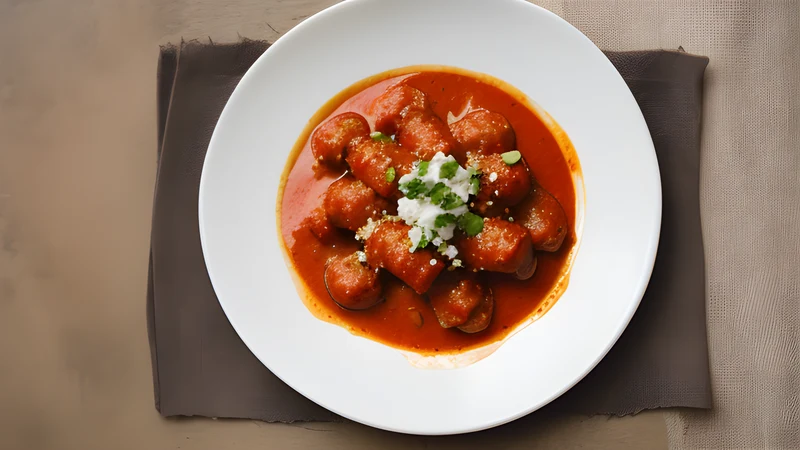
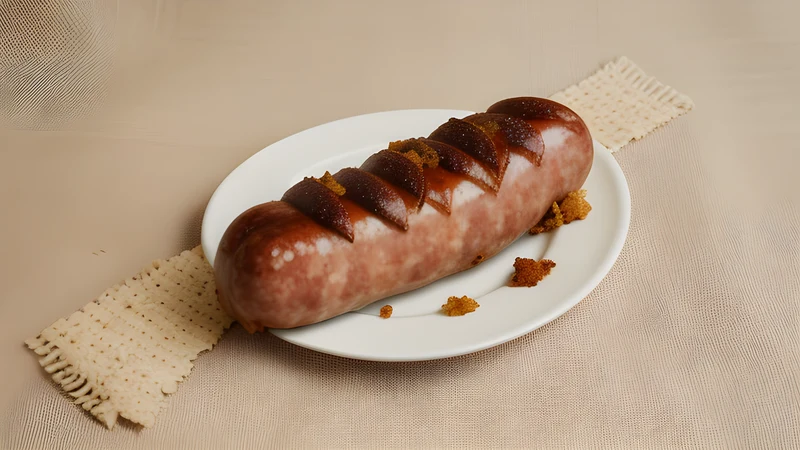
Weisswurst With Sweet Mustard and a Pretzel
Munich's breakfast sausage, the emulsion that holds it together, and the mustard you make yourself
Contents
↓ Jump to recipeWeisswurst is a sausage with a curfew. The Bavarian rule is that it must never hear the midday bell — die Weißwurst darf das Mittagsläuten nicht hören — and it is one of the few food rules anywhere that started as engineering and survived as manners. There is no curing salt in it, no smoke, no preservative of any kind. It was made at four in the morning, poached at nine, and eaten by eleven, because by two in the afternoon in a Munich summer it would have been a public health problem. Refrigeration arrived and the rule stayed, and Munich still eats them for breakfast, standing up, with a wheat beer, at an hour that alarms visitors.
They are pale, soft, faintly grey, and they taste of lemon, parsley and mace. Made at home they are a project, and the project is worth it, because the shop version is nearly always over-salted and under-lemoned.
Weisswurst With Sweet Mustard and a Pretzel
Ingredients
- 600 g veal shoulder, trimmed and cut into 2 cm cubes
- 300 g pork back fat, cut into 2 cm cubes
- 100 g pork belly, skinless, cut into 2 cm cubes
- 18 g fine sea salt
- 200 g crushed ice
- 1 small onion, very finely grated
- Zest of 1 unwaxed lemon, finely grated
- 20 g flat-leaf parsley, leaves only, finely chopped
- 1 tsp ground mace
- 1/2 tsp ground white pepper
- 1/4 tsp ground ginger
- 1/4 tsp ground cardamom
- 2.5 m hog casings, 26-28 mm, soaked and rinsed
- 70 g yellow mustard seeds, for the mustard
- 60 g dark brown sugar, for the mustard
- 80 ml cider vinegar, for the mustard
- 80 ml water, for the mustard
- 1/2 tsp fine salt, for the mustard
- 4 juniper berries and 2 cloves, ground, for the mustard
Method
- Make the mustard first, ideally two days ahead. Toast the yellow mustard seeds in a dry pan over medium heat for 3 minutes, shaking, until they smell nutty and start to pop. Cool completely, then grind coarsely.
- Melt the brown sugar in a small pan over medium heat until it darkens and smells of caramel, about 3 minutes. Off the heat, carefully add the water and vinegar — it will spit and seize. Return to a low heat and stir until the caramel dissolves.
- Pour the warm caramel liquid over the ground mustard, add the salt, juniper and cloves, and stir. Cool, jar and refrigerate for at least 48 hours. It thickens and mellows.
- For the sausage, put the veal, back fat, belly and salt in a bowl, mix, and freeze on a tray for 45 minutes until the edges are firm and crunchy but the centres give.
- Mince the chilled meat and fat through a 4 mm plate into a bowl set over ice. Return the mince to the freezer for 20 minutes.
- Working in two batches, blitz the mince in a food processor with half the crushed ice for 60-90 seconds, until it becomes a smooth, sticky, pale paste. Stop the moment it looks glossy. Check with a probe: it must stay below 12°C. If it climbs, stop and refreeze for 15 minutes.
- Fold in the grated onion, lemon zest, parsley, mace, white pepper, ginger and cardamom by hand, over ice, until evenly streaked with green.
- Fry a teaspoon of the mixture in a pan, taste, and correct the salt.
- Slide the casings onto a stuffer nozzle and fill without air pockets, keeping the fill soft rather than tight. Twist into 12 cm links, then prick any visible air bubbles with a pin.
- Bring a wide pan of water to 80°C, drop the sausages in and let the temperature settle to 70-75°C. Poach for 12 minutes, holding that range with a thermometer. Never let it boil.
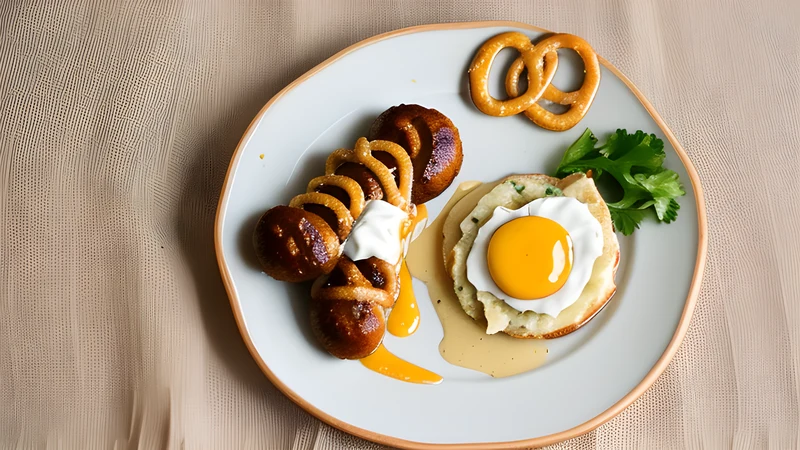
- Serve them in a warm tureen with their poaching water, with the sweet mustard and warm pretzels alongside.
22 February 1857, and a butcher who ran out
The story is precise enough to be suspicious and it is told everywhere. On Shrove Sunday 1857, at the Gasthaus Zum Ewigen Licht on Munich’s Marienplatz, an innkeeper called Sepp Moser ran out of the sheep casings he used for his usual grilling sausages. He sent an apprentice for more, the boy came back with pork casings, and Moser — knowing the thicker skins would split over a grill — dropped the sausages into hot water instead and sent them out anyway. The guests liked them. Whether any of it happened is unknowable, but the date, the address and the accident have been repeated for over 160 years, and Munich has never seen a reason to check.
What is documented is the regulation. In 1972 the Munich butchers’ guild issued a purity rule for Weisswurst: at least 51% veal, a fat content capped at around 30%, and no curing salt whatsoever. That last clause is why the sausage is the colour it is. Nitrite is what makes a frankfurter pink; without it, cooked meat protein goes grey-white, and any Weisswurst with a rosy blush has had something in it that should not be there.
Then there is the eating, which is a performance. The casing is inedible — thick, chewy, and there purely to hold the emulsion during poaching. The traditional method is zuzeln: pick the sausage up, bite the end, and suck the filling straight out, which is loud and is regarded as entirely correct in a beer garden. The polite method is to slit it lengthways with a knife and roll the meat out of its skin. There is a third camp that halves it crossways and unpeels each half, and Bavarians will argue about this at length, on a Sunday, before noon, having already had a beer.
The mustard is half the dish
Sharp mustard on a Weisswurst is a genuine offence in Munich, and the reason is chemistry. This sausage is delicate — mace, lemon, parsley, veal — and allyl isothiocyanate simply erases it. What it wants is süßer Senf, the sweet Bavarian mustard that Johann Conrad Develey is credited with formulating in Munich in 1854, three years before the sausage it now defines. Händlmaier’s, from Regensburg and made since 1914, is the jar most Germans buy.
Making it yourself takes fifteen minutes and it is the twist I would defend hardest here. Sweet mustard is mild by design, and the design is toasting the seed. Mustard heat comes from an enzyme, myrosinase, meeting a glucosinolate when the crushed seed is wetted. Three minutes in a dry pan denatures that enzyme before it ever gets the chance, so the seed contributes flavour, texture and body while producing almost no heat at all — the exact opposite of the cold-water method behind a Düsseldorfer Senf. Caramelising the sugar first adds the bitterness that stops the whole thing being cloying, and gives it the dark, slightly muddy colour it should have.
Make it two days ahead. Like all fresh mustard it is harsh on day one and settled by day three.
The emulsion, and the 12°C ceiling
A Weisswurst is a Brät — a fine meat emulsion, the same family as a frankfurter or a mortadella — and an emulsion is a thing that can break. Understanding what you are building makes the whole process obvious.
Salt dissolves the muscle protein myosin, pulling it out of the meat fibres into solution. Chopping fine, with water present as ice, spreads that dissolved protein through the mixture, where it wraps around every droplet of fat and holds it in suspension. Cook it, and the protein sets into a gel with the fat locked inside. That gel is what gives Weisswurst its springy, uniform bite.
Temperature is the only thing standing between you and failure. Pork back fat begins to soften and smear at around 15°C. Once it smears, it stops existing as discrete droplets that protein can coat, and it starts existing as grease. Cook a broken emulsion and the fat runs out into the poaching water, leaving a dry, crumbly, grainy sausage swimming in its own melted fat. There is no recovering it.
Hence the ice, which is an ingredient rather than a temperature trick — 200 g of it, which becomes the water in the finished sausage and keeps the food processor bowl cold while its blade does the opposite. Hence the two spells in the freezer, the bowl over ice, and the thermometer. 12°C is the number I stop at. If the paste climbs past it, everything goes back in the freezer for fifteen minutes and nothing is lost except your afternoon.
The mixture is right when it is smooth, pale, and sticky enough to cling to an upturned spoon for a second before falling. Overworked, it goes rubbery. A minute and a half in two batches is enough.
Poaching, and every way this goes wrong
70-75°C, and it must never boil. Boiling does two things, both bad: the casings tighten and split, and the emulsion inside is driven past the point where the protein gel holds, so the fat renders out. A pan at a rolling boil will burst half a batch in ninety seconds. Bring the water to 80°C, add the sausages, and the cold sausages will drag it down to the right band; then hold it there with the smallest flame you have.
Grey, wrinkled, deflated sausages. Overstuffed casings, or air pockets that expanded. Fill soft — the emulsion swells during poaching and a tight sausage has nowhere to go.
Fat slick on the poaching water. The emulsion broke. Look back at your temperatures.
Bland. Usually the lemon. A whole lemon’s zest into a kilo of meat sounds like a great deal and it is exactly right; Weisswurst without an assertive citrus note is just a pale sausage. Grate the onion rather than chopping it, so it disappears into the paste and gives sweetness without lumps.
No mincer. Ask a butcher to mince the veal and back fat through a 4 mm plate for you, and keep it iced on the way home. The food processor stage still needs doing but that is the part a domestic machine handles well.
They keep two days in the fridge, poached and cooled, and reheat in 70°C water for 6 minutes. They freeze raw for three months and should be poached from frozen with 4 minutes added.
Serve them in the water. A Weisswurst arrives at a Munich table in a lidded porcelain tureen half full of its own poaching liquid, and the reason is practical: the sausage is soft-set and lightly gelled, and it stiffens and goes rubbery within about four minutes of hitting a cold plate. Sitting in 70°C water, it stays at the texture it was built for, and the second one is as good as the first. Warm the tureen and warm the plates. This is the smallest step in the recipe and it is the one that separates a Weisswurst breakfast from two sausages going cold while somebody finds the mustard.
Casings, and the kit question
Hog casings at 26-28 mm are the right calibre and they arrive packed in salt, which is how they keep for a year in the fridge. Rinse the salt off, then soak them in warm water for 30 minutes and run water through the inside of each length like a hosepipe — this both checks for splits and lubricates them so they slide onto the nozzle without tearing. A casing that has been soaked for hours goes fragile, so 30 minutes is the target rather than the minimum.
The stuffer matters more than people admit. The mincer attachment sold with most stand mixers will fill casings, badly: it forces the paste back through the auger and the blade, which warms it and shears it, and by the third sausage your carefully cold emulsion has been through a blender it did not need. A cheap vertical piston stuffer — the kind with a hand crank and a tube — pushes the paste through without cutting it and costs less than a good pan. If you intend to make sausage more than once, buy one before you buy anything else.
Failing both, you can pipe the paste into casings with a large plain nozzle and a piping bag, and it works for a batch this size, with sore hands.
Twist the links in alternating directions — one link clockwise, the next anticlockwise — or the whole rope untwists itself while you carry it to the pan. Prick every visible bubble with a pin before poaching, because trapped air expands and finds the weakest seam.
Veal shoulder is the cut to ask for. Leg is too lean and gives a firm, dry Brät; shoulder carries enough intramuscular connective tissue to add body without needing more fat. If veal troubles you, a pale pork shoulder will make a perfectly good sausage that no Bavarian would accept as a Weisswurst.
The rest of the table
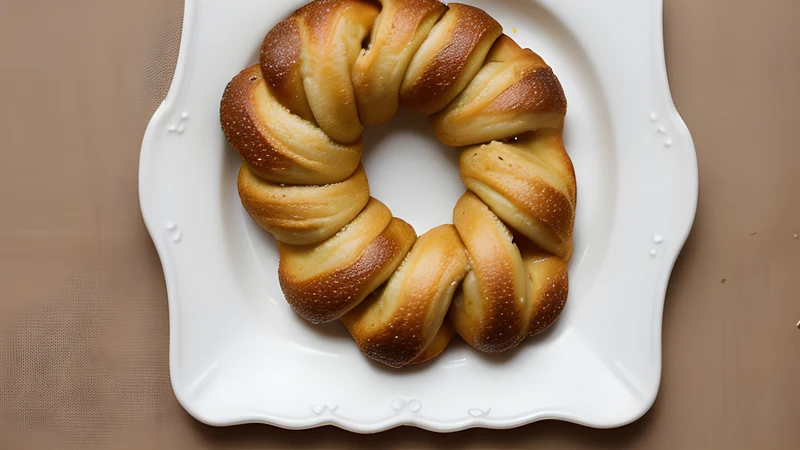
Warm Laugenbrezel is compulsory — the salt and the lye crust are the only things on the table with any edge to them. A Weissbier, unfiltered, in the tall glass, at nine in the morning, is what Munich does and it is difficult to argue with once you have tried it.
If the emulsion work appeals and the casings do not, Leberkäse is the same technique baked in a loaf tin with no stuffer required, and it is the sensible place to learn the temperature discipline. Frikadellen are the coarse, forgiving, unemulsified cousin for a weeknight. And if you want the whole Bavarian afternoon rather than the Bavarian morning, Schweinshaxe is waiting, and it does not care what the church clock says.
Related Content