Waterzooi: Ghent's Creamy Chicken Stew
Poached chicken, julienned root vegetables, and a broth thickened with egg yolk and cream
Contents
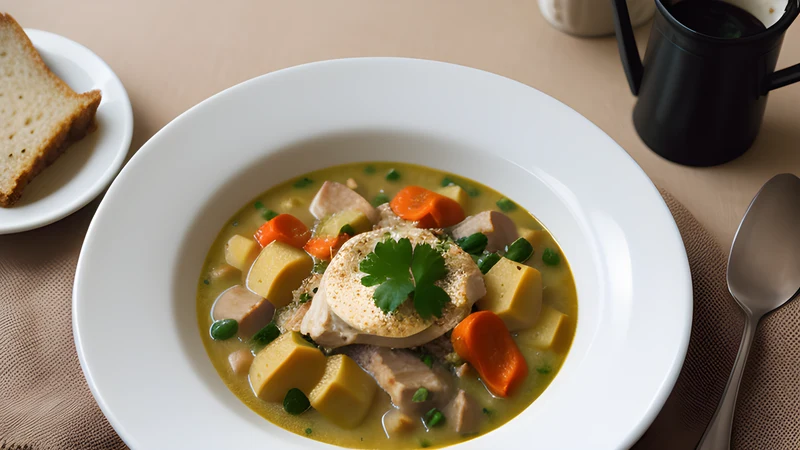
↓ Jump to recipeWaterzooi is the pale one. Belgian cooking is mostly dark — beer-black braises, deep-fried things, gravy — and then there is this, a wide bowl of ivory broth with fine strips of carrot and leek suspended in it and chicken falling off the bone. It looks like something a convalescent would be given. It tastes like the best chicken you have ever had, because that is genuinely all it is: chicken, its own stock, root vegetables, and an egg yolk.
There is one dangerous moment, and it lasts about three minutes. Everything else is patience.
Waterzooi: Ghent's Creamy Chicken Stew
Ingredients
- 1 free-range chicken, about 1.6 kg, jointed into 8 pieces, carcass reserved
- 1.5 litres cold water
- 1 onion, halved, studded with 2 cloves
- 2 bay leaves
- 6 black peppercorns
- 4 sprigs thyme
- 50 g unsalted butter
- 2 leeks (about 250 g), white parts only, cut into 5 cm matchsticks
- 200 g carrots, peeled and cut into 5 cm matchsticks
- 200 g celeriac, peeled and cut into 5 cm matchsticks
- 3 celery sticks, strings peeled off, cut into 5 cm matchsticks
- 300 g waxy potatoes (Charlotte or Anya), peeled and cut into 2 cm dice
- 2 tsp fine salt, or to taste
- 1/2 tsp freshly ground white pepper
- 3 egg yolks
- 150 ml double cream
- 1 tbsp lemon juice
- 3 tbsp chopped flat-leaf parsley
- 1 tbsp chopped chervil, if you can find it
Method
- Put the chicken carcass, wing tips, water, clove-studded onion, bay leaves, peppercorns and thyme in a pan. Bring slowly to a boil, skim the foam, then simmer very gently, uncovered, for 45 minutes. Strain and discard the solids. You should have about 1.1 litres.
- Melt the butter in a wide casserole over low heat. Add the leek, carrot, celeriac and celery with a pinch of salt and sweat them for 10 minutes, stirring, without letting them colour at all.
- Lay the chicken pieces on top of the vegetables, skin side up, and pour over the hot strained stock. It should just cover them.
- Bring to the barest simmer — a bubble every few seconds — and poach, uncovered, for 20 minutes. Add the diced potato and poach for a further 15 minutes, until the potato is tender and the chicken breast reads 72°C at the thickest point.
- Lift out the chicken pieces and keep them warm under foil. If you prefer, pull the meat off the bones now and discard the skin.
- Whisk the egg yolks and cream together in a bowl until smooth.
- Take the casserole off the heat entirely and let it stop bubbling. Ladle 200 ml of the hot broth into the yolk mixture in a slow stream, whisking constantly, to temper it.
- Pour the tempered mixture back into the casserole, whisking as you go. Return to the very lowest heat and stir for 3 minutes, until the broth thickens enough to coat the back of a spoon. It must not boil, or the yolks will scramble.
- Stir in the lemon juice, salt and white pepper. Taste and adjust.
- Return the chicken to the pot, scatter with parsley and chervil, and serve in wide bowls with bread and a spoon.
Ghent, and the fish that used to be in it
Zooien is an old Flemish verb meaning to boil or seethe, so waterzooi is roughly “water-boil”, which is the least flattering name any national dish has ever been given. It is honest about the method.
The original was fish. Ghent sits where the Leie meets the Scheldt, and until the nineteenth century those rivers ran with pike, perch, eel and carp. Waterzooi van vis was river-fish poached in their own broth and enriched, and it was what Ghent ate. The city’s fishmongers were a serious guild; the Groentenmarkt and the surrounding streets were built on freshwater fish. The chicken version — Gentse waterzooi, or waterzooi van kip — is the newcomer, and it exists because industrialisation killed the rivers. By the second half of the nineteenth century the Leie was carrying the effluent of Ghent’s flax-retting and textile industry, and the fish were gone. Ghent kept the dish and changed the animal.
Charles V is invoked in every account of it, on the grounds that he was born in Ghent in 1500 and is said to have been fond of the fish version. The claim is exactly as well-evidenced as most royal food attributions, which is to say barely at all, and it turns up in print centuries later. What is documented is that Ghent had a river-fish cuisine, that the rivers died, and that the dish survived the transplant.
The chicken version is now the default, and the fish version has quietly returned to Ghent restaurants using sea fish and eel. Both are built the same way: poach gently, thicken with yolk, serve wide and shallow. The technique is a first cousin of the French blanquette de veau, which uses exactly the same liaison and the same insistence on nothing browning.
Why nothing is allowed to brown
Every other stew in this part of Europe starts with hard browning. Waterzooi forbids it, and this is a deliberate choice rather than laziness.
The whole flavour of the dish is the clean, sweet taste of chicken and the aromatic oils of the root vegetables. Maillard browning would layer a hundred roasted, nutty, savoury compounds over the top — the compounds you want in a carbonade and specifically do not want here, because they would flatten the delicacy the dish exists to display. Waterzooi is one of a small family of European dishes built on the discipline of restraint: blanquette, poule au pot, some Scandinavian fish soups.
So the vegetables sweat rather than fry. Low heat, butter, a pinch of salt to draw out moisture, ten minutes, and if you see any gold at the edges the heat is too high. Use a heavy pan and be prepared to lift it off the burner.
The chicken poaches rather than simmers. Chicken breast muscle fibres begin contracting hard above about 75°C and squeeze out their water; the difference between a poached breast at 72°C and a boiled one at 85°C is the difference between silk and cotton wool. A bubble every two or three seconds, no more. If your smallest burner cannot go that low, use a heat diffuser or move it to a 140°C oven.
The bird itself
A dish with four flavours in it is a dish that exposes all four. Waterzooi is a chicken argument, and a cheap chicken makes it very obvious.
The difference is age and exercise. A standard intensively reared broiler reaches slaughter weight in about 35 days, having barely moved. Its muscle is pale, low in myoglobin, and its connective tissue has had no time to develop — which is why it cooks fast and tastes of very little. A free-range or label rouge bird lives 80 days or more and actually walks, so the leg muscles develop myoglobin and the collagen matures. That collagen is what gives the stock body, and the myoglobin is what gives the meat flavour. Poule au pot traditions across Europe went further still and used a retired laying hen of two or three years, which is tough as rope and makes a stock you could patch a roof with.
For this dish, buy the best 1.6 kg bird you can and use every part of it. The carcass and wing tips make the stock. The thighs carry the flavour and forgive the timing. The breasts are the fragile part and the reason for all the fuss about temperature.
There is a case for a two-stage poach, and it is worth the extra pan-watching. Legs and thighs want longer than breasts — their connective tissue needs time to soften, and they are perfectly happy at 80°C for half an hour. Breasts want 20 minutes and no more. So put the legs and thighs in first, give them 15 minutes, then add the breasts and wings and carry on for the remaining 20. This is fussier than the traditional method, which throws everything in together and accepts slightly overcooked breast as the price of tender leg. If you have a probe thermometer, use it: 72°C in the thickest part of the breast, 80°C in the thigh.
One further note on skin. It contributes almost nothing to a poached dish, since there is no dry heat to render or crisp it, and it releases fat that sits in yellow pools on top of an otherwise pale broth. Poach with the skin on for insulation, then pull it off before the chicken goes back into the pot. Ghent restaurants serve it either way and argue about it.
The stock, the knife work and the vegetables
Make the stock from the carcass. This takes forty-five minutes of doing nothing and it is the difference between waterzooi and a bowl of soup. Shop-bought chicken stock is usually salted, often gelatine-thin and always tastes of something other than the bird you are about to poach in it. Ask the butcher to joint the chicken and give you the carcass, or joint it yourself in five minutes.
Simmer the stock uncovered and gently, and skim it. A rolling boil emulsifies the fat into the liquid and turns it cloudy, and waterzooi is supposed to be limpid until the cream goes in. Forty-five minutes is right for a chicken carcass; beyond about an hour and a half the bones start giving up chalky, faintly bitter compounds.
The vegetables are cut into julienne — matchsticks about 5 cm long and 3 mm square — and the cut is part of the dish rather than a chef’s affectation. Fine strips cook through in the same time as the chicken, they suspend in the broth instead of sinking, and they give you vegetable in every spoonful without anything needing to be chased. Take twenty minutes over it with a sharp knife. A mandoline and a bit of care gets you most of the way.
Celeriac is the one people substitute and should not. It carries the aromatic backbone of the dish. Peel the strings off the celery with a peeler — celery strings are collagen-free plant fibre that never softens, and they are the single most common textural fault in a home waterzooi.
The potato is waxy here rather than floury, which reverses the rule in almost every other Dutch and Belgian dish on this desk. Floury potato would disintegrate and cloud the broth. Charlotte or Anya hold their dice.
The liaison, and the three minutes that matter
An egg yolk and cream liaison is the oldest thickener in the European repertoire and the most nerve-racking. It works because egg yolk proteins denature and form a loose network at around 65°C, which traps water and gives the broth body without any flour or starch flavour. It fails because those same proteins coagulate into visible curds at around 73°C. The working window is eight degrees wide.
Tempering is what buys you the window. Ladling hot broth into the yolks slowly, whisking hard, raises their temperature gradually and dilutes them so that when they go back into the pot no part of the mixture ever sits in a locally hot spot at 80°C. Pour the yolks straight into a simmering pan and you get sweet chicken soup with scrambled egg in it, instantly and irreversibly.
Take the pan off the heat completely before you start. Let the bubbling stop. Then temper, return, and stir over the lowest heat you have for three minutes. The test is the back of a spoon: dip it, draw a finger through the coating, and if the line holds you are done. If it runs, another minute. If you see any graininess, stop immediately and blitz the broth with a stick blender, which rescues about half of a mildly split liaison.
The lemon juice goes in after the liaison has set, since acid added early would help the yolks curdle.
Where it goes wrong, and what else to do with it
The broth scrambled. Too hot, or the yolks went in untempered. A stick blender saves a mild case; a bad one is soup for the freezer.
It is thin. Not enough time on the heat after the liaison, or too much stock. Reduce the stock harder next time; 1.1 litres for a 1.6 kg bird is the working ratio.
The chicken is dry and fibrous. It boiled. Watch the bubbles rather than the clock.
The broth is cloudy before the cream. The stock boiled rather than simmered.
The celery is stringy. Peel it.
For the fish version, use 800 g of firm white fish and 200 g of eel or salmon, make a stock from the fish bones for twenty minutes only, and poach the fish for six to eight minutes at the very end. It is the older dish and it is arguably the better one. Some Ghent cooks add 200 g of sliced mushrooms with the vegetables; some finish with a splash of dry white wine, which pushes it towards moules-frites territory and is a defensible modern habit.
It does not freeze — the liaison splits on thawing. It keeps two days in the fridge and reheats over very low heat with constant stirring, never above a bare steam. Serve it with bread and a spoon, in a wide bowl, and eat it the same day if you can.
Related Content