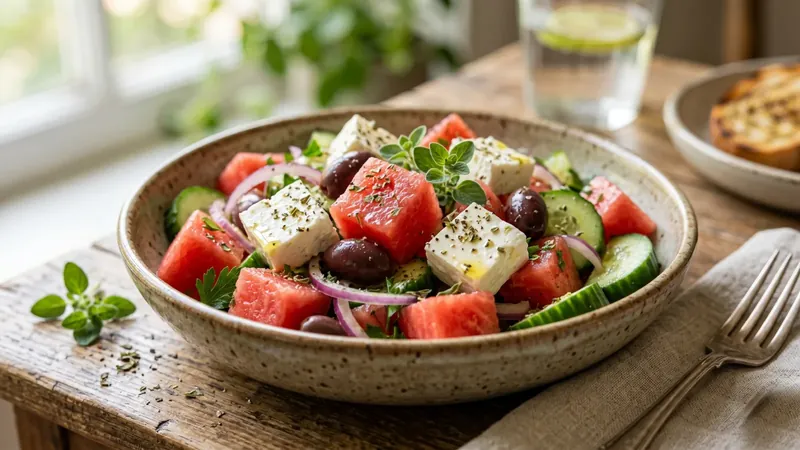
Greek Salad with Watermelon and Oregano-Honey Dressing
Summer on a plate
Contents
↓ Jump to recipeA traditional Greek salad already sings of summer, but a handful of cool watermelon cubes takes it somewhere even brighter. The melon’s sweetness plays beautifully against salty feta and briny olives, while a dressing sharpened with red wine vinegar and rounded with a little honey and oregano ties the whole bowl together. It is barely a recipe, more an assembly, but the balance of sweet, salty and herbal makes it the kind of thing you will want on the table all season long.
Greek Salad with Watermelon and Oregano-Honey Dressing
Ingredients
- 500g watermelon flesh, cut into 2cm cubes
- 4 ripe tomatoes, cut into wedges
- 1 cucumber, halved and sliced thickly
- 1 small red onion, thinly sliced
- 200g block feta
- 100g Kalamata olives
- 4 tbsp extra-virgin olive oil
- 1 tbsp red wine vinegar
- 1 tsp runny honey
- 1 tsp dried oregano, plus extra to serve
- Salt and black pepper
Method
- Put the watermelon cubes in a colander for a few minutes to let any excess juice drain, then transfer to a wide serving bowl.
- Add the tomato wedges, sliced cucumber and red onion.
- Scatter over the Kalamata olives.
- For the dressing, whisk together the olive oil, red wine vinegar, honey and oregano, then season with salt and black pepper.
- Pour about two-thirds of the dressing over the salad and turn gently to coat, taking care not to break up the watermelon.
- Sit the whole block of feta on top of the salad rather than crumbling it in.
- Drizzle the remaining dressing over the feta and finish with a pinch more oregano and a grind of black pepper.
- Serve straight away, with bread to mop up the juices.
The Story
The salad Greeks call horiatiki, meaning village or country salad, is a study in restraint. The traditional bowl contains tomatoes, cucumber, green pepper, red onion and olives, dressed simply with olive oil and oregano and crowned with a thick slab of feta. Crucially, it contains no lettuce, and the cheese is placed on top in a single piece rather than crumbled through, so each diner breaks it apart as they eat. It is food built around the quality of a few sun-ripened ingredients, the sort of plate that makes sense only when tomatoes actually taste of something.
Feta is the heart of it, and a genuinely Greek product with protected status: real feta is made in designated regions of Greece from sheep’s milk, or a blend of sheep’s and goat’s milk, and matured in brine, which gives it that firm, crumbly texture and characteristic salty tang. Drizzled with olive oil and dusted with dried oregano, a block of feta sitting proudly atop the vegetables is one of the defining images of a Greek table.
The watermelon here is the gentle twist, though it is far from a foreign idea in the eastern Mediterranean, where the fruit grows abundantly in the summer heat and is eaten in vast quantities. The pairing of watermelon and feta has become a familiar one in modern kitchens precisely because it works so well: the fruit’s clean sweetness and high water content refresh the palate, while the cheese answers back with salt. Folding cubes of melon into the classic mix of tomato, cucumber and onion simply pushes that contrast further, turning a savoury salad into something with a sweet, juicy edge.
The dressing leans into the theme. A spoonful of honey echoes the watermelon and softens the bite of red wine vinegar, while oregano, dried rather than fresh, supplies the resinous, slightly peppery aroma that flavours so much Greek cooking. Dried oregano is more concentrated than fresh, its character intensifying as the herb loses its moisture, which is why a modest pinch carries so much fragrance through the bowl. Whisking it into the oil and vinegar gives it a few minutes to soften and bloom before it ever touches the salad.
Assembly is everything with a dish this simple, because there is nowhere for a tired ingredient to hide. Drain the watermelon briefly before it joins the bowl so its juice does not flood the dressing, slice the onion finely so it perks up rather than overwhelms, and choose tomatoes that are properly ripe and full of flavour. Dress everything at the last moment so the vegetables keep their crunch and the watermelon its shape. Serve with good bread, and let people scoop up the pink-tinged juices left in the bottom of the bowl.
Getting the details right
A few small decisions separate a good bowl from a watery one. Deseed the watermelon as you cube it, or buy a seedless variety, so nobody is picking pips out of their teeth. Cut the flesh into 2cm cubes rather than thin slices; larger pieces hold their shape and their cold juiciness against the dressing, while thin ones collapse. The five-minute rest in a colander is not optional: watermelon is more than 90 per cent water, and salt from the feta and dressing draws even more of it out, so shedding the loose juice first keeps the salad from drowning.
Feta choice is worth a thought too. Buy a proper brined block rather than the pre-crumbled tubs, which are drier and often bulked out with additives; a real block has the creamy-crumbly texture that makes sitting it whole on top so satisfying. Take it out of the fridge twenty minutes before serving, because cold blunts its salty tang and the fragrance of the oregano. If you can only find a firmer, saltier feta, ease back on any added salt in the dressing.
Red onion can bully a raw salad. If yours is fierce, slice it thinly and soak the slices in cold water for ten minutes, then drain; this washes out the sulphurous edge and leaves a milder, crunchier onion that still brings colour and bite. The same trick works on any raw onion in a salad.
The dressing rewards a moment’s patience. Whisking the dried oregano into the oil and vinegar a good five minutes before you dress the salad lets the herb soften and release its oils, so its resinous, faintly bitter fragrance carries right through the bowl rather than sitting as dry flecks. Dried oregano is genuinely better than fresh here, which is unusual; drying concentrates the aromatic compounds that give Greek oregano its punch, and it is what most Greek cooks reach for. If all you have is fresh, use three times as much and add it right at the end. The honey is not there to sweeten so much as to round off the sharp red wine vinegar and echo the watermelon; a single teaspoon is enough, and more will tip the balance.
Swaps, make-ahead and serving
The bones of this salad are forgiving. Swap the watermelon for cubes of ripe honeydew or cantaloupe when melons are at their best, or leave it out entirely for a classic horiatiki. A handful of torn mint or basil leaves lifts the whole bowl if you have them, and a scatter of toasted pistachios or sunflower seeds adds welcome crunch. Vegans can replace the feta with a firm, brined plant-based cheese, or simply lean harder on the olives for their salt.
This is not a salad to make far ahead: dressed watermelon weeps and the vegetables soften. You can, however, do all the chopping and whisk the dressing up to a few hours in advance, keeping the components separate and cold, then assemble and dress just before you carry it to the table. Serve it as a light lunch with flatbread, or alongside grilled lamb, chicken or fish at a summer meal.
Think of it less as a fixed recipe than as a template for high summer, when the produce is doing the heavy lifting. Everything hinges on ripeness: a tomato picked green and ripened in transit will taste of almost nothing here, where it has nowhere to hide, so buy the ugliest, most fragrant tomatoes you can find and, if they need it, leave them on a sunny windowsill for a day or two. The watermelon should be heavy for its size with a creamy-yellow patch where it sat in the field, the sign it ripened on the vine. Get those two right and the salad more or less makes itself.
It scales up beautifully for a table of people, and because there is nothing to cook it is a gift on a hot day when you would rather not stand over a stove. Double or triple the quantities, tip everything into your largest shallow bowl, and set out the whole blocks of feta on top so the arrangement looks generous. Put a basket of warm flatbread and a bottle of chilled rosé beside it and you have the bones of an easy summer lunch, the pink juices at the bottom of the bowl the sign of a plate well cleared.
If you like a salad that leans on a punchy, savoury dressing, my lighter Caesar salad works the same trick with anchovy and yoghurt. And for a heartier, warm-weather bowl in the same fresh, big-flavour spirit, try the crispy chickpea and sweet potato bowl with tahini dressing.
Related Content