Vlaai: The Limburg Fruit Tart
A wide, shallow yeasted tart with a lattice top, cut into twelve and handed round
Contents
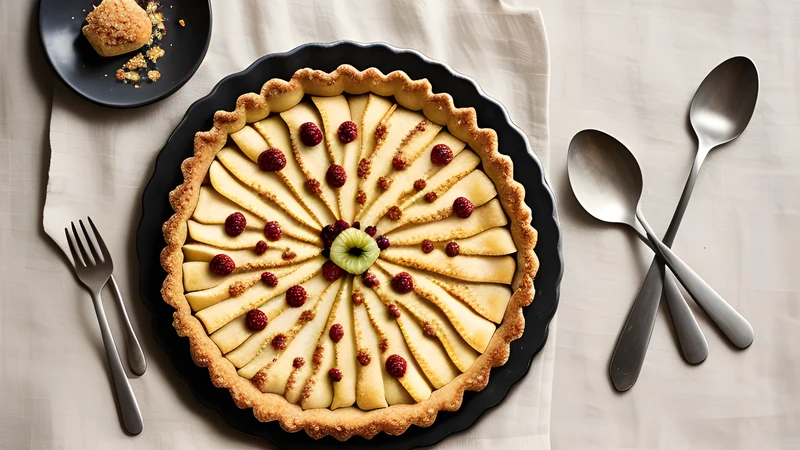
↓ Jump to recipeA vlaai is thirty centimetres wide and about three centimetres deep, which makes it the flattest tart in Europe and a slightly startling object the first time you see one. It is cut into twelve, and twelve is a real number rather than an approximation: Limburg households buy them by the whole tart and hand them round, and a vlaai cut into eight is a vlaai that somebody has got wrong.
The base is a yeasted dough, which is the thing that separates it from every other fruit tart on the continent. There is no shortcrust here and no puff. It is bread — enriched, rolled thin, proved twice — and it behaves like bread, which means the whole method is different from what your hands expect.
Vlaai: The Limburg Fruit Tart
Ingredients
- 350 g strong white bread flour
- 7 g fast-action dried yeast
- 40 g caster sugar
- 5 g fine salt
- 150 ml whole milk, warmed to 35°C
- 1 egg, beaten
- 60 g unsalted butter, softened and cut into cubes
- Finely grated zest of 1 lemon
- 800 g pitted morello cherries (jarred in juice, drained, juice reserved)
- 300 ml of the reserved cherry juice
- 100 g caster sugar, for the filling
- 40 g cornflour
- 1 tbsp lemon juice
- 1/4 tsp ground cinnamon
- 1 egg yolk beaten with 1 tbsp milk, for the glaze
- 1 tbsp apricot jam, warmed and sieved, for the finish
Method
- Combine the flour, yeast, 40 g sugar and salt in a large bowl, keeping the yeast and salt on opposite sides until you mix.
- Add the warm milk, the beaten egg and the lemon zest, and mix to a shaggy dough. Knead on an unfloured worktop for 5 minutes.
- Add the softened butter a few cubes at a time, kneading each addition in fully before adding the next. The dough will break apart and look wrong; keep going. After 10 minutes it will be smooth, glossy and slightly tacky.
- Shape into a ball, put it in an oiled bowl, cover, and prove at room temperature for 90 minutes until doubled.
- Meanwhile make the filling. Whisk the cornflour into 100 ml of the cold cherry juice until completely smooth.
- Bring the remaining 200 ml juice, the 100 g sugar and the cinnamon to a boil in a pan. Whisk in the cornflour slurry and cook, whisking, for 2 minutes until very thick and glossy.
- Take off the heat, stir in the lemon juice and fold in the drained cherries. Cool completely — at least 1 hour. Warm filling will melt the dough.
- Knock back the dough and cut off one third; set it aside covered. Roll the larger piece into a 36 cm circle, about 3 mm thick.
- Line a greased 30 cm shallow tart tin or vlaai tin with the dough, pressing it into the corner and letting it overhang. Trim to a 1 cm overhang and prick the base all over with a fork.
- Spread the cold filling evenly over the base, up to 1 cm from the edge.
- Roll the reserved dough into a rectangle 3 mm thick and cut it into 14 strips, 1.5 cm wide. Lay 7 across the tart, then weave the other 7 through at right angles to make a lattice. Press the ends onto the overhang and fold the overhang inwards over them, pinching to seal.
- Cover loosely and prove for 30 minutes. Meanwhile heat the oven to 200°C.
- Brush the lattice and rim with the egg yolk glaze. Bake for 30 to 35 minutes, until the lattice is deep golden and the filling is bubbling at the edges.
- Cool in the tin for 15 minutes, then slide onto a wire rack. Brush the exposed fruit with the warmed apricot jam while still hot. Cool completely before cutting into 12 slices.
Limburg, bakers, and the province that eats tart at funerals
Limburg is the long thin province in the south-east of the Netherlands, wedged between Belgium and Germany, and it is culturally distinct enough that the rest of the country treats it as faintly foreign. It is Catholic where the north is Protestant, it speaks Limburgish, and it eats vlaai.
The dish is old. Baking flat yeasted fruit tarts is documented in the Meuse region from the medieval period, and the mechanism is the communal oven: villages had one, it was fired once or twice a week, and after the bread came out the residual heat was used for something flat that could go in and out quickly. A vlaai is thin because it had to bake in a cooling oven. The word itself relates to Middle Dutch vlade, a flat cake, and cognates run right across into German Fladen.
Its social function is what makes it strange to outsiders. Vlaai in Limburg is a fixture of every kind of gathering, and specifically of funerals — the post-funeral coffee-and-vlaai is an institution with its own name, and the number of tarts ordered is a form of social accounting. It appears at kermis, the village fair, where households historically baked several and competed. It appears at births, at communions, and on any Sunday afternoon when somebody visits. The line “koffie met vlaai” is close to a definition of Limburgish hospitality.
Limburgse vlaai has held a protected geographical indication since 2013, which means a tart sold under that name must be made in Limburg to the traditional method with a yeast base. The commercial bakers of the province take this extremely seriously.
The fillings run to about a dozen classics: morello cherry (kersenvlaai, the most famous), apricot, plum, gooseberry, rice pudding (rijstevlaai, with a lattice), and kruimelvlaai, topped with a rubble of crumble instead of a lattice. Cherry with a woven lattice is the one that shows up on postcards.
The dough, and the butter that ruins it if you rush
This is a lean-ish enriched dough — about 17% butter and 11% sugar on flour weight — which puts it between a bread and a brioche. Both the butter and the sugar make it slower and more delicate than plain bread dough, and knowing why makes the process much less alarming.
Gluten forms when glutenin and gliadin proteins hydrate and link into an elastic network. Fat coats those proteins and physically obstructs the links, and sugar competes with the flour for available water, slowing hydration. Add all the butter at the start and the gluten never develops properly; you get a dough that tears rather than stretches and a base that goes soggy.
So the butter goes in last, cube by cube, after five minutes of kneading has already built a network for it to lubricate. The dough will fall apart and look like a curdled disaster around the third addition. This is normal and it comes back together. Ten minutes total on an unfloured worktop — adding flour to fix stickiness is the single most common way home bakers ruin an enriched dough, because it changes the hydration and gives you a dry, tight base.
Warm the milk to 35°C and no hotter. Yeast dies above about 50°C, and milk hot enough to feel hot on your wrist is already in the danger zone.
Roll it to 3 mm. This feels far too thin for a yeasted dough and it is exactly right: the second prove and the oven spring will roughly double it, and a vlaai base is meant to be a thin, slightly chewy shell rather than a bready one. Rolling it thick gives you a fruit sandwich.
The filling, and the cornflour
The filling goes in cold. This is the rule that catches people out, and the reason is butter. Warm filling on a yeasted base melts the butter in the dough before it hits the oven, and the fat leaks out and fries the base from above, giving you a greasy, dense layer that never bakes through.
Cornflour rather than flour, at 40 g to 300 ml of liquid, which is a stiff set. Cornflour is nearly pure starch, so it thickens harder per gram than plain flour and it sets clear and glossy rather than cloudy — visually important when the fruit is showing through a lattice. It also has no raw-flour taste to cook out.
Two things break a cornflour set, and both are avoidable. Slurry it with cold liquid first; cornflour dropped into hot liquid clumps instantly and hydrates on the outside of each lump, sealing dry powder in. And cook it for two full minutes after it thickens, whisking, but stop there — cornflour gels reach maximum viscosity and then break down under prolonged heat and agitation, going thin and slack again.
Acid also breaks a cornflour gel by hydrolysing the starch, so the lemon juice goes in off the heat at the end.
Jarred morello cherries are the right choice and no compromise at all. Fresh sour cherries have a season measured in weeks; jarred morellos are picked ripe, they come with their juice, which is your filling liquid already made, and they hold their shape. Sweet cherries are a mistake — the tart needs the acidity, and a kersenvlaai made with dessert cherries tastes flabby.
The lattice, and the bake
Seven strips one way, seven the other, woven properly rather than laid in a grid. Lift alternate strips back, lay the crossing strip, fold them down, repeat. It takes about five minutes and it looks like a professional did it.
The lattice is functional. Vlaai filling is wet and it needs to lose steam during the bake; a solid lid would trap it and steam the base. The gaps let moisture out and let the top of the filling caramelise slightly at the edges.
Fold the overhanging dough inwards over the strip ends and pinch. This seals the lattice to the rim, and an unsealed lattice shrinks in the oven and slides towards the middle.
Egg yolk glaze rather than whole egg. Yolk has the fat and the protein and browns to a deep gold; whole egg is diluted and gives a paler, streakier finish.
200°C is hot for a yeasted dough and correct here, because the base is thin and needs to set fast before the filling soaks in. Thirty to thirty-five minutes; the edges of the filling should be visibly bubbling.
The tin, and the shape of the thing
A real vlaai tin is a shallow tinned-steel ring about 30 cm across and 3 cm deep, with a rolled edge and a removable base, and Limburg households own several. The shallowness is the whole identity of the dish, so if you use a standard 23 cm deep tart tin you will produce something perfectly nice that is emphatically a different cake — thicker base, more filling per slice, and none of the thin-crisp-shell-against-wet-fruit contrast that vlaai exists for.
The workable substitute is a 30 cm pizza tin or a shallow flan ring set on a baking sheet. What matters is diameter and depth: wide and shallow. Failing that, a large baking sheet and a free-form tart, with the dough rolled to a 34 cm circle and the edge folded up 2 cm and pinched into a wall, gets you close. The lattice ends need something to anchor to, which is the only reason the rim exists.
Grease the tin properly with softened butter rather than spray oil, and get into the corner where the side meets the base. A yeasted dough sticks harder than shortcrust because the sugars on its surface caramelise directly against the metal.
Twelve slices is the Limburg standard and it is a serving convention with teeth. A vlaai is bought or baked whole, cut into twelve at the table, and offered around — and the received wisdom is that you take a slice when offered, because refusing is a small rudeness. At a funeral coffee the bakery order is calculated at roughly one and a half slices per mourner, which means somebody in the family is doing arithmetic on the number of expected attendees on the worst morning of their year. That is a strange and rather moving thing for a fruit tart to be responsible for, and it explains why the province is so unyielding about how the dish is made.
Where it goes wrong, and the other vlaaien
The base is soggy. The filling went in warm, or the base was not pricked, or the oven was too cool.
The dough tore when rolling. Under-kneaded, or the butter went in too early.
The filling is runny. Under-cooked cornflour, or the lemon juice went in over the heat.
The lattice slid into the middle. The strip ends were not sealed under the rim.
It is dense and heavy. Over-floured worktop, or the second prove was skipped.
For abrikozenvlaai, swap in 800 g of drained tinned apricot halves and use their syrup. For kruimelvlaai, skip the lattice and top with 100 g flour, 60 g cold butter and 60 g sugar rubbed to a rubble. For rijstevlaai, fill with a thick cold rice pudding made from 100 g pudding rice and 700 ml milk. The apple version overlaps with appelflappen territory in its spicing and is worth making in October.
A vlaai keeps two days under a cloth at room temperature and goes stale rather than mouldy, which is the yeast base behaving like the bread it is. Refrigeration accelerates staling — the starch retrogrades faster at fridge temperature than at room temperature — so keep it in the cupboard. It freezes well, whole or in slices, for two months. The Limburg way with a slightly stale one is to warm it briefly and serve it with whipped cream, in the same spirit that turns the last of a boterkoek into something worth putting on the table again.
Related Content