Victoria Sponge with Roasted Strawberry Jam
The classic teatime cake, lifted by a quick roasted-berry jam
Contents
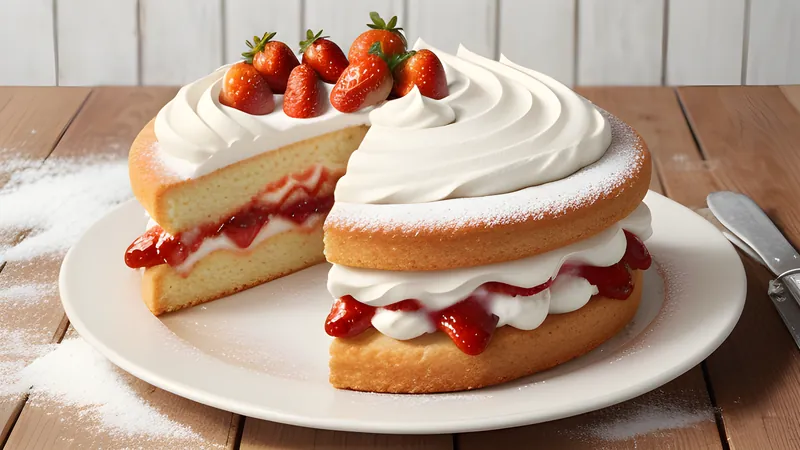
↓ Jump to recipeThere is nothing to a Victoria sponge, which is exactly why it’s so hard to make a really good one. Two plain sponges, jam, cream, a dusting of sugar. No frosting to hide behind, no exotic flavour to distract. It’s the cake your grandmother made and the cake that wins and loses village fetes, and the only way to make it sing is to get every humble component absolutely right. My one indulgence — the thing that makes people pause mid-bite — is making the jam myself, roasted, in the time it takes the oven to come up to temperature.
Victoria Sponge with Roasted Strawberry Jam
Ingredients
- 225g (1 cup) unsalted butter, softened
- 225g (1 cup plus 2 tbsp) caster sugar
- 4 large eggs, room temperature
- 225g (1¾ cups) self-raising flour
- 1 tsp baking powder
- ½ tsp fine sea salt
- 1 tsp vanilla extract
- 2 tbsp whole milk
- For the jam: 400g (14oz) strawberries, hulled and halved
- 100g (½ cup) caster sugar
- Juice of ½ lemon
- For the filling: 250ml (1 cup) double cream
- 1 tbsp icing sugar, plus extra to dust
Method
- First make the jam: heat the oven to 200C/180C fan/400F. Toss strawberries with sugar and lemon juice.
- Roast in a baking dish for 25-30 minutes until syrupy and jammy. Cool and crush lightly with a fork.
- Drop the oven to 180C/160C fan/350F. Grease and line two 20cm sandwich tins.
- Cream the butter and caster sugar until very pale and fluffy, 4-5 minutes.
- Beat in the eggs one at a time, then fold in the flour, baking powder, salt and vanilla.
- Loosen with the milk to a soft dropping consistency, divide between the tins and level.
- Bake 22-25 minutes until golden and springy. Cool completely on a rack.
- Whip the cream with icing sugar to soft peaks. Sandwich the sponges with cream and roasted jam, and dust with icing sugar.
A cake named for a queen
The Victoria sponge is named, of course, for Queen Victoria, who is said to have taken a slice with her afternoon tea after Anna, the seventh Duchess of Bedford, popularised the whole institution of afternoon tea in the 1840s. Its existence as a light, even sponge owes a great deal to the arrival of chemical raising agents around the same period. Alfred Bird invented a version of baking powder in 1843, and Henry Jones patented self-raising flour in 1845; between them they let home bakers achieve a reliable rise without beating air in by hand for the better part of an hour. So this very plain cake is a little monument to Victorian kitchen technology. It has been the British benchmark sponge ever since, and it is telling that the Women’s Institute still specifies the classic version — jam only, no cream, dusted with caster rather than icing sugar — as its competition standard. The old “weigh your eggs, then match the butter, sugar and flour to them” method is still the most reliable route to the right batter, and it is why the four eggs here are paired with 225g each of the other three.
The orthodox version uses shop jam and, often, just jam — no cream at all. I’m firmly in the jam-and-cream camp, and I’m even more firmly of the view that the jam is where most Victoria sponges fall down. Cloying, over-set supermarket strawberry jam drags the whole thing into sugary blandness.
The twist: roast the strawberries
So I make a quick roasted-strawberry jam instead, and it’s barely more effort than opening a jar. You toss halved strawberries with sugar and lemon juice and roast them hot at 200C (180C fan) for under half an hour, while you get on with the sponges. The roasting concentrates the fruit, drives off water, and — this is the point — caramelises the cut edges, giving you a jam with a deep, almost toffee-ish strawberry flavour and a loose, spoonable set. It tastes intensely of the season in a way that boiled-for-an-hour preserves never quite do. There’s no pectin, no thermometer, no sterilising of jars. You want a soft, glossy, vividly red jam, lightly crushed, to layer into the cake.
The lemon juice isn’t optional. Beyond brightening the fruit and stopping the roasted sugar tipping into one-note sweetness, its acidity does real work: it helps the natural pectin in the strawberries set, which is why the jam thickens to a spoonable consistency without any added pectin. Strawberries are low in pectin compared with, say, blackberries or apples, so that squeeze of lemon is doing more than seasoning. Because this jam isn’t boiled to a full preserving temperature and holds a lot of fruit, treat it as fresh: it keeps in the fridge for about a week, not months.
Getting the sponge right
The sponge itself is a classic creamed cake, and there are only a few ways to ruin it. Cream the butter and sugar for longer than you think you need to — four or five full minutes until it’s genuinely pale and mousse-like — because this is where the lightness comes from. Have your eggs at room temperature so they don’t seize the butter, and add them slowly; if the mix looks like it’s about to curdle, a spoonful of the flour brings it back. Fold the flour in gently and stop the moment it’s combined. Overworked batter means a tough, tight crumb.
The milk at the end loosens everything to a “soft dropping consistency” — a spoonful of batter should fall off the spoon with a gentle shake. Get that right and the sponge bakes up tender and even. Divide it scrupulously between two tins (I weigh them, frankly) so your finished cake sits level rather than lurching to one side.
Why you weigh the tins, and the science of the crumb
The reason a creamed sponge rises is mechanical before it is chemical. When you beat softened butter with sugar for those four or five minutes, the sharp edges of the sugar crystals cut tiny air pockets into the fat, and it is those pockets, expanding in the oven’s heat, that the baking powder and self-raising flour then inflate further. If you rush the creaming, there are too few air pockets to expand and the cake bakes dense however much raising agent you use. This is why the step cannot be skipped or shortened, and why the butter must be genuinely soft to begin with; cold butter will not hold the air.
The eggs go in one at a time for the same reason. Added too fast, or straight from the fridge, they chill and shock the butter, which then splits into a curdled, watery mess and loses the air you worked to beat in. Room-temperature eggs emulsify smoothly into the batter. If it does start to look grainy and separated, a tablespoon of the measured flour beaten in will pull it back together. Fold the remaining flour in with a light hand and stop the instant no dry streaks remain, because every extra stir develops gluten and toughens the crumb.
Dividing the batter evenly between the two tins is the difference between a cake that sits level and one that lurches. I put the tins on the scales and spoon batter between them until they weigh the same, which takes thirty seconds and saves a lopsided sandwich later. Bake them on the same shelf, not one above the other, so they cook at the same rate.
Assembly and the small dignities
Whatever you do, let the sponges cool completely before you fill them, or the cream will melt and the whole thing will slump. Whip the cream only to soft, billowing peaks — overwhipped cream is grainy and joyless, and it tips over into butter faster than you expect, so stop while it still looks a touch too soft and finish the last few strokes by hand. Spread the roasted jam onto the bottom sponge first, right to the edges, then pipe or dollop the cream over the jam and crown with the second sponge, gently pressing so it settles level. Putting the jam underneath the cream rather than the other way round keeps the fruit from bleeding down the sides and stops the cream sliding off. A simple dusting of icing sugar through a sieve is the only decoration this cake should ever have. Resist the urge to gild it with fresh fruit or piping; the plainness is the point.
Variations, storage and what goes wrong
The two most common failures both come from impatience. Filling a warm cake melts the cream into a greasy slick, so let the sponges cool completely, at least an hour. And underwhipped cream weeps while overwhipped cream turns grainy and butter-like, so stop at soft, billowing peaks that just hold their shape. If your sponges come out domed and cracked, the oven was too hot; drop it 10 degrees and check they are done by a gentle press in the centre (it should spring back) rather than by colour alone. A sponge that sinks in the middle was almost always taken out too soon.
Once you have the roasted-jam trick, it swaps happily with the season: roasted raspberries or a mix of summer berries in July, or roasted plums with a little cinnamon in autumn. For a lighter finish, replace the double cream with mascarpone loosened with a spoonful of milk, which holds up longer without weeping. The classic Women’s Institute version skips the cream entirely and uses jam alone, which does keep for a couple of days in a tin if you would rather bake ahead.
Eat it the day you make it — a Victoria sponge with cream doesn’t keep, and that’s part of its charm. It’s a cake for an occasion, however small: a friend dropping round, a Sunday afternoon, a reason to put the kettle on. If you have strawberries left over and the weather is warm, Eton mess is the other great British answer to a punnet of them, all cream and crushed meringue. And if this cake is the pudding to a proper lunch, a bowl of butternut squash soup makes a gentle, savoury start before it. Made with a bit of care and that roasted jam, this most ordinary of cakes becomes something people remember.
Related Content